
Production planners, buyers, storekeepers, supervisors, maintenance teams, engineers, QA/QC personnel, safety teams and industrial abrasive users
Item master; demand history; replenishment lead time; inventory status; cycle and safety stock; reorder points; min/max planning; criticality; stock rotation; shelf-life and condition; traceability; cycle counting; stockouts; continuity planning; parameter review and troubleshooting.
- Never issue quarantined, damaged, unidentified or unapproved abrasive stock.
- Keep product identity and condition visible through receipt, storage, transfer and issue.
- Do not use a stockout to justify uncontrolled substitution.
- Preserve guards, mounting systems, accessories and machine/product compatibility.
- Apply the storage and handling instructions for the actual product family.
- Refer to the product label, Technical Data Sheet, or MKTECH representative.
Reorder planning must balance availability, product condition, traceability, working capital and application risk. A stockout must never become permission for an uncontrolled abrasive substitution.
Industrial abrasive inventories contain many forms, sizes, interfaces, grades and constructions. Two products that look similar may not be interchangeable, while one product code may serve several work areas with different demand patterns. Good planning begins with controlled identity and reliable movement records, then applies demand, lead-time and risk logic appropriate to each item.
This chapter provides a practical customer-facing method. It does not assign MKTECH-specific stock levels, reorder points, service targets, shelf life, storage conditions, order quantities or performance guarantees.
Chapter objectives
After this chapter, the reader should be able to:
- maintain a controlled abrasive item master;
- distinguish physical, available, committed, quarantined and on-order quantities;
- clean issue, return and adjustment history before forecasting demand;
- measure replenishment lead time and its variability;
- separate cycle stock from safety stock;
- calculate a reorder point using approved local inputs;
- choose reorder-point, min/max or periodic-review logic;
- segment inventory by criticality, value and supply risk;
- control dates, condition, rotation, traceability and obsolete stock;
- investigate stock-record differences; and
- manage stockouts without bypassing product approval.
Define the inventory objective
The objective is not maximum stock or minimum stock. It is reliable availability of the correct approved product in usable condition at a controlled total cost.
Balance five questions:
- What production or maintenance activity does the item support?
- What happens if it is unavailable?
- How predictable are demand and replenishment?
- How long can the product remain fit for use under its specified conditions?
- What cash, space, handling and obsolescence exposure does stock create?
ISO 55001:2024 frames asset decisions around performance, risk and expenditure. Apply the same disciplined balance to abrasive inventory without treating consumables as permanent assets. [S337]
Assign clear ownership
| Role | Planning responsibility |
|---|---|
| Item/application owner | Confirms approved identity, use and criticality |
| Planning or purchasing | Maintains lead time, order policy and open-order visibility |
| Stores | Controls receipt, location, status, condition, issue and return |
| Production/maintenance | Records genuine consumption and upcoming demand changes |
| QA/QC or technical owner | Controls quarantine, release, substitution and disposition |
| Finance/management | Reviews working capital, write-off and policy trade-offs |
One owner should coordinate parameter changes so demand, ordering and store records do not drift apart.
Build a controlled item master
Every stocked identity needs a unique, understandable record.
Include, as applicable:
- internal item code and controlled description;
- manufacturer and product name/code;
- abrasive family and physical form;
- dimensions, bore, thread, shank or attachment;
- grade or grading-system designation;
- pack and base unit of measure;
- approved applications or specification reference;
- storage, date or condition-control fields;
- approved supplier and replenishment route;
- status—active, restricted, superseded or obsolete; and
- alternative-product relationship where formally approved.
Do not merge two products merely because their common description is similar. Keep P-grade, F-grade, superabrasive and proprietary designations within their correct systems. [S342; S346; S347; S348; S349]
Keep units of measure consistent
Abrasives may be bought by carton, box, roll, belt, disc, wheel, sheet, kilogram or piece and issued in another unit. Define conversion factors explicitly and control changes in pack size.
| Field | Example of required control |
|---|---|
| Purchase unit | Supplier pack identity |
| Stock unit | Unit counted in the store |
| Issue unit | Unit issued to the user |
| Conversion | Exact controlled relationship between units |
| Rounding rule | Treatment of partial packs where permitted |
A wrong pack conversion can create a false surplus or stockout even when every physical count is correct.
Distinguish inventory quantities
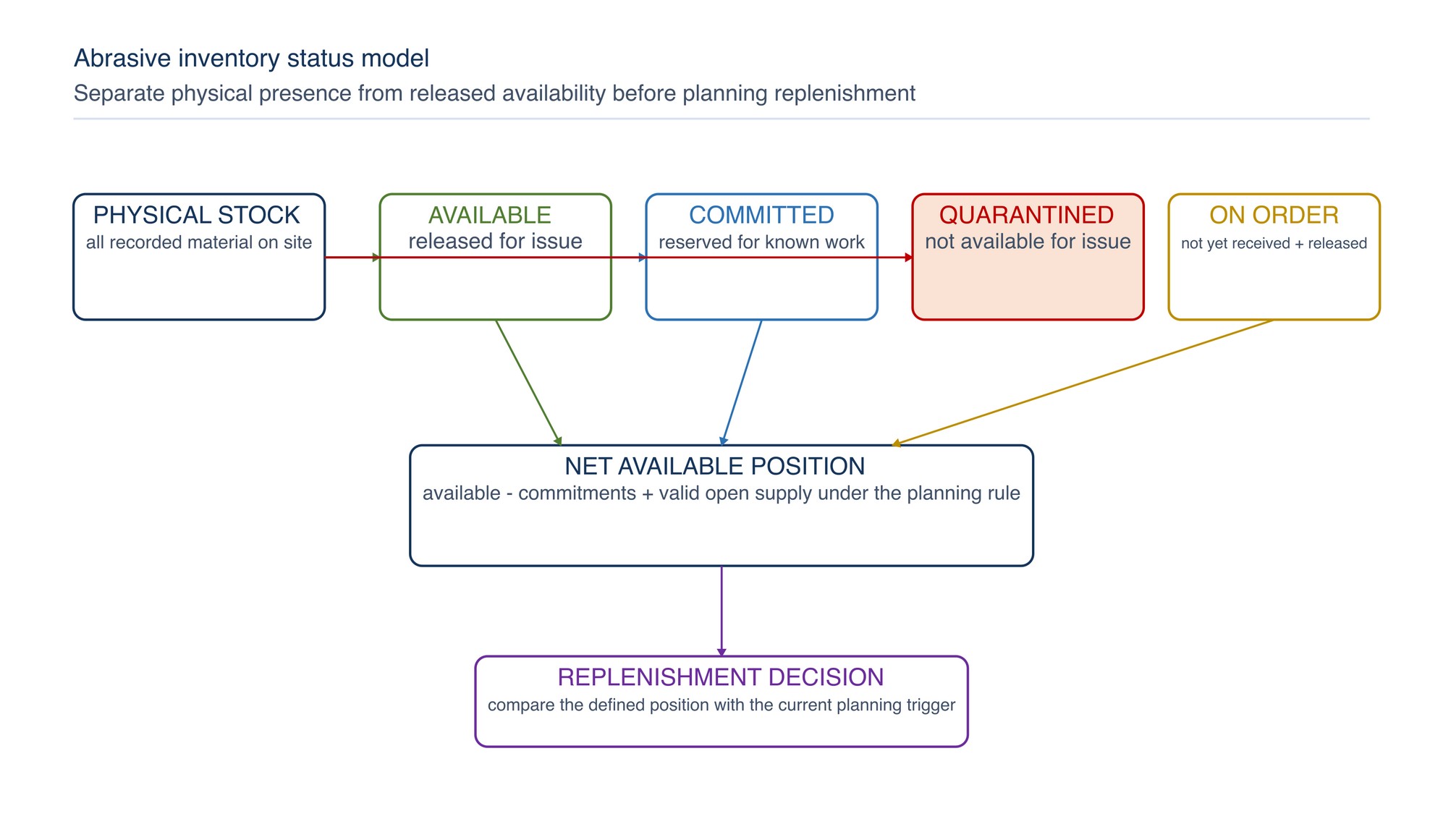
Use clear definitions:
- Physical quantity: material present at recorded locations.
- Available quantity: released material that can be issued.
- Committed quantity: available material reserved for known work.
- Quarantined quantity: material not permitted for normal issue.
- On-order quantity: confirmed replenishment not yet received and released.
- Net available position: usable supply after commitments, considering only valid open orders under the organisation's planning rule.
Never count damaged, expired where applicable, unidentified or quarantined product as available.
Create reliable demand history
ASCM describes inventory management as tracking stock movement while balancing supply and demand. [S361] For abrasive planning, use actual issue and return records rather than purchase history alone.
Clean the history for:
- duplicate or delayed transactions;
- pack/unit conversion errors;
- returns posted as new receipts;
- transfers between locations counted as consumption;
- one-time shutdown, project or trial demand;
- stock adjustments masking unrecorded issues;
- product-code changes or supersession; and
- abnormal demand caused by process problems.
Separate recurring, intermittent, seasonal, project and emergency demand. A simple average can be misleading when demand contains long zero periods or large planned shutdown requirements.
Measure replenishment lead time
Lead time should reflect the complete replenishment route, not only the supplier's quoted production time.
Measure relevant components:
- internal request and approval;
- purchase-order processing;
- supplier confirmation and manufacture/picking;
- transport and customs where applicable;
- receiving, inspection and release; and
- movement to the usable store location.
Record actual elapsed times and reasons for exceptional delays. Use a planning lead time that reflects the controlled process and known variability rather than an optimistic single quotation.
Separate cycle stock and safety stock
Cycle stock supports expected demand between replenishments. Safety stock protects against uncertainty such as demand variation, forecast error or lead-time variation.
ASCM describes safety stock as inventory carried to reduce stockout exposure arising from uncertainty and notes that policies can differ by strategic importance or other relevant groupings. [S362]
Do not use safety stock to hide:
- inaccurate records;
- late purchasing action;
- uncontrolled consumption;
- unreliable suppliers without improvement action;
- obsolete specifications; or
- recurring process waste.
More buffer may reduce stockout frequency but increases cash, space, condition and obsolescence exposure.
Calculate a reorder point
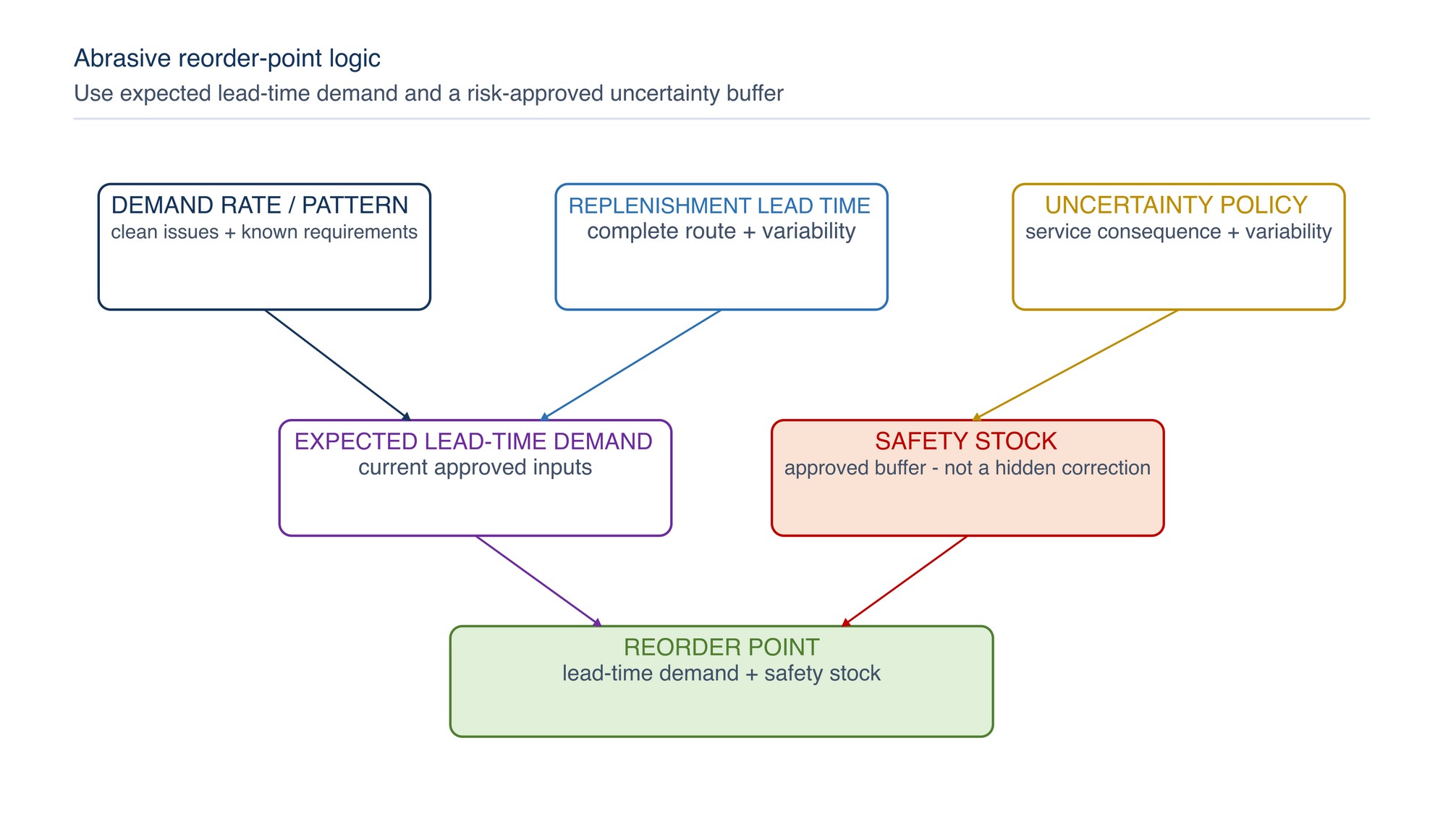
Use the general relationship:
Reorder point = expected demand during replenishment lead time + safety stock
For a continuous-review item, trigger replenishment when the defined inventory position reaches or falls below the reorder point. The inventory-position definition should account consistently for available stock, commitments, open orders and backorders where applicable.
Inputs must come from current records and the organisation's approved service/risk policy. Do not insert a universal service level, statistical factor or number of days of cover.
Choose an ordering method
| Method | Suitable pattern | Main control |
|---|---|---|
| Reorder point | Continuous visibility and reasonably stable replenishment | Accurate inventory position and lead-time demand |
| Min/max | Practical store replenishment within defined bounds | Reviewed minimum, maximum and order-up-to logic |
| Periodic review | Orders reviewed on a fixed calendar | Include demand across review interval and lead time |
| Planned requirement schedule | Shutdown, project or known production schedule | Link quantity and date to the controlled work plan |
| Two-bin/visual signal | Stable low-complexity point-of-use consumption | Clear bin quantity, replenishment ownership and no mixed identity |
The same method need not apply to every item. Use the simplest method that reliably controls the actual demand and supply pattern.
Determine order quantity
Order quantity should consider expected demand, target position, pack size, minimum order where applicable, storage capacity, product condition, cash exposure and transport economics.
Do not increase quantity only to obtain a lower unit price without checking the total exposure. A price saving can be lost through damage, ageing, changed demand or specification obsolescence.
Segment by criticality and value
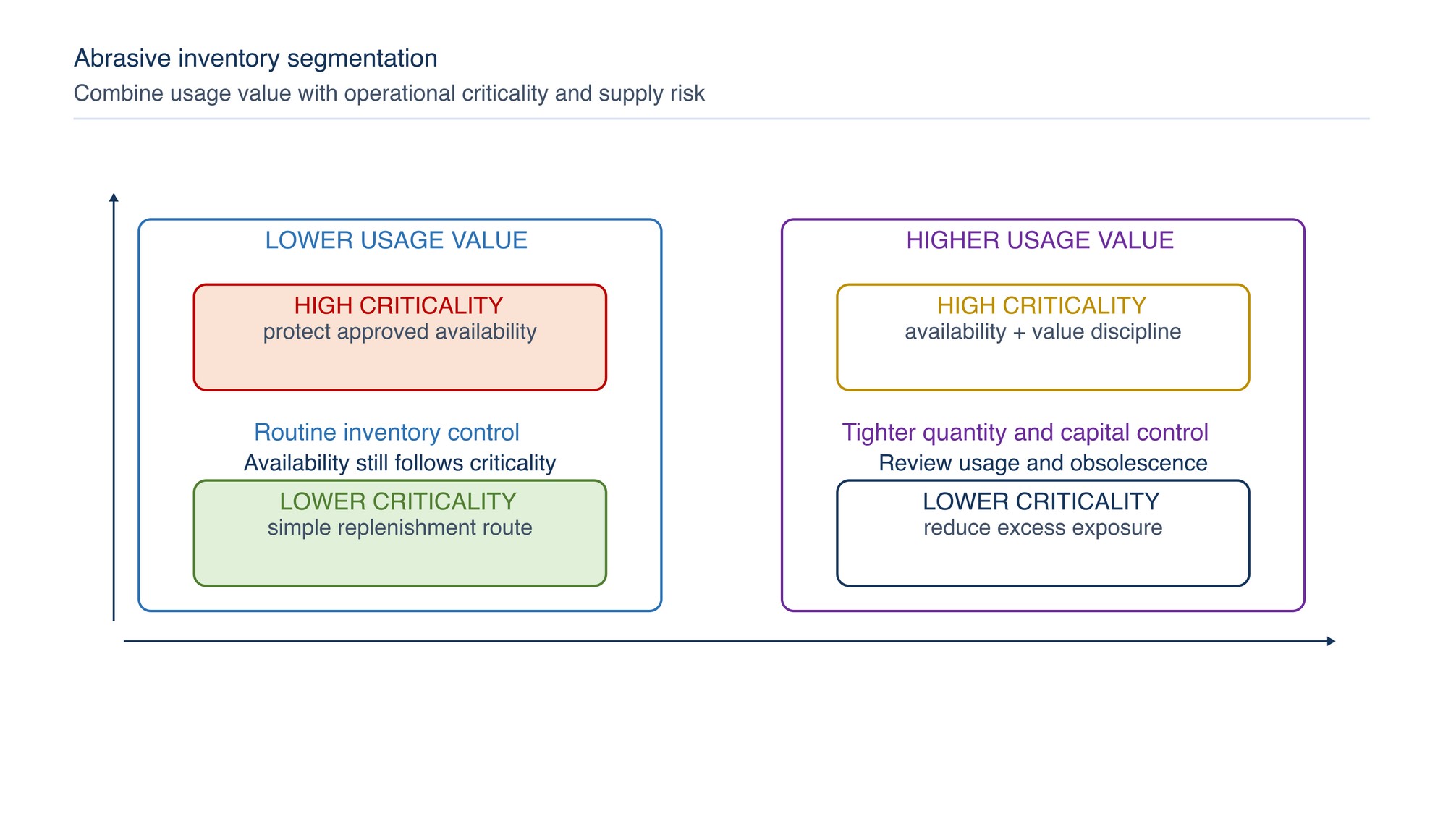
Evaluate at least:
- consumption value;
- production, maintenance or safety consequence of stockout;
- replenishment time and variability;
- availability of an already approved alternative;
- product condition or date sensitivity;
- demand predictability; and
- supplier or logistics concentration.
ABC value analysis alone is insufficient. A low-value wheel or belt can stop a critical maintenance job or production line.
Control storage condition and rotation
Store abrasives by product family and manufacturer guidance. Protect them from moisture, temperature extremes, deformation, impact, contamination and unauthorised mixing as applicable. Manufacturer and FEPA guidance support careful receipt, suitable support, dry controlled storage, original packaging and stock rotation. [S338; S339; S340; S341]
Use FIFO where receipt sequence governs. Use FEFO where a controlled use-by, expiry or shelf-life date makes earliest expiry the correct issue priority.
For exact storage conditions, shelf life, date interpretation or packaging requirements, Refer to the product label, Technical Data Sheet, or MKTECH representative.
Maintain location and traceability
GS1's Global Traceability Standard distinguishes class-, batch/lot- and instance-level identification and links traceable objects with receipt, shipment, location and status events. [S363]
Choose a traceability level proportionate to product and application risk. Record:
- item identity;
- batch/lot, date or serial information where applicable;
- receipt source and date;
- storage location and status;
- quantity movements; and
- affected destination where needed for controlled recall or investigation.
Do not mix approved, evaluation, returned, quarantined or rejected material in one unlabeled location.
Count stock and investigate differences
Use cycle counting or periodic physical inventory according to item criticality and record risk. Count by controlled item, unit, location and status.
When a difference occurs:
- secure the affected identity and location;
- recount independently where appropriate;
- check recent receipts, issues, returns, transfers and conversions;
- examine mixed stock, wrong locations and unposted transactions;
- correct the record through authorised adjustment; and
- address the cause if the difference can recur.
An adjustment restores the balance; it does not by itself correct the process.
Control slow-moving and obsolete stock
Review stock with no recent demand, excess cover, superseded identity, damaged packaging or approaching controlled date limits.
Classify it as active slow-moving, project-reserved, excess, restricted, obsolete or pending technical disposition. Before transfer to another application, confirm that the product is approved and suitable for that application. Do not relabel or use obsolete stock merely to avoid a write-off.
Manage stockouts safely
| Stockout response | Required control |
|---|---|
| Expedite approved identity | Confirm supplier, product, quantity and delivery status |
| Transfer between sites | Preserve identity, condition, approval and traceability |
| Use another approved product | Confirm the approval covers the actual application and machine |
| Propose a new alternative | Apply Chapter 059 before production release |
| Reschedule work | Communicate production and customer consequence |
| Stop work | Use when no safe, approved and suitable route is available |
Urgency does not validate a similar-looking product, grit number or mounting arrangement.
Plan for disruption and continuity
ISO 22301:2019 provides a business-continuity management framework for preparing for, responding to and recovering from disruption. [S364]
For critical abrasives, consider:
- alternate approved suppliers or products;
- supplier and logistics concentration;
- early-warning and escalation contacts;
- protected stock for defined critical work;
- planned shutdown and seasonal demand;
- recovery priorities; and
- controlled reversion after emergency arrangements.
Contingency stock is not a substitute for supplier improvement, accurate records or approved alternatives.
Review planning parameters
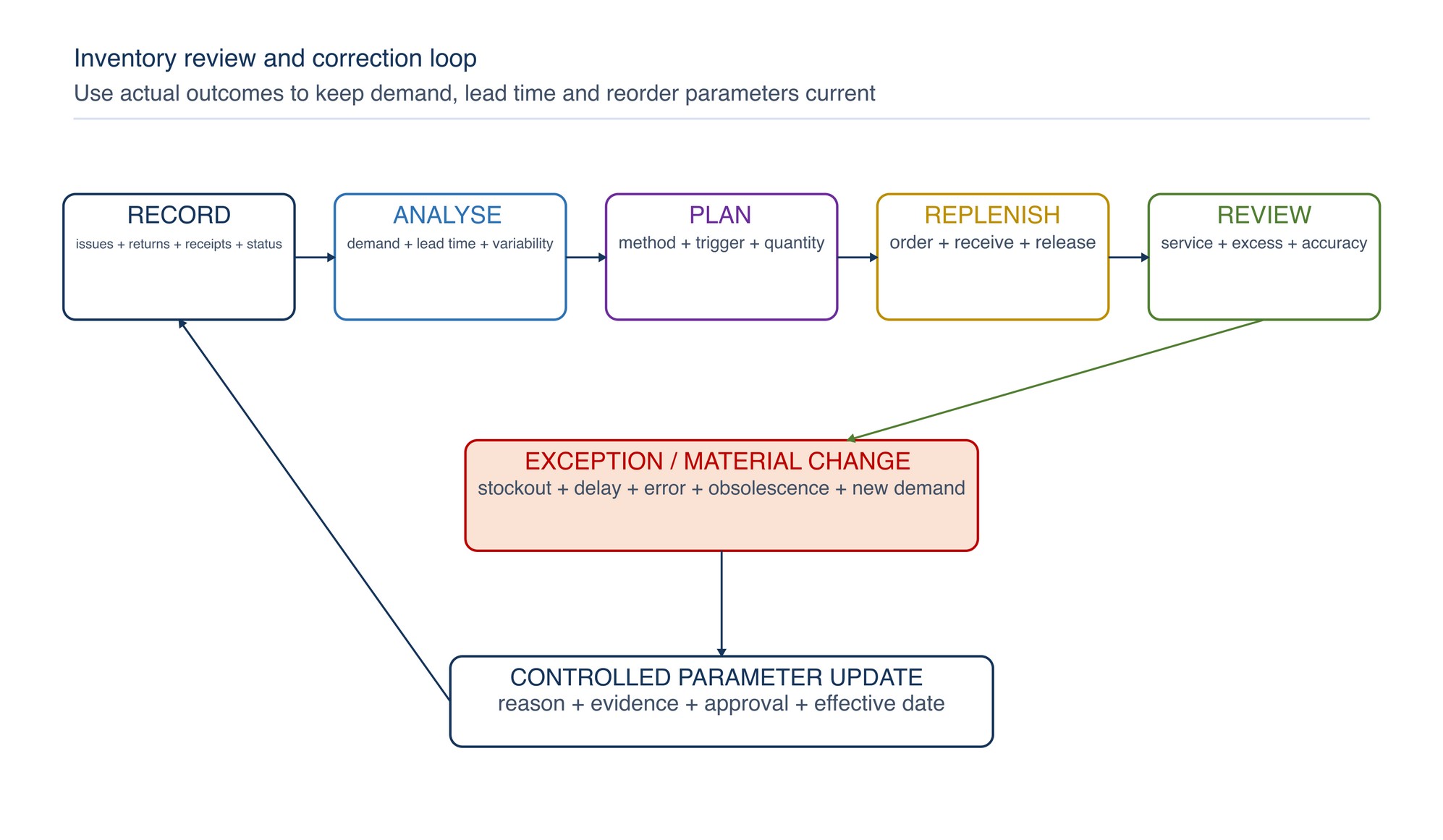
Review parameters when:
- demand level or pattern changes;
- lead time or supplier route changes;
- stockouts, expedites or excess stock recur;
- record accuracy deteriorates;
- pack size or unit conversion changes;
- a product is approved, superseded or withdrawn;
- shelf-life or storage information changes; or
- a new process, machine or contract changes criticality.
Keep the reason, approver, effective date and previous value so planning changes remain auditable.
Troubleshooting inventory and reorder planning
| Problem | Likely cause | Improvement |
|---|---|---|
| System shows stock but none is usable | Quarantine, condition or commitment excluded poorly | Separate status and calculate available quantity correctly |
| Frequent stockouts despite high stock | Wrong identities or demand concentrated in another item | Review item master, usage and substitution controls |
| Reorder occurs too late | Lead time omits internal or receiving stages | Measure the complete replenishment route |
| Excess stock grows | Parameters ignore falling demand or pack constraints | Review demand, order quantity and active status |
| Count differences repeat | Transactions or unit conversions are uncontrolled | Correct the process, not only the balance |
| Old stock remains while new stock is issued | Rotation and location discipline are weak | Use FIFO/FEFO and visible date control |
| Emergency substitution occurs | Continuity plan lacks approved alternatives | Approve alternatives before disruption |
| Average demand misleads planning | Demand is intermittent or project-driven | Segment history and plan known requirements separately |
| Safety stock increases continuously | Buffer hides process problems | Separate variability protection from corrective action |
Inventory and reorder checklist
Before releasing or revising a replenishment policy, confirm that:
- the item identity, unit and approval status are controlled;
- physical, available, committed, quarantined and on-order quantities are distinct;
- demand history excludes transfers, errors and exceptional events appropriately;
- complete replenishment lead time and variability are understood;
- cycle stock and safety stock serve different purposes;
- the reorder formula uses current approved inputs;
- order method and quantity suit the demand pattern and pack constraints;
- criticality, value, condition and supply risk are considered together;
- storage, rotation, dates and traceability protect product fitness;
- count differences are investigated and causes corrected;
- slow-moving and obsolete stock have controlled status;
- stockout routes preserve product approval; and
- parameters are reviewed after material change or recurring exception.
Concise safety reminders
- Never issue quarantined, damaged, unidentified or unapproved abrasive stock.
- Keep product identity and condition visible through receipt, storage, transfer and issue.
- Do not use a stockout to justify uncontrolled substitution.
- Preserve guards, mounting systems, accessories and machine/product compatibility.
- Apply the storage and handling instructions for the actual product family.
- Refer to the product label, Technical Data Sheet, or MKTECH representative.
Why Unit Price Is Not Total Cost
This section appears on the following page of the printed handbook (page 552), outside this chapter extract.