

Production managers, engineers, supervisors, estimators, buyers, cost accountants, QA/QC personnel, continuous-improvement teams and industrial abrasive users
Accepted-component definition; batch boundary; consumable use; labour and machine time; changeover; inspection; rework; scrap; shared costs; first-pass yield; unit conversion; allocation; sensitivity; reconciliation; reporting and review.
Cost per accepted component must never be improved by exceeding a product limit, defeating a guard, omitting required inspection, using damaged product, extending use beyond safe condition, reducing extraction or accepting an unsuitable machine/accessory arrangement. Follow product marking, machine instructions, workplace controls and applicable Malaysian requirements.
Divide the complete included process cost by the number of components that meet the defined acceptance requirement. Keep rework and scrap visible so the denominator cannot hide poor process performance.
Cost per accepted component turns the broad total-cost method from Chapter 061 into an auditable calculation. It answers a practical question: after all included abrasives, labour, machine time, inspection and quality losses are counted, what did each conforming component cost within the defined operation?
The calculation is only as reliable as its boundary, units and source records. Use actual shop-floor observations, current quotations and organisation-approved cost rates. When an exact product value is required, Refer to the product label, Technical Data Sheet, or MKTECH representative.
Chapter objectives
After this chapter, the reader should be able to:
- define an accepted component and a consistent observation boundary;
- distinguish first-pass accepted, reworked accepted and scrapped units;
- build a transparent total-cost numerator;
- build a valid accepted-output denominator;
- convert pack, time and rate units consistently;
- allocate shared and one-off costs without double counting;
- calculate first-pass yield and final cost per accepted component;
- compare technically suitable options on a like-for-like basis;
- test sensitivity to variable inputs; and
- reconcile and approve a controlled calculation.
Define the result before collecting cost
Describe the component, operation and acceptance requirement. Include the incoming condition, included work steps, final inspection point and the unit that counts as accepted.
Examples of scope language:
- weld removal and blending on one fabricated bracket to the controlled visual and dimensional requirement;
- cut and edge preparation of one tube section ready for the next operation; or
- surface preparation of one panel accepted for coating.
Do not mix different component families, materials or acceptance requirements in one denominator unless the costing method deliberately normalises them.
Classify every processed component
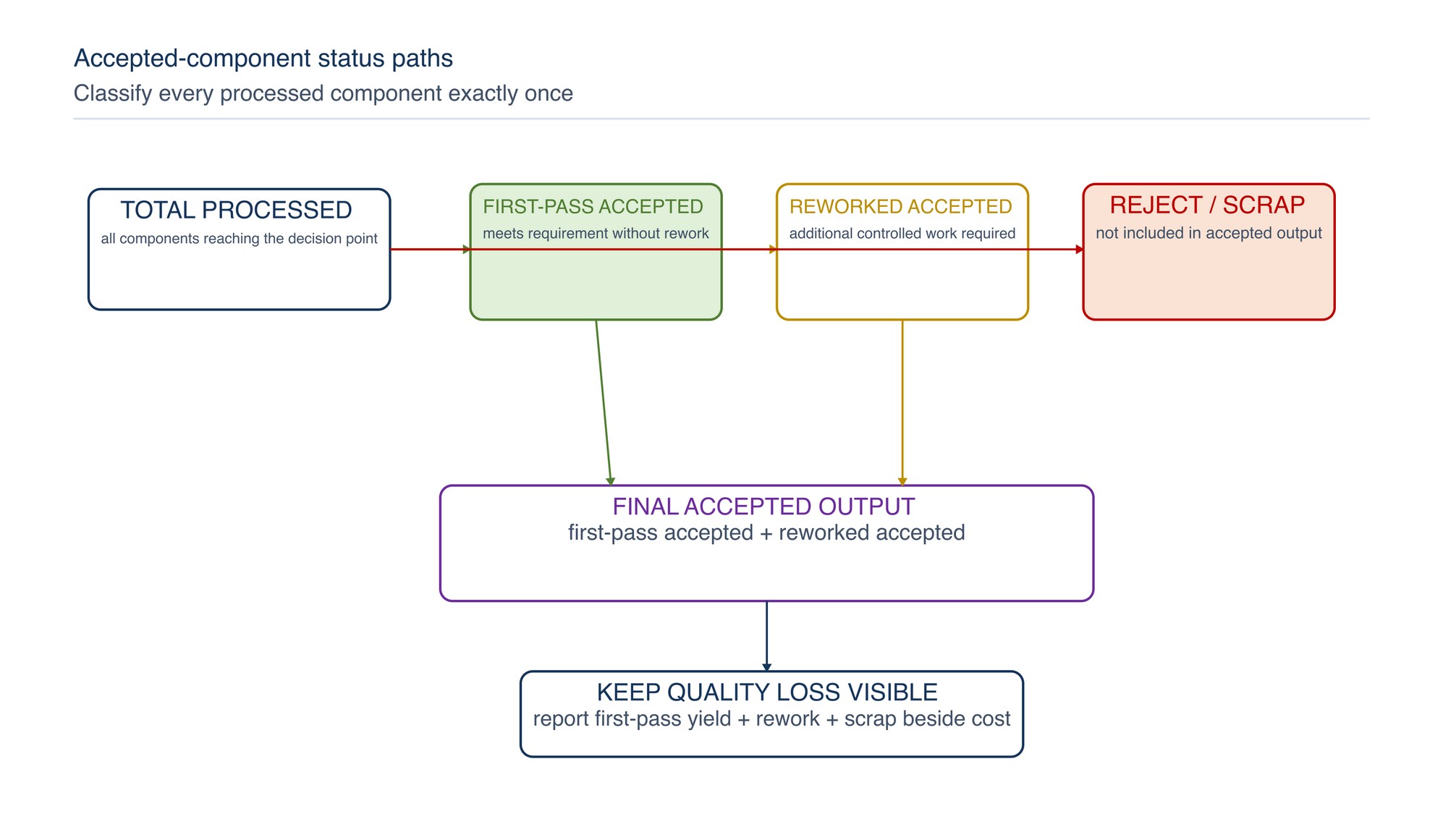
| Output status | Definition | Cost treatment |
|---|---|---|
| First-pass accepted | Meets the requirement without rerun, repair or offline correction | Included in accepted output and first-pass yield |
| Reworked accepted | Meets the requirement only after additional controlled work | Included in final accepted output; rework cost remains visible |
| Rejected or scrapped | Does not become acceptable within the defined disposition | Excluded from accepted output; incurred cost remains in the numerator |
| Pending or quarantined | Decision not complete at the calculation cut-off | Exclude or carry forward consistently under the stated rule |
ASQ defines first-pass yield around units that complete the process and meet quality guidelines without scrap, rerun, retest, return or offline repair. [S372]
Freeze the observation boundary
Record:
- start and end date/time;
- work order, batch, shift or other population identity;
- component and material identity;
- incoming condition;
- included process steps;
- machine and workstation;
- approved abrasive and accessory identity;
- operators or team basis where relevant;
- inspection method and acceptance requirement; and
- treatment of work already in progress at the cut-off.
Use the same boundary for the cost numerator and output denominator.
Build the numerator
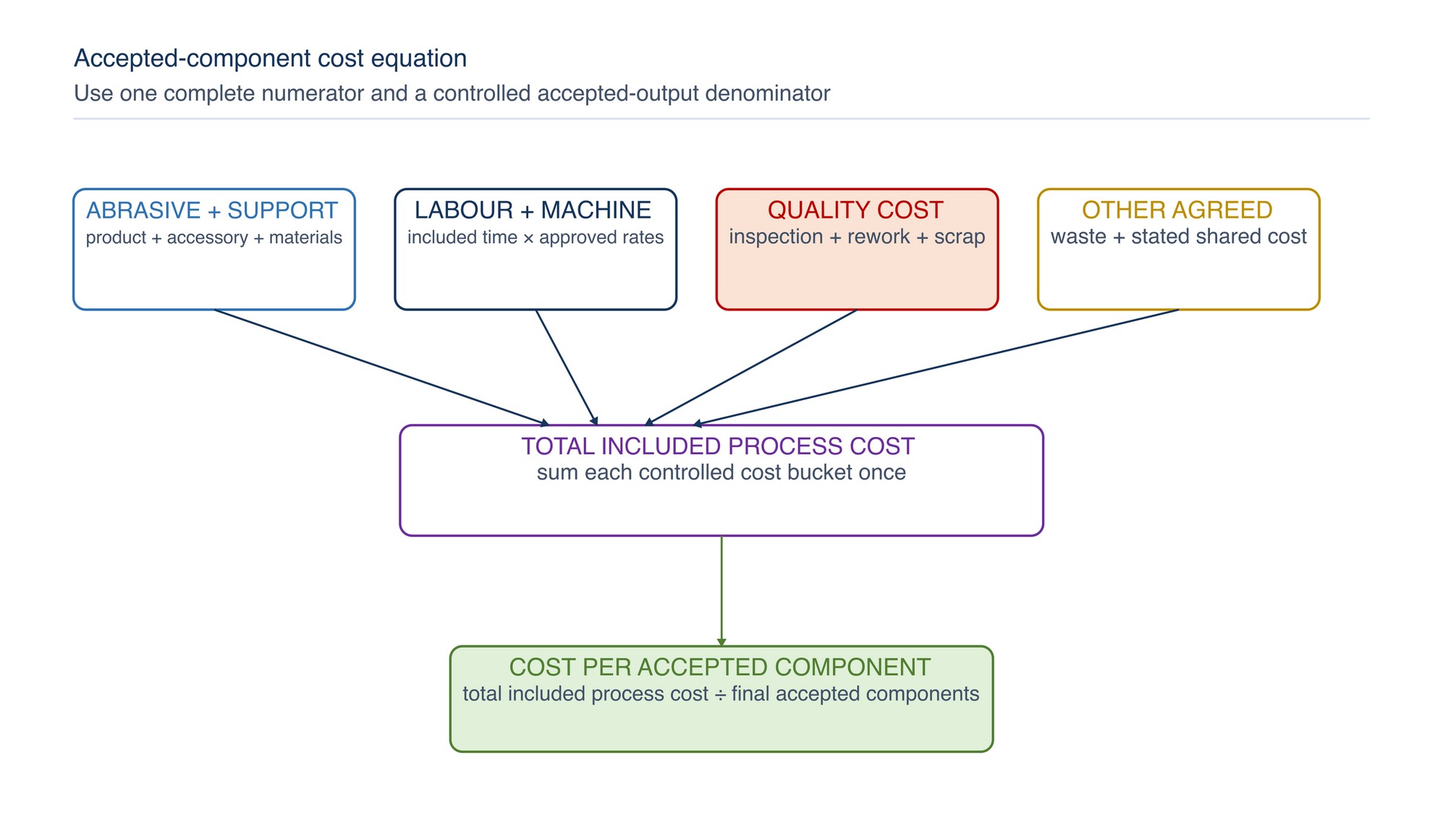
Use the general relationship:
Cost per accepted component = total included process cost ÷ final accepted components
Where:
Total included process cost = abrasive + supporting consumables + labour + machine/workstation + changeover + inspection + rework + scrap + waste/disposal + other agreed costs
Document exclusions. A short and consistent model is better than a complex model with unreliable allocations.
Build the denominator
Use:
Final accepted components = first-pass accepted + reworked accepted
Also retain:
Total processed = first-pass accepted + reworked accepted + rejected/scrapped + unresolved units treated under the stated cut-off rule
Never increase accepted output with units that have not passed the defined acceptance requirement.
Convert abrasive purchase data
Establish the base unit:
Landed cost per abrasive unit = landed pack cost ÷ usable abrasive units per pack
Then:
Abrasive cost = landed cost per abrasive unit × abrasive units consumed
For rolls, compounds or bulk media, use a controlled issue quantity such as length, mass or volume. Reconcile partial products, unused issued material and returned stock consistently. Exact pack identity and product information should remain traceable to the controlled quotation and product record.
Include supporting consumables
Capture items materially affected by the option:
- backing pads, contact elements, flanges or adaptors;
- dressing and conditioning tools;
- lubricant, coolant, compound or cleaner;
- masking and protection materials;
- extraction filters or collection media;
- inspection consumables; and
- packaging and waste containers where relevant.
For a reusable accessory:
Allocated accessory cost = observed accessory cost × allocation fraction used by the boundary
State whether allocation is based on uses, time, batches or another approved driver.
Calculate labour cost
Convert time and rate to compatible units:
Labour cost = included labour time × approved labour rate
If several people work simultaneously, use person-time rather than elapsed clock time:
Person-hours = sum of each person's included hours
Separate productive processing, preparation, changeover, inspection and rework when the distinction helps identify improvement.
Calculate machine or workstation cost
Use:
Machine/workstation cost = included machine or workstation time × approved rate
State whether the rate includes energy, maintenance, depreciation, extraction or overhead. Do not add the same item again as a separate cost.
Where a tool is handheld and the organisation does not apply a machine rate, record that treatment explicitly rather than inventing one.
Allocate changeover and preparation
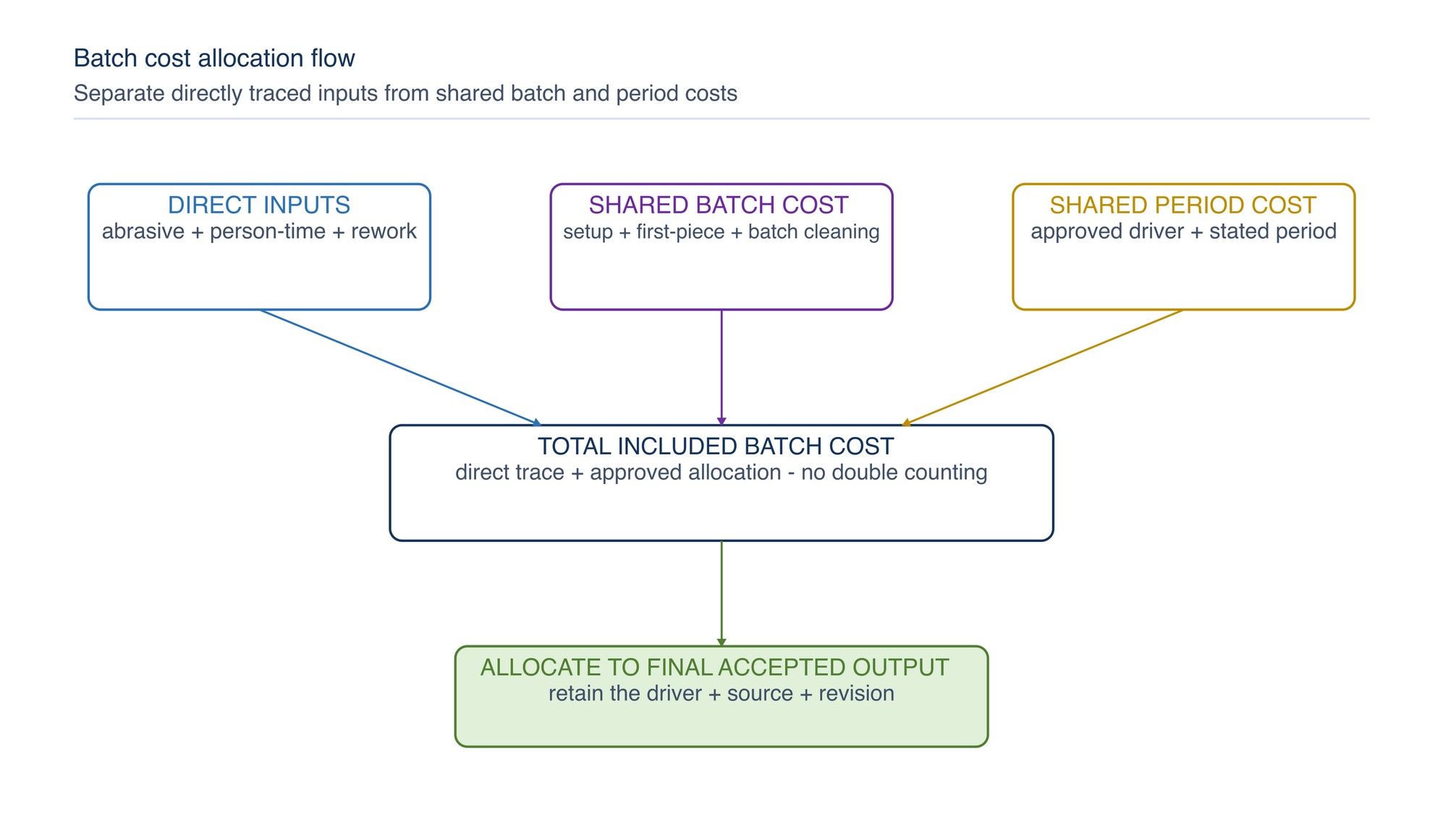
Changeover can include isolation, product removal, inspection, mounting, adjustment, dressing, cleaning, reset and first-piece verification.
For a batch-level activity:
Allocated changeover cost per accepted component = total included changeover cost ÷ final accepted components in the batch
Keep abnormal changes caused by damage, loading or process instability visible as exceptions.
Include inspection cost
Inspection cost can include inspector labour, operator self-check time, equipment time and necessary consumables. The acceptance method must match the controlled drawing, specification or visual standard. [S343; S344; S345]
Separate:
- routine inspection required for every candidate;
- additional checks introduced by a candidate;
- repeated inspection after rework; and
- investigation or containment inspection after an abnormal result.
Calculate rework cost
For each reworked component, include the additional abrasive, accessory, labour, machine, cleaning and inspection cost inside the boundary.
Use:
Total rework cost = sum of all additional controlled rework inputs
Reworked accepted components remain in final accepted output but not in first-pass accepted output. This preserves the final cost calculation while making process instability visible.
Calculate scrap cost
Scrap cost can include:
- material value at the stated process stage;
- abrasive and supporting consumables already used;
- labour and machine time already incurred;
- inspection and disposition effort;
- replacement preparation where inside the boundary; and
- waste or recovery treatment.
Use the organisation's approved material and work-in-process valuation. Do not count the same consumed processing cost both inside the normal cost buckets and again in a fully loaded scrap value.
Control shared, fixed and one-off costs
| Cost type | Examples | Allocation control |
|---|---|---|
| Direct variable materials | Abrasive units, operator minutes, rework materials | Trace to the observed batch or component |
| Shared batch | Setup, first-piece check, batch cleaning | Allocate across the stated accepted batch |
| Period shared | Workstation, extraction, supervision | Use the approved cost-driver and period |
| One-off improvement | Fixture, training, method development | Report separately or amortise on an approved basis |
| Sunk cost | Past expenditure unaffected by the decision | Do not use to distort the current comparison |
NIST manufacturing-cost guidance supports disciplined cost categories and stated data sources. [S373] ISO 14051 similarly links physical material flows with associated costs for internal decision-making. [S369]
Calculate the main result
Use a calculation sheet with one row per cost bucket:
| Cost bucket | Quantity | Unit | Approved rate or unit cost | Included cost | Source/owner |
|---|---|---|---|---|---|
| Abrasive | A | unit | P | A × P | Stores/purchasing |
| Supporting consumables | S | stated unit | Q | S × Q | Process record |
| Labour | L | hour | R | L × R | Time record/finance |
| Machine/workstation | M | hour | T | M × T | Time record/finance |
| Inspection | I | hour or event | U | I × U | QA/process record |
| Rework | Sum of rework inputs | — | mixed | — | Rework log |
| Scrap | Approved calculated value | — | mixed | — | NCR/cost record |
| Waste/other | Approved calculated value | — | stated unit | — | Disposal/other record |
Sum the included-cost column, then divide by final accepted components. Retain currency, rounding rule and calculation revision.
Report first-pass performance beside cost
Use:
First-pass yield = first-pass accepted ÷ total processed under the defined rule
Final acceptance proportion = final accepted ÷ total processed under the defined rule
The cost figure and yield measures answer different questions. A stable cost with falling first-pass yield may indicate that rework is being absorbed or misclassified.
Compare candidates on the same basis
| Comparison field | Candidate A | Candidate B | Control |
|---|---|---|---|
| Product identity | Controlled record | Controlled record | Complete and traceable |
| Workpiece/boundary | Same | Same | No mixed scope |
| Total processed | Observed | Observed | Same counting rule |
| First-pass accepted | Observed | Observed | Same acceptance gate |
| Reworked accepted | Observed | Observed | Same rework definition |
| Final accepted | Calculated | Calculated | Denominator |
| Total included cost | Calculated | Calculated | Same buckets and rates |
| Cost per accepted component | Calculated | Calculated | Decision input |
| Safety/technical status | Acceptable | Acceptable | Mandatory gate |
Do not compare a mature process with an unstable learning run without explaining the difference.
Test sensitivity
Test inputs that can change the conclusion:
- abrasive consumption;
- labour or machine time;
- changeover frequency;
- first-pass acceptance;
- rework severity;
- scrap occurrence;
- quotation or pack-size change; and
- allocation period for one-off cost.
Recalculate with observed low, typical and high cases or another approved method. NIST notes the importance of avoiding double counting and examining uncertainty through sensitivity analysis in manufacturing cost work. [S374]
Reconcile the calculation
Before release, verify:
- opening issue plus receipts minus returns and closing balance agrees with consumption;
- recorded person-time agrees with the defined scope;
- machine and labour time units match their rates;
- processed units reconcile to all output statuses;
- final accepted output agrees with inspection records;
- rework and scrap events have not been omitted;
- shared costs use the approved driver;
- no cost appears twice;
- currency and quotation dates are consistent; and
- totals reproduce from the source rows.
Investigate material differences before using the result commercially.
Approve, control and review
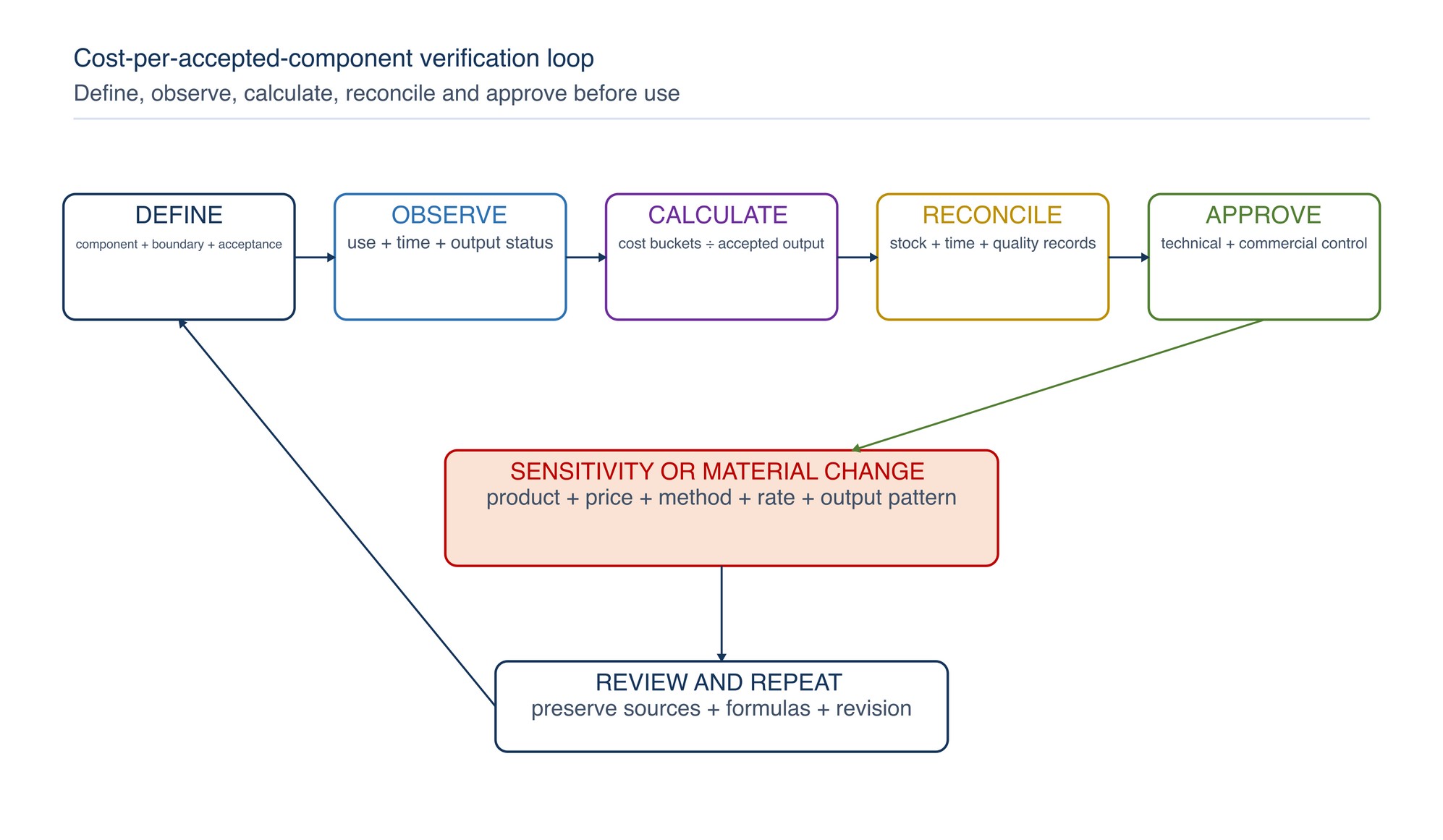
Release the calculation with:
- title and decision;
- boundary and acceptance definition;
- product/process identities;
- source-period dates;
- input table and formulas;
- result and sensitivity range;
- assumptions and exclusions;
- safety and technical status;
- reviewer and approval status; and
- revision and next review trigger.
Review after a material change in product, price, pack, machine, method, workpiece, acceptance requirement, cost rate or output pattern.
Practical calculation checklist
Confirm:
- the component and acceptance requirement are unambiguous;
- the numerator and denominator use the same boundary;
- every processed unit has one status;
- reworked accepted units remain distinguishable;
- pack and time conversions are correct;
- rates are current and approved;
- all material cost buckets are included once;
- shared and one-off costs use stated allocation rules;
- output counts reconcile with inspection records;
- sensitivity has been tested; and
- the commercial conclusion does not override safety or technical suitability.
Troubleshooting
| Problem | Likely cause | Improvement |
|---|---|---|
| Cost per accepted component is lower when rejects rise | Rejects remain in the denominator | Use only final accepted output |
| First-pass yield looks high but rework is common | Rework is classified as routine processing | Define first-pass acceptance before observation |
| Abrasive consumption will not reconcile | Pack conversion, returns or partial use are uncontrolled | Reconcile issues, returns and remaining stock |
| Labour cost differs from clock time | Multiple people or excluded preparation time | Use person-time and the stated boundary |
| Scrap is counted twice | Loaded scrap value repeats direct inputs | Map each cost once |
| Candidate ranking changes with one event | Observation is too sensitive to an exception | Extend observation and show a range |
| Shared cost overwhelms the result | Allocation driver or period is unsuitable | Review the approved allocation basis |
| Cost falls but first-pass yield deteriorates | Rework is hidden or under-costed | Report yield and rework beside cost |
| Results cannot be reproduced | Sources, units or formulas are not retained | Use the controlled worksheet and revision record |
| Lowest cost candidate fails suitability review | Commercial result was used before technical gating | Apply safety and technical acceptance first |
Cost per accepted component must never be improved by exceeding a product limit, defeating a guard, omitting required inspection, using damaged product, extending use beyond safe condition, reducing extraction or accepting an unsuitable machine/accessory arrangement. Follow product marking, machine instructions, workplace controls and applicable Malaysian requirements.
Key takeaways
- Define accepted output before calculating cost.
- Keep first-pass accepted, reworked accepted and scrap separate.
- Use one complete and transparent cost numerator.
- Convert pack, time and rate units consistently.
- Allocate shared costs on a stated approved basis.
- Reconcile source records and prevent double counting.
- Report cost, yield, sensitivity and technical status together.
Controlled Product Trials
The Controlled Product Trials chapter appears on the following page of the printed handbook (page 572), outside this chapter extract.