
Production engineers, supervisors, operators, QA/QC personnel, maintenance teams, safety personnel, procurement staff and technical sales personnel
Qualitative comparison of grinding wheels, flexible grinding discs, flap discs, fibre discs, ceramic-grain discs, sanding discs, non-woven discs, belts, mounted points, carbide burrs and polishing wheels. This chapter does not approve an MKTECH SKU, machine, speed, pressure, backing pad, contact wheel, compound, sequence, finish result, productivity claim or cost claim.
A matrix cell is not an operating instruction. The exact product, machine, guard, attachment, support element, dimensions, maximum operating speed, work material, work geometry and current manufacturer instructions must all be compatible. Stop for missing identification, damage, wrong support, uncertain stainless segregation or any condition outside the declared use. [S032]
Chapter objectives
After this chapter, the reader should be able to:
- separate a product family from its grain, grit, backing, bond and converted form;
- use removal, finish, flexibility, heat, edge, geometry, stainless, skill and cost criteria as screening questions;
- recognise where product families overlap and where comparison is not meaningful;
- choose a short list for a representative controlled trial; and
- record the technical basis for selecting an exact abrasive product.
What this matrix can and cannot decide
An abrasive family describes the architecture that presents a cutting or finishing medium to the work. It does not determine performance by itself. A coarse fibre disc, a fine non-woven disc and a bonded grinding wheel can all be circular, yet their support, contact, wear and surface effects differ. Conversely, ceramic abrasive grain may be supplied in a fibre disc, flap disc, belt or other coated format. “Ceramic disc” therefore means a disc using ceramic abrasive grain or a shaped ceramic-grain technology; it is not a separate attachment system. [S044; S047; S060; S061]
The matrix uses screening tendencies, not universal rankings. “High removal potential” means that suitable products in the family can be selected for stock removal. It does not mean every product in that family removes more material than every alternative. “Finish-led” means that the family is commonly selected for refinement or polishing, not that it produces a guaranteed roughness or appearance.
Define the comparison task first
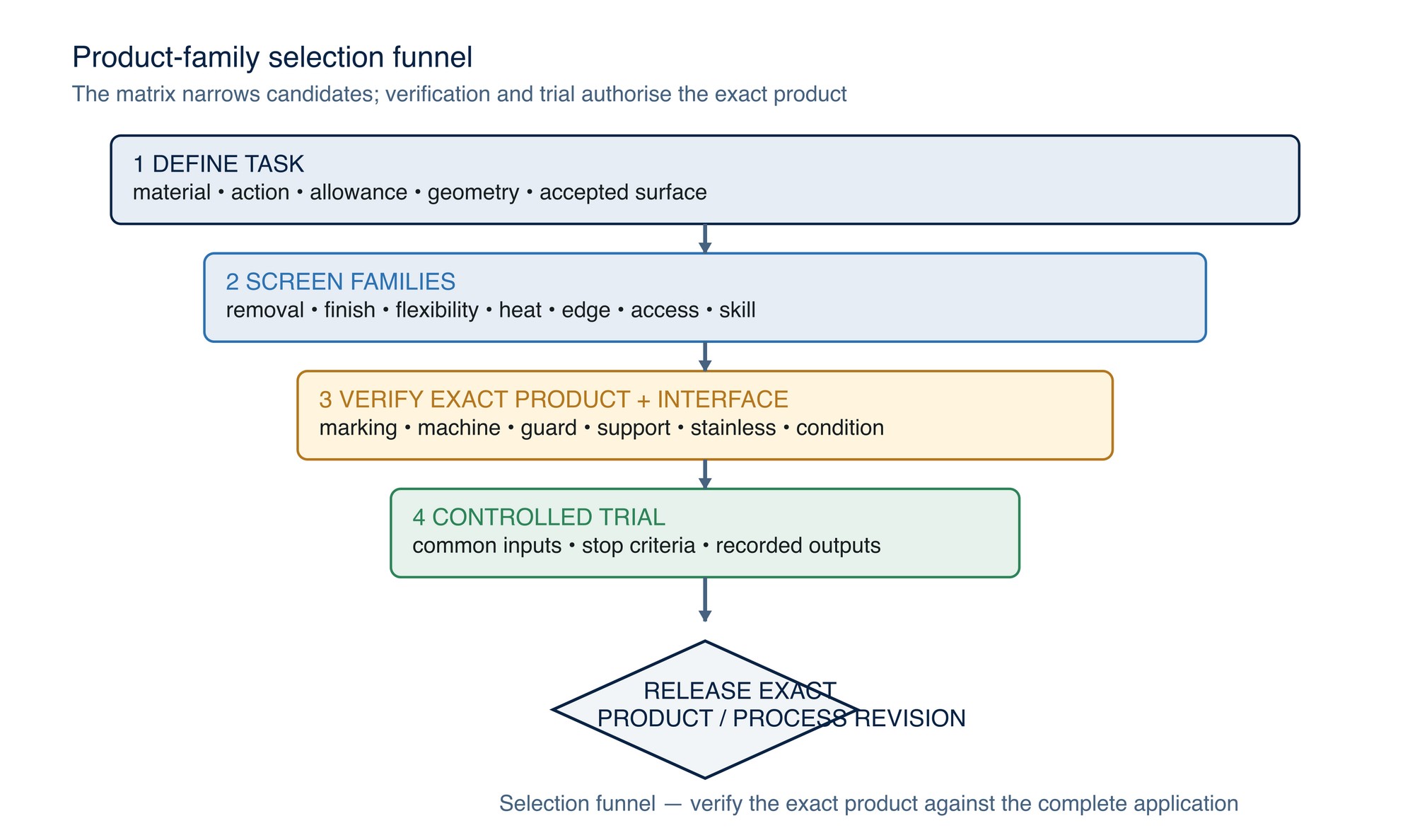
Do not compare unlike tasks. Record the following before using the matrix:
- work material, grade, hardness, coating and contamination controls;
- action required: cut, heavy remove, blend, deburr, clean, refine or polish;
- stock to remove and geometry that must remain;
- flat, edge, radius, bore, groove, fillet, tube or free contour;
- required texture, direction, roughness or visual standard;
- machine type, spindle, guard and available speed range;
- permitted support pad, platen, contact wheel, mandrel or arbor;
- wet-or-dry status, extraction and thermal limits;
- acceptable process time, changeover and consumable use; and
- operator competence, inspection method and stop criteria.
Complete these fields before using the matrix to select a product family.
Matrix key and interpretation rules
| Term | Meaning in this chapter | Required verification |
|---|---|---|
| Relative capability available within the family | High / medium / low potential for the defined action result | Exact grain, grit, construction, machine and trial |
| Rigid / semi-flexible / flexible when correctly supported | How the working face can follow geometry | Product construction, support hardness, angle and permitted bend |
| Heat risk | Likelihood of harmful local heating under an unsuitable method; not a measured temperature | Material limit, contact time, pressure, speed, loading and cooling method |
| Edge durability | Ability of the complete product to retain a usable cutting face near an edge; not snag immunity | Product edge, pad or wheel support, angle, damage and work geometry |
| Stainless suitability | A candidate exists only when explicitly declared, segregated and contamination-controlled | Product marking, chemistry, tooling history and approved cleaning process |
| Relative cost | Must be assessed as cost per accepted part, metre, weld or area | Local price, life, cycle time, changeover, rework and disposal data |
The words conditional and product-dependent are deliberate controls. They prevent a family-level table from being mistaken for a product specification.
Product-family identity and primary role
| Product family | Working architecture | Primary role | Required interface |
|---|---|---|---|
| Grinding wheel | Bonded abrasive body; rigid or shaped wheel | Heavy stock removal, weld removal, shaping | Correct spindle, flange or hub, guard and declared working face |
| Flexible grinding disc | Thin flexible bonded or coated construction, product-specific | Controlled grinding or blending where some compliance is required | Declared pad or hub, guard and permitted angle |
| Flap disc | Overlapping coated-abrasive flaps fixed to a backing plate | Weld blending, stock removal and finish improvement | Correct Type 27/29 geometry, guard and working angle |
| Fibre disc | Coated abrasive on vulcanised-fibre backing | Fast right-angle stock removal and blending | Compatible backing pad, retainer and guard |
| Ceramic-grain disc | Disc format using ceramic or shaped ceramic abrasive grain | Product-dependent: from heavy removal to controlled refinement | The underlying disc format controls the pad, hub, guard and use |
| Sanding disc | Paper, cloth, film or other coated disc; PSA, hook-and-loop or quick-change variants | Sanding, defect removal, blending and finish preparation | Declared attachment and compatible support pad |
| Non-woven disc | Abrasive mineral distributed through an open synthetic-fibre web | Cleaning, blending, light deburring and surface conditioning | Declared attachment, support and product density |
| Belt | Continuous coated-abrasive loop | Stock removal, deburring, dimensioning or finishing | Correct belt size and direction, tension, tracking, platen or contact wheel |
| Mounted point | Small bonded-abrasive shape on a shank | Bores, grooves, fillets, small radii, local deburring and blending | Correct collet, clamping depth, speed and unsupported length |
| Carbide burr | Toothed tungsten-carbide rotary cutter on a shank | Local machining, deburring, edge work and shape correction | Rigid collet and drive, correct cut, speed and controlled engagement |
| Polishing wheel | Cloth, felt, non-woven or other resilient wheel, with or without compound | Fine finishing, cosmetic refinement and polishing | Correct arbor, guard, wheel/compound system and speed |
Grinding wheels, flap discs and fibre discs can overlap in right-angle weld-removal duties, but their construction and support requirements differ. Mounted points suit local geometries, chamfering and cleaning, while carbide burrs are rotary cutting tools selected by material and application. Abrasive belts can cover duties from stock removal through controlled finishing. [S055-S057; S059]
Removal, finish and thermal-response matrix
| Product family | Removal-rate tendency | Finish-quality tendency | Heat-generation control |
|---|---|---|---|
| Grinding wheel | High potential for suitable heavy-duty products | Coarse to intermediate; usually followed by refinement when appearance matters | High risk if angle, pressure, loading or dwell is wrong; monitor work and wheel |
| Flexible grinding disc | Medium to high, construction-dependent | Intermediate; can blend more readily than a rigid wheel | Compliance can spread contact, but dwell and over-flexing still create heat |
| Flap disc | Medium to high; fresh coated abrasive is exposed as flaps wear | Intermediate to good, grit- and construction-dependent | Broad contact may moderate peaks, but capping, glazing and excess pressure add heat |
| Fibre disc | High short-duration potential with the correct pad hardness | Coarse to intermediate; pad changes the response | Efficient cutting can limit rubbing, but worn or loaded discs rapidly generate heat |
| Ceramic-grain disc | Potentially high when the exact grain and format are designed for cutting | Coarse through fine; “ceramic” does not set finish | Grain technology may cut efficiently, but cooler cutting is product- and condition-specific |
| Sanding disc | Low to medium; broad range by grit and backing | Intermediate to fine; strong candidate for scratch refinement | Loading, wrong pad, dwell and fine-grit rubbing can overheat thin work |
| Non-woven disc | Low to medium; generally not for dimensional stock removal | Good for blending, cleaning and controlled texture | Open web clears swarf, but pressure can collapse the web and increase friction |
| Belt | Low to high depending on machine, backing, grain and contact element | Coarse through fine with high process repeatability potential | Contact-wheel/platen hardness, speed, force, cooling and belt condition control heat |
| Mounted point | Medium local removal potential | Coarse to intermediate on small features | Small contact area creates high local heat risk; avoid dwell and loading |
| Carbide burr | High local removal potential with correct cut and engagement | Machined texture; fine cuts can refine but do not equal polishing | Sharp cutting can be efficient; chatter, wrong speed or excessive engagement raises heat and damage risk |
| Polishing wheel | Very low stock-removal intent | Fine to high-lustre potential within an approved sequence | Friction, compound loading and dwell can heat and smear the surface |
Manufacturer tests may show one product outperforming another under stated conditions, but those results cannot be transferred to other diameters, grains, operators, materials or machines. Use comparative literature only to identify possible application roles, never as a universal speed, life or productivity ranking. [S055]
Geometry, flexibility, edge and operator-control matrix
| Product family | Flexibility / edge behaviour | Flat-surface suitability | Curved or confined-surface suitability | Operator skill requirement |
|---|---|---|---|---|
| Grinding wheel | Rigid; durable face but edges and working angles are product-specific | Strong for accessible heavy removal; easy to dish or gouge if uncontrolled | Limited on gentle external contours; poor for deep confined features unless specially shaped | High for angle, pressure, profile preservation and thermal control |
| Flexible grinding disc | Flexible to semi-flexible; edge support is critical | Good for blending when uniformly supported | Good for shallow contours within declared bend | Medium to high; avoid edge snagging and over-flexing |
| Flap disc | Semi-flexible; plate stiffness and flap wear control conformity | Good for weld blending and broad accessible surfaces | Good for external radii and mild contours; limited in recesses | Medium; angle and pressure must expose abrasive without damaging flaps |
| Fibre disc | Pad-controlled flexibility; exposed disc edge needs care | Very good for accessible planar work with the correct pad | Good for shallow contours with suitable pad; poor for deep cavities | Medium; pad selection and disc-edge control are decisive |
| Ceramic-grain disc | Inherits flexibility and edge behaviour from its disc format | Product-dependent | Product-dependent | Product-dependent; do not infer from grain name |
| Sanding disc | Flexible with a soft pad; more stable with a firm pad | Very good for refinement and finish preparation | Good on broad curves; small quick-change forms suit local features | Medium; scratch progression and pad control matter |
| Non-woven disc | Compliant; resists loading by open structure but can round edges | Good for cleaning and blending without intended dimensional change | Very good on contours, transitions and irregular profiles | Low to medium for light work; pressure control is still required |
| Belt | Contact element sets rigidity; belt edges and joints are vulnerable to misuse | Excellent on platen-supported flat work | Excellent around contact wheels or slack sections when the belt is designed for it | Medium to high; tracking, tension, feed, edge and work support matter |
| Mounted point | Rigid small shape; good local access, fragile if side-loaded or overhung | Poor for broad flatness control | Excellent for bores, grooves, fillets and small radii | High; collet, runout, speed, contact and dwell require control |
| Carbide burr | Rigid toothed cutter; strong local edge capability but can grab or chatter | Poor for broad finish uniformity | Excellent for holes, contours, edges and local geometry | High; cut, direction, engagement and two-hand control are critical |
| Polishing wheel | Highly compliant to semi-rigid by wheel construction | Good for accessible wheel faces if waviness and edge roll are controlled | Good for external contours; access depends on wheel diameter and profile | High for compound, pressure, direction, cleanliness and edge safety |
Carbide-burr choice depends on material and application, requires a suitable rigid drive and clamping system, and relies on controlled contact rather than excessive engagement. Carbide burrs therefore offer strong local capability and demand operator skill, but provide limited control of broad flatness. [S056]
Stainless-steel suitability and contamination boundary
No family is automatically suitable for stainless steel. The complete product must be declared for the alloy and task, and tools must be segregated from carbon-steel contamination. A product sold for multiple materials is not clean after it has contacted carbon steel.
| Screening question | Acceptable evidence | Stop condition |
|---|---|---|
| Is the exact product declared for stainless? | Current manufacturer product data and marking | Family name, colour or seller description only |
| Is the tool and support system segregated? | Identified storage, dedicated pad/wheel/brush and clean handling record | Unknown prior use or shared contaminated support |
| Is heat-tint and smear controlled? | Approved sequence, inspection and cleaning/passivation requirement | Uncontrolled colour, embedded debris or smeared surface |
| Is the finish functionally acceptable? | Drawing, sample, roughness/appearance criterion and inspection method | “Looks polished” without the required acceptance standard |
Examples of manufacturer-declared stainless products exist among grinding wheels, fibre and flap discs, belts, mounted points, non-woven products and polishing systems. That establishes availability, not interchangeability. [S045; S055-S061]
Typical application shortlist
| If the task is primarily… | Start the shortlist with… | Do not assume… |
|---|---|---|
| Remove a heavy accessible weld or large stock allowance | Grinding wheel, fibre disc, suitable flap disc or belt | The fastest initial cut gives the lowest total cost or best profile |
| Blend a normal weld into adjacent surface | Flap disc, fibre disc, flexible disc or belt | One stage will also produce the final specified finish |
| Refine scratches on a broad surface | Sanding disc, belt, structured/ceramic-grain disc or non-woven disc | Grit labels across systems are equivalent |
| Clean oxide, light corrosion, sealant or handling marks | Non-woven disc or a purpose-declared sanding/cleaning product | Cleaning is dimensionally neutral or contamination-free |
| Work a bore, groove, fillet or tight radius | Mounted point, carbide burr or small quick-change disc | A broad-face disc can be forced safely into the feature |
| Chamfer, deburr or correct a local edge | Carbide burr, mounted point, fibre/flap disc or belt depending on access direction | Edge contact is safe without declared support and direction |
| Produce a fine cosmetic or reflective finish | Fine sanding/structured abrasive, non-woven stage and polishing wheel in a validated sequence | A polishing wheel will remove deep defects or produce a specified roughness by itself |
This shortlist is a hypothesis generator. The final choice depends on the exact product construction and the controlled trial.
Relative cost: use cost per accepted output
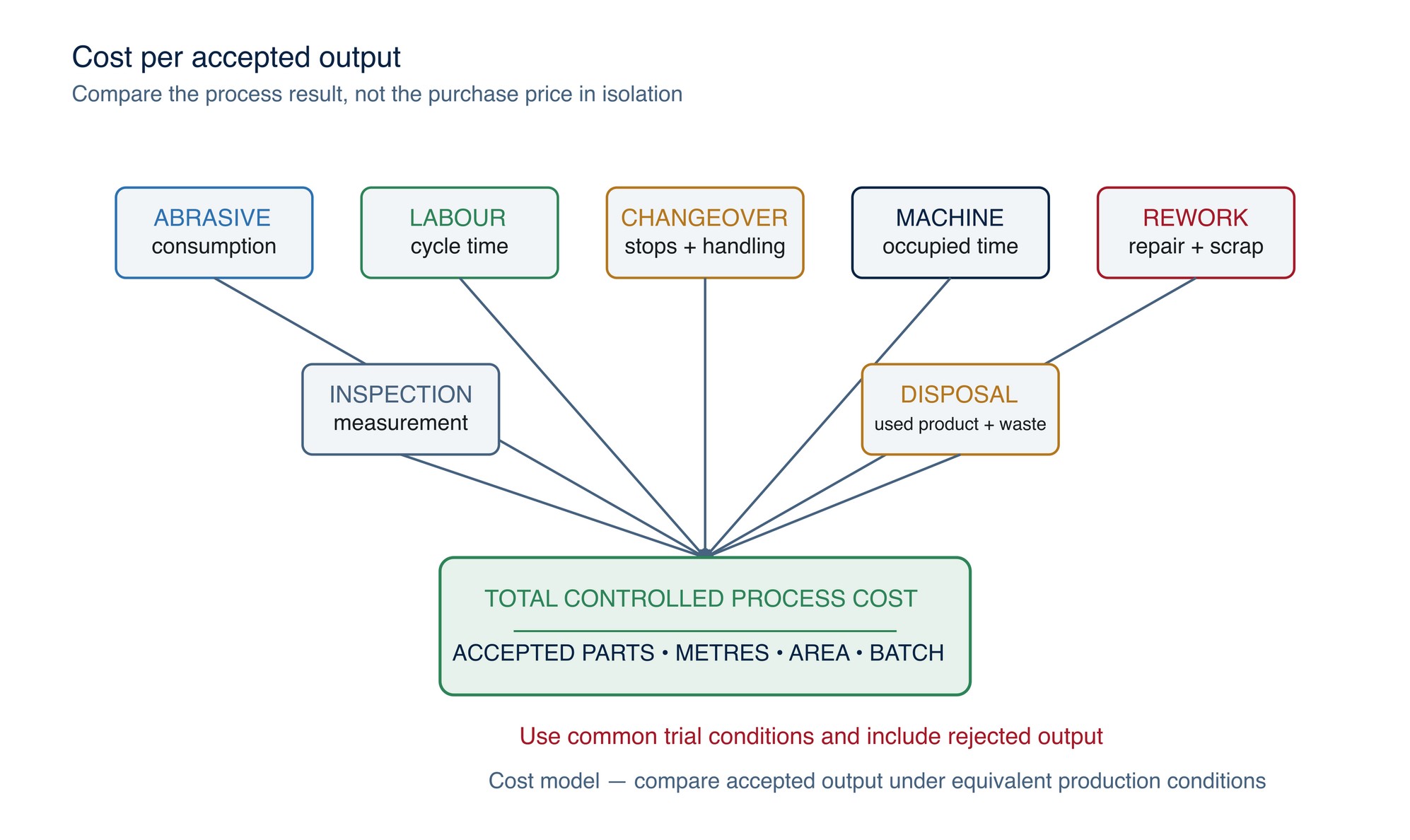
Unit price is not relative process cost. A lower-priced abrasive can cost more if it cuts slowly, changes frequently, distorts the work or creates rework. A higher-priced product can still be uneconomic if its potential is not realised on the available machine.
Use one consistent basis:
Cost per accepted output = abrasive consumption + labour time + changeover + machine time + rework + inspection + disposal.
Record the numerator and denominator: per accepted part, metre of weld, square metre or defined batch. Include rejected work. Compare candidates only under the same material, geometry, operator method, machine condition and acceptance criterion. Use “low/medium/high cost” only when supported by measured results for the stated application.
Controlled selection workflow
- Define material, geometry, action, removal allowance and accepted surface.
- Eliminate families that cannot reach the feature or maintain the geometry.
- Eliminate products without a complete compatible machine and support system.
- Verify current manufacturer use, safety, stainless and storage information.
- Shortlist two or three exact products, not generic families.
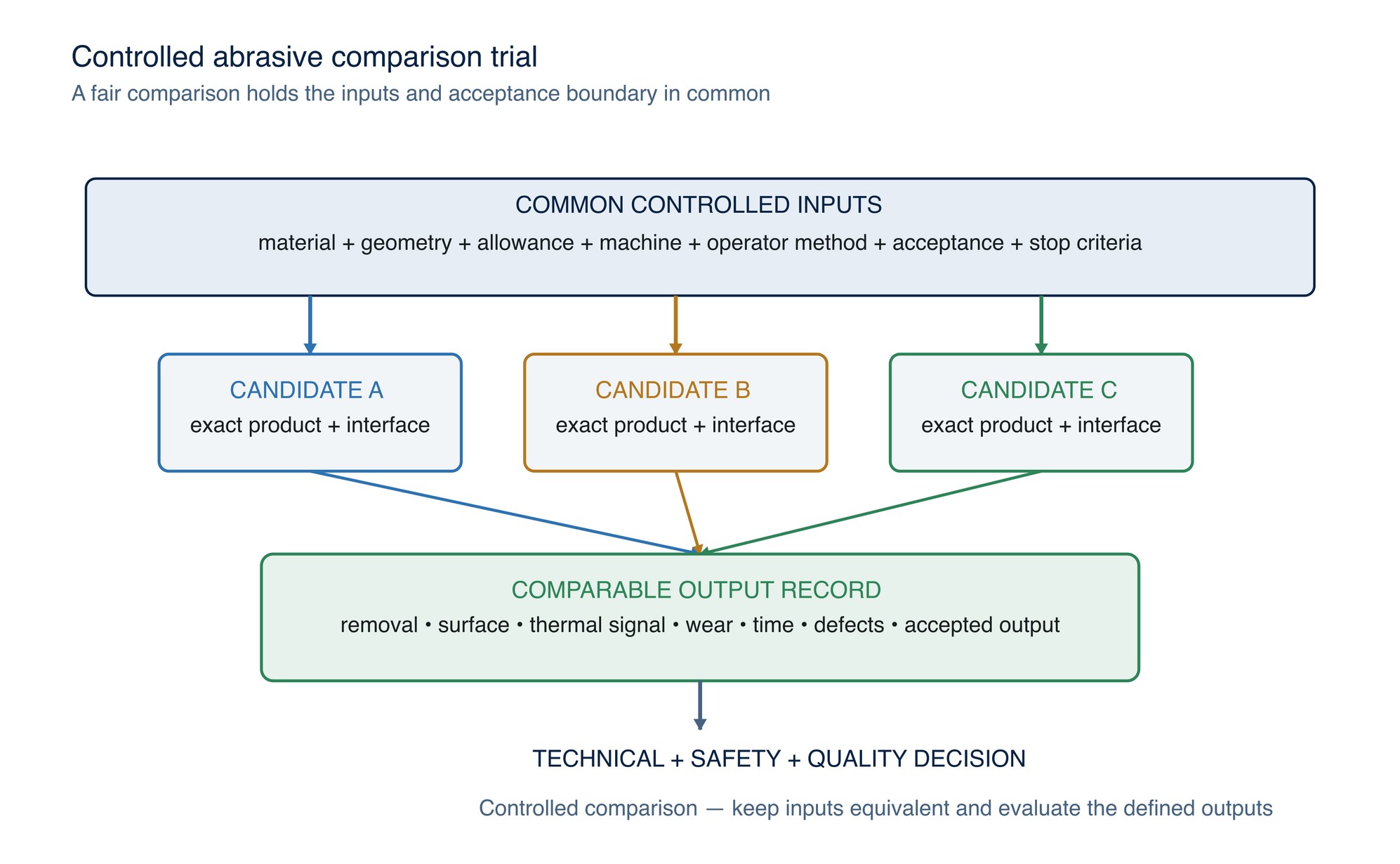
- Trial them on representative work with fixed inspection and stop criteria.
- Record removal, surface, temperature signal, wear, changeover, defects and operator observations.
- Calculate cost per accepted output and approve the exact product/process revision.
Failure signals that invalidate the comparison
| Signal | Why the result is invalid | Required response |
|---|---|---|
| Different material, weld size, access or operator method | Candidate results are not on a common basis | Repeat with controlled representative work |
| Wrong pad, platen, contact wheel, collet or guard | Product architecture is not being tested as declared | Stop and correct the interface |
| Loaded, glazed, damaged, curled or contaminated abrasive | Heat, cut, finish and life no longer represent normal use | Remove from service; investigate product and storage |
| Workpiece colour, smear, gouge, edge roll or dimensional loss | Acceptance boundary has been crossed | Stop; quarantine work and review the sequence |
| Different change-out criteria | Life and cost comparison is biased | Define one approved end-of-life rule |
| Unrecorded speed, pressure, time or cooling | Performance cannot be reproduced | Treat result as exploratory only |
Practical example: stainless weld blend and directional finish
A fabricator must level a stainless weld on a formed enclosure and reproduce the surrounding directional finish. The geometry includes a broad face and a shallow external radius. The team first separates the task into level, blend and refine stages.
For levelling, it shortlists an explicitly stainless-suitable fibre disc with the declared pad and a flap disc with a compatible geometry. A grinding wheel remains an option only where removal allowance and profile risk justify it. For the radius, the team evaluates the conformity of the pad or flap construction. For refinement, it shortlists a sanding or structured-abrasive disc followed, if necessary, by a non-woven product that matches the directional texture. A polishing wheel is excluded because a reflective finish is not the acceptance target.
Each candidate is trialled on representative coupons. The record captures exact product identity, settings, contact method, time, disc consumption, temperature signal, edge condition, visual direction and measured requirement where applicable.
The team releases the sequence with the lowest controlled cost per accepted enclosure—not the lowest disc price or the fastest single pass.
Product-family selection in practice
Shortlist the product family by the action required: cutting, heavy removal, weld levelling, blending, scratch refinement, deburring or polishing. Then check material suitability, geometry and access, machine and mounting interface, finish target, contamination control and operator exposure. Select for the complete accepted result rather than maximum removal or lowest unit price alone.
Use a representative comparison when more than one family is suitable. Keep the workpiece, machine, contact method and inspection consistent, and compare removal, heat, finish, geometry, product condition, rework and cost per accepted output.
Refer to the product label, Technical Data Sheet, or MKTECH representative.
Selection and comparison record
For a repeatable comparison, record work material and condition, geometry, action, allowance, required finish, product family, exact product code, grain and grit system, backing/bond or cut, attachment, support element, machine, guard, dimensions, rated speed, actual setting, contact method, wet-or-dry status, stainless segregation, inspection result, change-out point, cycle time, consumable use, rework and cost per accepted output.
Grinding Machines and Power Tools
The next chapter, Grinding Machines and Power Tools, appears on the following page of the printed handbook (page 82), outside this chapter extract.