
Production engineers, supervisors, operators, QA/QC personnel, maintenance teams, safety personnel, procurement staff and technical sales personnel
Paper, cloth, film, fibre, vulcanised-fibre and polyester backings; resin-over-resin, glue and flexible resin systems; reinforcement; and their qualitative effects on flexibility, edge durability, tear resistance, water resistance, finish, product life and operator control. This chapter does not approve an MKTECH SKU, backing grade, bond chemistry, wet-use method, machine, speed, pressure, sequence, finish result or product-life claim.
A backing or bond name is not an operating instruction. Verify the complete abrasive product, attachment, support pad or contact wheel, dimensions, maximum operating speed, machine compatibility, wet-or-dry marking, storage condition and current manufacturer instructions. Stop for missing identification, cracks, cuts, creases, cupping, delamination, joint damage, softened bond, abnormal grain loss or any product that has been wetted without approval. [S032; S051]
Chapter objectives
After this chapter, the reader should be able to:
- identify the backing and bond as separate parts of a coated-abrasive system;
- distinguish paper, cloth, polyester cloth, film and vulcanised-fibre backings;
- explain the roles of the base or make coat and the size coat;
- distinguish resin-over-resin, glue-containing and flexibilised resin systems without assuming universal performance;
- recognise reinforcement by backing weight, weave, impregnation, lamination, vulcanisation, joint design and required support;
- explain how backing and bond choices influence control and surface generation; and
- screen a candidate product for a controlled trial without converting a backing code into an unsupported process setting.
Backing and bond work as one system
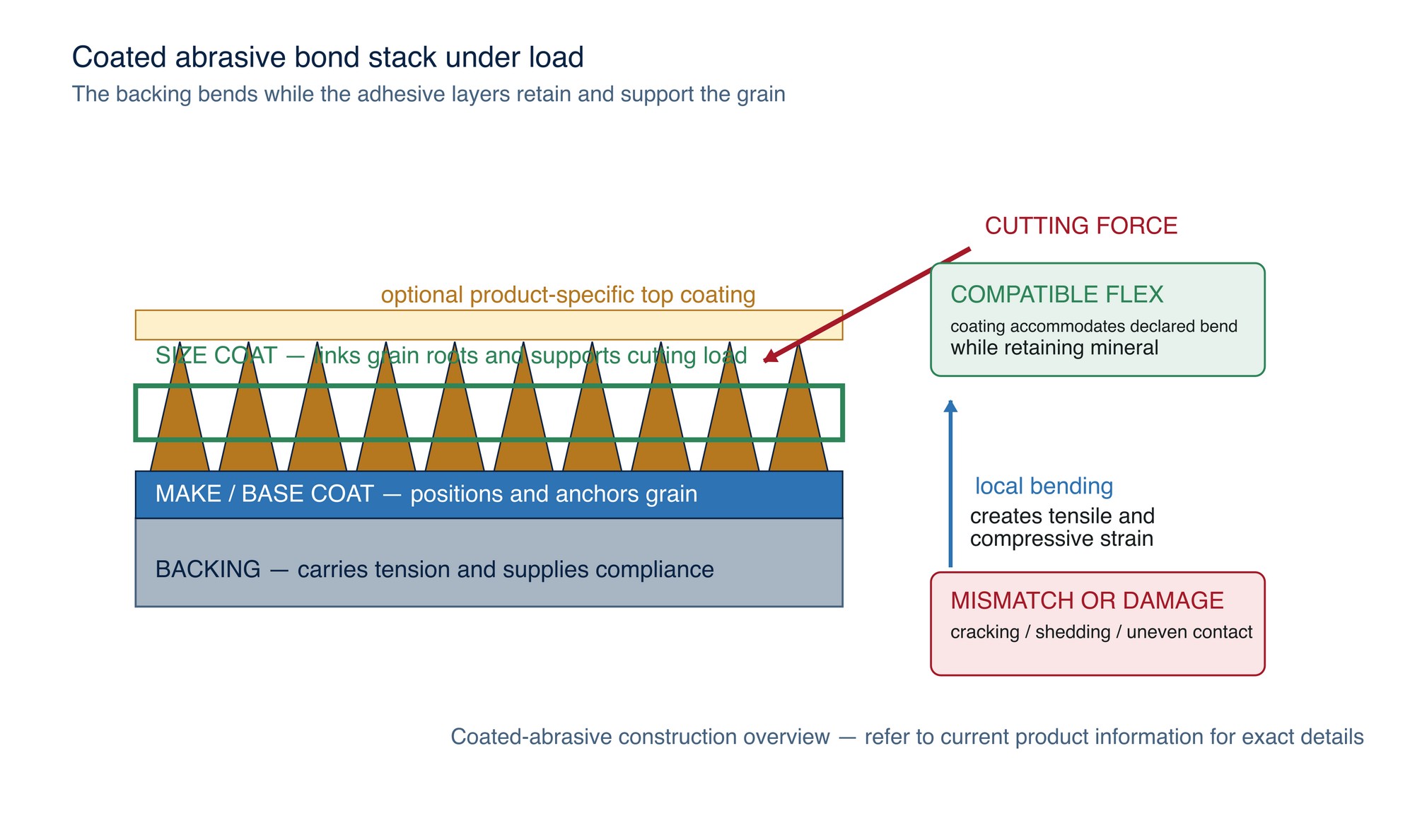
In a coated abrasive, the backing carries tensile load, bends around the tool or work, supports the mineral and transfers force from the operator or machine. The bond anchors and laterally supports the grains while accommodating the strain imposed by that backing. Neither part acts alone. A very flexible carrier with an unsuitable brittle coating can shed or crack; a tough bond on a damaged or poorly supported carrier still cannot provide a stable cutting face.
Common coated-abrasive backings include paper, cloth, plastic film, vulcanised fibre, foam and paper-cloth combinations. Backing selection affects grip and adhesion, stretch, tear resistance, tensile strength, flexibility and dimensional stability. The construction also separates the base coat, which positions the grain, from the size coat, which bonds grains to each other and to the backing. [S044]
The practical rule is to read four fields together: backing material, backing weight or flexibility treatment, bond system, and required support.
Identification before comparison
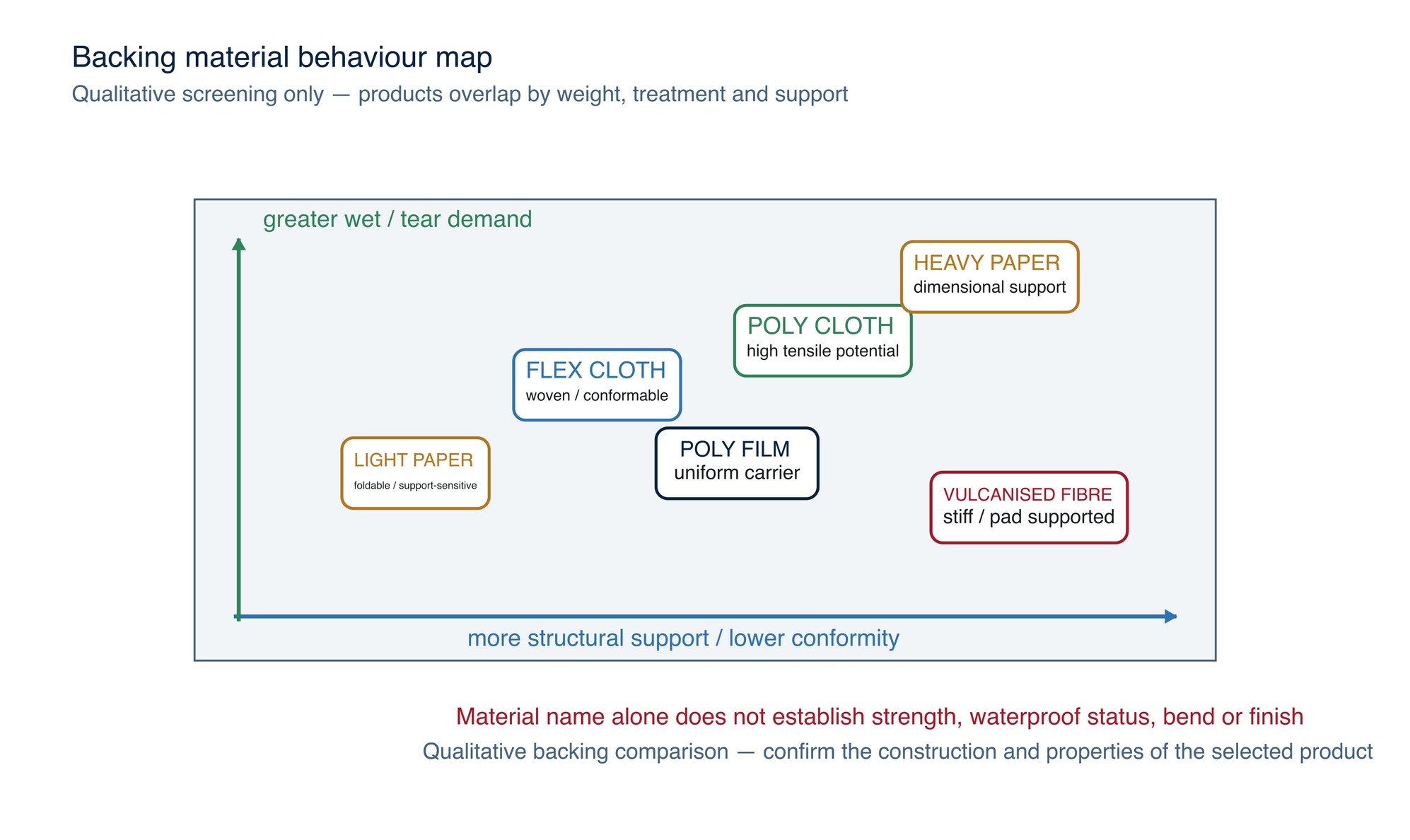
Backing labels are families, not complete specifications. Paper letters, cloth weight codes, film thicknesses and proprietary flexibility suffixes vary by supplier and product line. They are useful only when tied to the current manufacturer record.
Before comparing products, record:
- backing material and declared weight, thickness or flex treatment;
- fibre composition where the backing is cloth;
- base or make-coat chemistry and size-coat chemistry where declared;
- wet-or-dry approval and permitted liquid;
- coating density, top coating and attachment layer;
- product form, dimensions, direction, joint or edge construction;
- required pad, contact wheel, platen, block or other support; and
- storage limits, rated speed and inspection criteria.
Do not translate one manufacturer's A, J, X, Y or film designation into another manufacturer's product without confirmation. A familiar letter can describe a relative weight within one convention, but it does not establish tensile strength, waterproof status, joint design, bond flexibility or safe machine use.
Paper backings
Paper provides a broad range of weights and can be cut, folded and converted economically. Lighter papers are typically more conformable and suitable for hand sheets or supported discs; heavier papers provide more dimensional support and can be used in selected belt constructions. Lettered paper-weight systems are manufacturer and product-family conventions rather than a universal performance code; work shape, moisture, belt dimensions and grade must be checked for the selected product. [S050]
A lighter paper can improve feel on a shaped hand block or supported finishing disc, but edge contact, creasing and local overstress can initiate a tear. A heavier paper can improve support and resist deformation, but it does not become cloth and may still kink or split if forced around a contour.
Paper is not automatically dry-only or waterproof. A paper abrasive may be suitable for wet use only when the complete backing, bond, coating and attachment system is expressly declared for that duty. Never infer wet-use suitability from paper weight or appearance alone. [S053]
Cloth and polyester backings
Cloth is a woven carrier. Fibre type, yarn, weave, weight, finishing treatment and flexing process all affect tensile behaviour, stretch, edge response and conformability. Lettered cloth-weight families and flex treatments vary by manufacturer, so the complete backing and bond description must be read rather than interpreting one letter in isolation. [S050; S054]
A lighter or flex-treated cloth can wrap a contour and maintain contact where a stiff sheet would bridge. A heavier cloth can stabilise a belt or resist tearing under higher mechanical demand, but increased strength often comes with reduced conformability. The weave can also print through under unsuitable support or pressure, so cloth does not guarantee a finer finish than paper or film.
Polyester can appear as woven cloth or as a continuous film. In cloth form it is commonly selected where high tensile demand, moisture resistance or wet processing is declared. A moisture-resistant carrier does not automatically approve the adhesive system, belt joint, attachment or machine for wet operation; the complete product must carry the required declaration. [S050]
Film backings
Film is a continuous polymer carrier rather than a woven fabric or paper network. Its uniform thickness and surface can support even grain presentation and consistent finishing, while its tear behaviour differs from paper because there is no paper-fibre network. Thickness, polymer, coating, perforation and attachment still matter.
Film backings can provide a uniform surface, controlled thickness, flexibility and tear resistance for selected contour-finishing and precision-finishing duties. Thickness and wet-or-dry status are product-specific fields and must be verified on the exact product. [S052]
Do not generalise that example into “film is always best.” A thin film can be cut by a sharp edge, a perforated film can initiate a tear at a damaged hole, and an unsupported film can wrinkle or concentrate pressure. Film also changes the operator's feedback because its smooth, dimensionally stable carrier can transmit tool motion differently from a soft paper or cloth.
Vulcanised-fibre backings
Vulcanised fibre is a dense, chemically consolidated cellulose-based sheet used where a stiff, strong carrier is required, notably in fibre discs. It is formed by consolidating cellulose-based plies through controlled chemical, heat and pressure processes. [S044; S050]
The fibre backing distributes load over a compatible backing pad. It is not a self-supporting grinding wheel. Moisture, cupping, edge cracks, an incorrect pad profile, incomplete seating or pad damage changes the support condition and can overload the disc. Verify the exact disc format and attachment rather than selecting by diameter alone. [S047]
Base coat, size coat and bond system
The first adhesive layer is commonly called the base coat or make coat. It holds the grain in the required position while the abrasive layer is formed. The size coat covers and links the grain roots, supporting grains against cutting force and binding the abrasive layer to the carrier. Some constructions add a further top coating for loading, heat or friction control. [S044; S050]
Resin-over-resin systems
“Resin-over-resin” commonly means resin is used for both the make and size functions. Phenolic or other thermosetting resin systems can provide heat resistance and strong grain support, but resin type, cure, filler, coating weight and flexibility treatment are product-specific. Tougher binder systems generally provide firmer grain support, while the delivered cutting action and durability still depend on the complete construction and application. [S044; S050]
This does not mean the hardest bond is always preferable. A bond that is too rigid for the backing's bend radius or the work contour can crack, shed mineral or create an uneven contact pattern. “Resin-over-resin” is therefore an architecture label, not a universal ranking.
Glue-containing systems
Traditional glue systems generally soften more readily with heat and moisture than thermosetting resin systems. Their more cushioning response can suit selected finishing duties, but heat resistance, aggressiveness and service life depend on the complete declared construction. [S050]
Glue-containing products require disciplined storage and duty control. They must not be assumed water-resistant, high-temperature capable or interchangeable with a resin-over-resin product. A softer scratch response can be useful only when the complete product is declared for the task and retains adequate grain.
Flexible resin systems
Flexible resin is not a single chemistry. Manufacturers can modify a binder with dispersions or other formulation choices to accommodate bending while still retaining the grain. Flexibilised resin systems can therefore range from firm, high-performance constructions to highly flexible finishing products. [S044]
The correct flexibility is a balance. The coating must survive repeated bending, but must also support the grain at contact. Confirm the minimum bend, converted form, joint, product direction and intended contact element; do not manually “break in” or over-flex an unidentified abrasive.
Reinforcement systems
Reinforcement can be built into the backing or supplied by the operating interface. Examples include:
- heavier paper weight or latex impregnation;
- stronger yarn, tighter weave or polyester content in cloth;
- paper-cloth laminates or polymer film;
- chemical consolidation into vulcanised fibre;
- a belt joint and edge treatment designed for the declared running direction;
- a disc backing pad, hook-and-loop layer or pressure-sensitive adhesive; and
- a platen, contact wheel or hand block that controls local bending.
Reinforcement is not permission to misuse the product. A strong carrier can transmit a damaging load instead of tearing first. The complete construction must still be inspected and used on the declared machine and support system.
How backing and bond change the process
| Property | Construction influence | What the user must verify |
|---|---|---|
| Flexibility and operator control | Carrier thickness, weave, flex treatment and bond elasticity control how readily the product follows a contour and how concentrated contact feels | Work geometry, support hardness, permitted bend and representative trial |
| Edge durability and tear resistance | Fibre network, yarn, film continuity, impregnation, vulcanisation, holes and edge quality affect crack initiation and propagation | Edge condition, perforations, joint, pad support and snag risk |
| Water resistance | Carrier, bond, joint and attachment must all tolerate the declared liquid and exposure | Explicit wet-or-dry marking, approved liquid, machine and extraction method |
| Finish quality | Dimensional stability, grain support, carrier texture and contact compliance affect scratch uniformity and surface following | Required texture, inspection method, support and stage acceptance criterion |
| Product life | Grain retention, heat resistance, backing fatigue, loading, joint and storage condition can end service before the mineral is exhausted | Product instructions, damage limits, controlled wear record and stop criteria |
These are screening relationships, not rankings. Product life is an outcome of the complete abrasive, machine, work, environment and method. No carrier or bond family is universally longer-lived.
Storage, conditioning and moisture control
Backing and bond can respond differently to humidity. Paper, cloth and fibre backings may exchange moisture at different rates from resin or glue bonds, producing curl, bowing, loose backing, creasing, loading, premature grain loss or brittleness. Preserve original packaging, protect products from dampness and condition unpacked belts in accordance with the manufacturer instructions. [S051]
Treat storage limits as controlled product data. Do not copy one supplier's temperature, humidity or conditioning time to another product without confirmation. Quarantine distorted, damp, brittle or delaminated stock and investigate the storage environment and batch history.
Backing-and-bond selection workflow
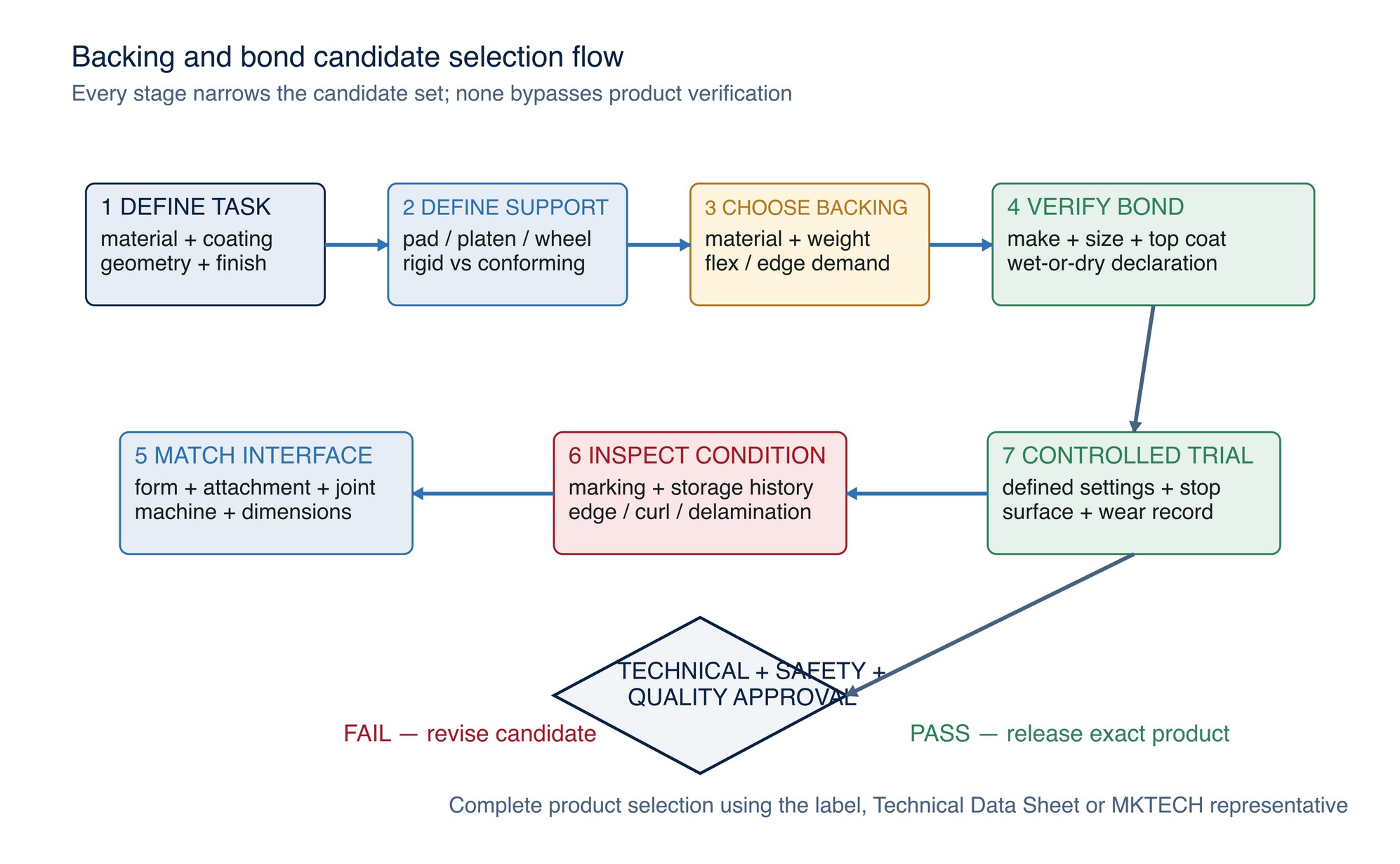
Use a controlled sequence:
- Define the action, work material, coating, geometry and required surface.
- Define the needed contact support and conformability.
- Shortlist the backing family, weight or flex treatment.
- Verify the bond system, wet-or-dry declaration and top coating.
- Match the converted form, attachment, joint, pad, platen or contact wheel.
- Check marking, rated speed, storage history and physical condition.
- Trial on representative work with defined stop and acceptance criteria.
- Record the exact product identity, result, wear and approval decision.
Common failure signals
| Observed signal | Backing-or-bond possibilities | Controlled response |
|---|---|---|
| Disc curls, cups or will not seat | Humidity change, moisture exposure, heat, storage damage or incompatible attachment | Remove from service; inspect batch, storage and support system |
| Edge tears or holes elongate | Snagging, wrong pad, insufficient edge support, excessive local load or damaged carrier | Stop; discard damaged product; correct interface before retrial |
| Grain sheds in patches | Bond cracking, overheating, moisture, contamination, excessive flex or product deterioration | Stop and quarantine; compare with current product instructions |
| Belt strikes, tracks poorly or breaks at joint | Wrong direction, joint damage, edge damage, wrong tension, alignment or conditioning | Stop machine; inspect belt and machine; do not repair for production use |
| Finish varies across the contact | Wrinkled carrier, inconsistent support, local bond damage, backing texture or uneven pressure | Stop; inspect product and support; verify on a controlled sample |
| Product loads or smears rapidly | Wrong coating or bond for the material, trapped debris, heat, contamination or exhausted product | Reassess construction and extraction; do not add pressure blindly |
The table is diagnostic screening only. A damaged abrasive is not returned to service by trimming, gluing, flattening or reconditioning unless an approved manufacturer procedure explicitly allows it.
Practical example: controlled refinement of a stainless radius
A fabricator needs to blend a formed stainless radius without flattening the profile and then produce a controlled directional pre-finish. The team does not start with a brand or grit. It first defines a flexible contact requirement, segregated stainless tooling and a visible acceptance boundary.
For the blend stage, the team shortlists a flex-treated cloth product because the carrier must survive repeated bending and maintain contact through the radius. For refinement, it trials a supported film or light paper construction because dimensional stability and even grain presentation may improve scratch uniformity. These are hypotheses, not approvals.
The trial records exact products, backing and bond declarations, support-pad hardness, machine, speed, contact method, temperature signal, wear, edge condition and surface result. The chosen sequence is released only if both stages pass the technical, safety and quality criteria. A different radius, finish, machine or product revision reopens the selection.
Selecting the backing and bond in practice
Choose the backing for the required balance of conformity, edge stability, tear resistance and dimensional control. Paper and film can support fine, consistent finishing; cloth and polyester can provide flexibility and durability; vulcanised fibre depends on correct backing-pad support. The bond system must suit the work material, heat, loading tendency, moisture exposure and required product form.
Check wet-or-dry suitability, storage conditions, belt direction and joint construction, attachment method, and the required pad, platen, contact wheel or block. Inspect edges, joints and backing condition before use. Refer to the product label, Technical Data Sheet, or MKTECH representative.
Application setup record
For repeatable work, record the material and coating, geometry, required finish, abrasive identity, backing family and weight, bond system, product form, attachment, machine, support element, dimensions, rated speed, wet-or-dry status, storage condition, process setting, observed condition and inspection result.
Abrasive Product Selection Matrix
The selection matrix grid appears on the following page of the printed handbook (page 74), outside this chapter extract.