
Production engineers, supervisors, operators, QA/QC personnel, maintenance teams, coating applicators, safety personnel, procurement staff and technical sales personnel
Practical surface preparation for industrial painting and coating on new work, maintenance work and repaired areas, with particular attention to Malaysian heat, humidity, condensation and contamination risks.
Use only abrasive products, tools, machines, hoses, nozzles, guards and attachments intended for the task. Treat unknown legacy coating as a potential hazardous-material source until properly assessed. Control combustible dust, ignition sources and mixed-metal residues through the workplace risk assessment. Follow current Malaysian workplace requirements, the machine instructions and the coating and abrasive product information. [S032; S145; S146]
Core principle — A surface is ready for coating only when its substrate condition, cleanliness, profile, dryness and environmental condition all meet the selected coating system and project requirement.
This chapter is an educational and application-selection guide. It explains how the preparation controls fit together so that an appropriate abrasive product, cleaning route and inspection method can be selected for the work.
Chapter objectives
After this chapter, the reader should be able to:
- define coating preparation as more than rust removal;
- identify oil, grease, corrosion, oxide, dust, moisture and soluble contamination;
- choose between hand-tool, power-tool, abrasive-blast, waterjet and controlled scuffing routes;
- distinguish visible cleanliness from surface profile;
- protect galvanized, aluminium, stainless-steel and previously coated substrates;
- manage condensation, flash rust and time-to-coat;
- complete a practical final inspection; and
- troubleshoot common preparation and early coating problems.
Coating life begins at the substrate
Paint can bridge colour differences, but it cannot reliably correct a weak, oily, dusty, damp or unstable surface beneath it. Preparation must therefore create a sound interface for the complete coating system. The required result depends on the substrate, existing coating, corrosion condition, service exposure, coating chemistry, application method and project specification. [S113; S139]
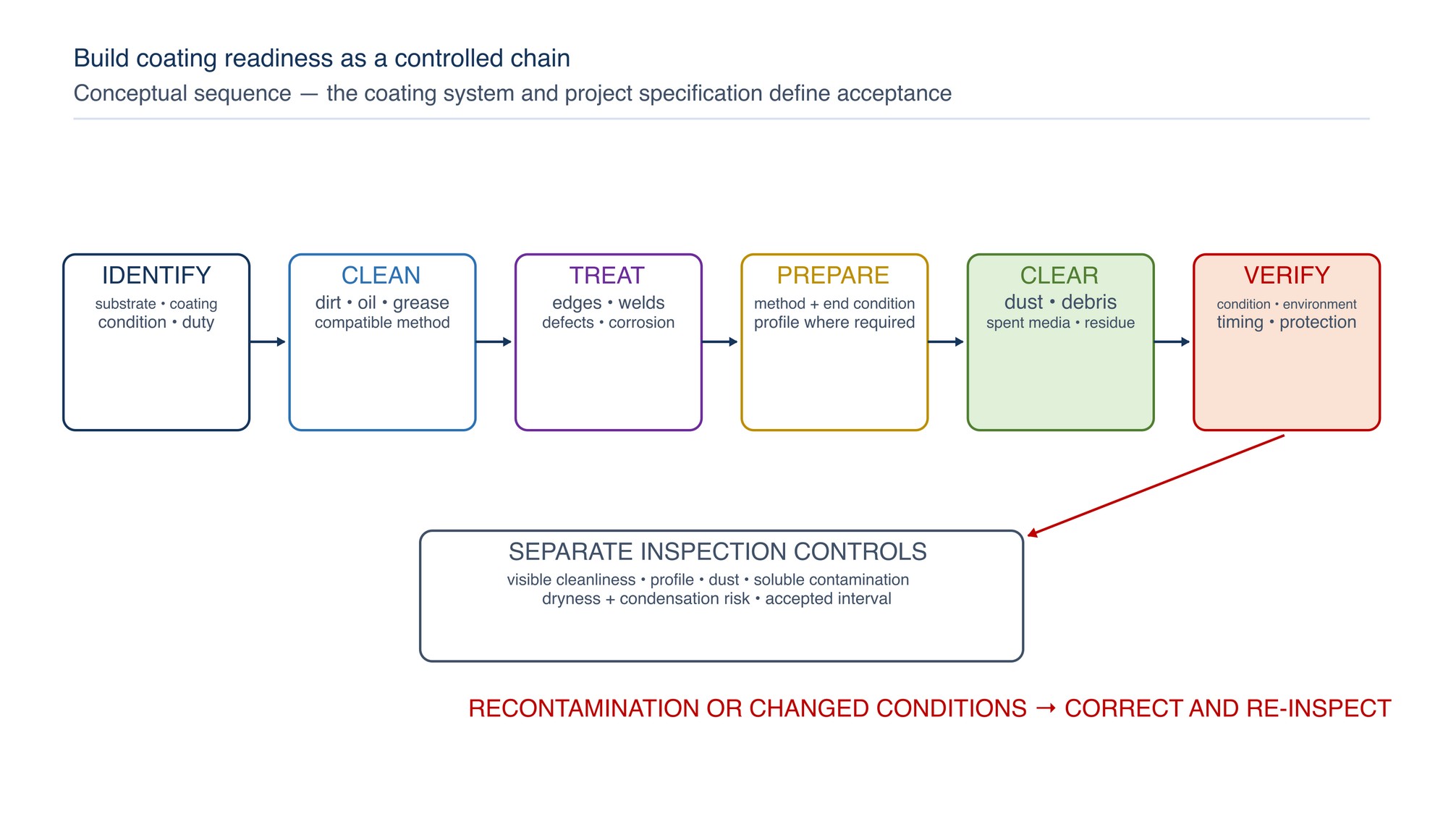
Surface readiness has five linked controls:
- sound substrate — defects, sharp features and weak material are treated as required;
- cleanliness — oil, grease, dirt, corrosion products, weak coating and residues are removed;
- profile — the texture is suitable for the selected coating system;
- dryness and environment — condensation and recontamination are controlled; and
- inspection and timing — the accepted surface is coated within the permitted condition and interval.
Define the complete preparation requirement
Before selecting an abrasive or machine, establish what the coating system requires. A preparation grade identifies a defined condition, not a complete product recommendation. Different steel surfaces and existing finishes can require different preparation routes, and non-carbon-steel substrates need their own controls. [S111; S136; S139]
| Preparation input | Why it matters | Practical question |
|---|---|---|
| Substrate | Steel, galvanized steel, aluminium, stainless steel and previously coated surfaces respond differently | What material and surface treatment are actually present? |
| Existing condition | Mill scale, rust, oxide, old coating, repair edges and fabrication defects require different work | What must be removed, retained or repaired? |
| Coating system | Primer chemistry and total system determine acceptable cleanliness, texture and substrate condition | What preparation does the coating manufacturer specify? |
| Service environment | Immersion, chemical exposure, weathering, heat, hygiene or appearance can change the required control | What duty must the completed system withstand? |
| Inspection standard | Visual grade, profile method, dust test and soluble-salt assessment answer different questions | Which standard, revision and acceptance criterion apply? |
| Application window | Humidity, condensation, flash rust, dust and delay can change the prepared surface | How will the surface be protected and released for coating? |
Where the exact product requirement is needed, Refer to the product label, Technical Data Sheet, or MKTECH representative.
Identify the substrate and existing coating
Begin with the actual surface rather than its apparent colour. Determine whether the work is bare carbon steel, alloy steel, galvanized or zinc-coated steel, aluminium, stainless steel, thermally sprayed metal, shop-primed steel or an existing paint system. ISO 12944-4 recognises that these surface types require distinct preparation considerations. [S139]
On maintenance work, identify the existing coating system and its condition before disturbing it. Old industrial coatings can contain hazardous metals or other substances that become airborne during sanding, grinding, needle-gunning or blasting.
Work planning must cover material identification, containment, extraction, waste handling, hygiene and suitable personal protective equipment. [S026; S145; S146]
Inspect edges, welds, spatter, laminations, pits, burrs and surface imperfections. Coating tends to pull thin over sharp features and can leave inaccessible contamination around weld details. ISO 8501-3 provides preparation grades for visible weld, edge and other steel-surface imperfections before coating. [S136]
Clean and degrease before mechanical preparation
Oil and grease can be driven into the surface, spread across a larger area or transferred to abrasive media if mechanical preparation starts first. The cleaning step should remove visible oil, grease and other specified contaminants without leaving an incompatible residue. AMPP SSPC-SP 1 defines solvent cleaning by its end condition rather than by one universal solvent. [S140]
Use this practical sequence:
- remove loose dirt and gross deposits;
- select a cleaner compatible with the substrate, existing coating and next process;
- lift contamination away with clean materials rather than redistributing it;
- rinse or remove cleaner residue where the method requires it;
- allow the surface to dry; and
- re-inspect before abrasive or mechanical work begins.
Replace contaminated wipes, brushes, pads and cleaning solution before they become transfer sources. Keep clean and dirty materials separate. Compressed air used for cleaning or blasting must not introduce oil or moisture. [S147]
Treat defects, corrosion and oxide deliberately
Preparation must remove the material specified by the coating system while preserving sound substrate. Loose rust, scale and failed coating are obvious targets, but pits, crevices, weld toes and edges require deliberate access and inspection. A broad clean appearance can hide residual corrosion deep in a pit.
For carbon steel, the specification may call for a visual preparation grade reached by abrasive blasting, hand or power tools, or another defined route. ISO 8501-1 provides written and photographic grades for relevant steel surfaces, while ISO 8504-3 describes hand- and power-tool cleaning methods. [S111; S138]
For stainless steel, aluminium and galvanized surfaces, avoid applying carbon-steel assumptions. Use dedicated, compatible tools and abrasives where contamination matters. Protect intact zinc and thin metal coatings from unnecessary removal. Brush-off blasting for non-ferrous metals, galvanized steel and stainless steel has distinct substrate considerations. [S021; S125; S144]
Select the preparation method by required outcome
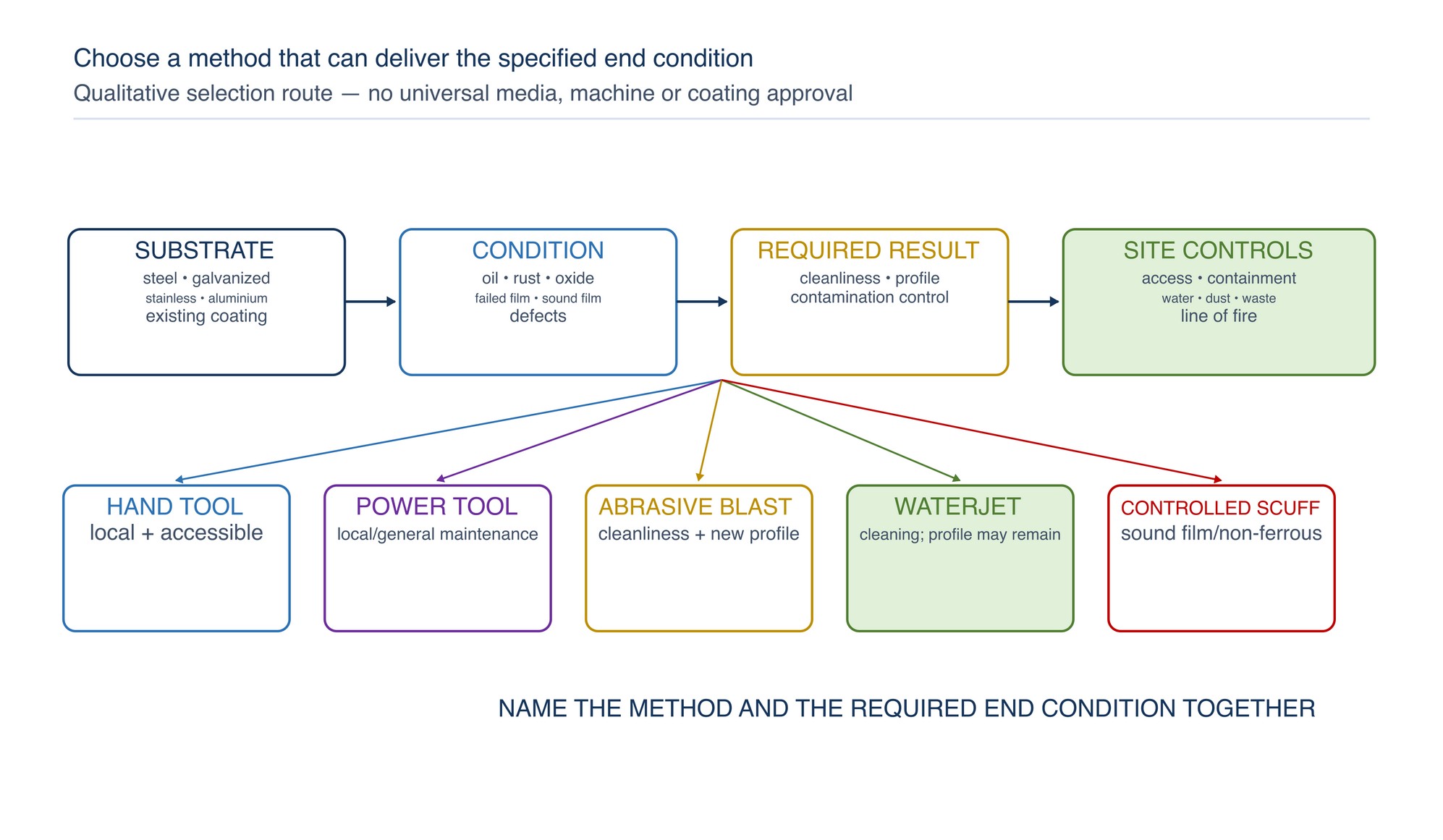
Choose the method capable of achieving the specified cleanliness and profile without unacceptable substrate damage, contamination or environmental risk.
| Method | Best suited to | Principal strengths | Main limitations and checks |
|---|---|---|---|
| Hand-tool cleaning | Local maintenance, light loose material and restricted access | Simple access and controlled local work | Limited production rate and ability to remove tightly adherent material; inspect crevices and pits |
| Power-tool cleaning | Local or general maintenance where blasting is impractical | Greater removal rate; varied brushes, discs and specialised tools | Can polish, smear, groove or leave an unsuitable profile if the tool and method are mismatched |
| Abrasive blast cleaning | Broad steel areas requiring defined cleanliness and profile | Removes corrosion and coating while generating a controllable blast profile | Requires compatible media, clean dry air, containment, dust control and profile verification |
| Waterjet cleaning | Coating and corrosion removal where waterjetting is specified | Can remove coatings and contamination without an abrasive-blast profile | Existing profile may remain; flash rust, water quality, runoff and coating compatibility require control |
| Controlled abrasion or scuffing | Sound existing coating, non-ferrous substrate or local preparation where specified | Creates a key, removes gloss and blends repair boundaries | Does not by itself prove removal of oil, salts, dust, moisture or weak underlying material |
AMPP publishes distinct cleanliness standards for blast cleaning and waterjet cleaning, confirming that the method and specified end condition must be named together. [S141; S143]
Visible cleanliness and surface profile are different
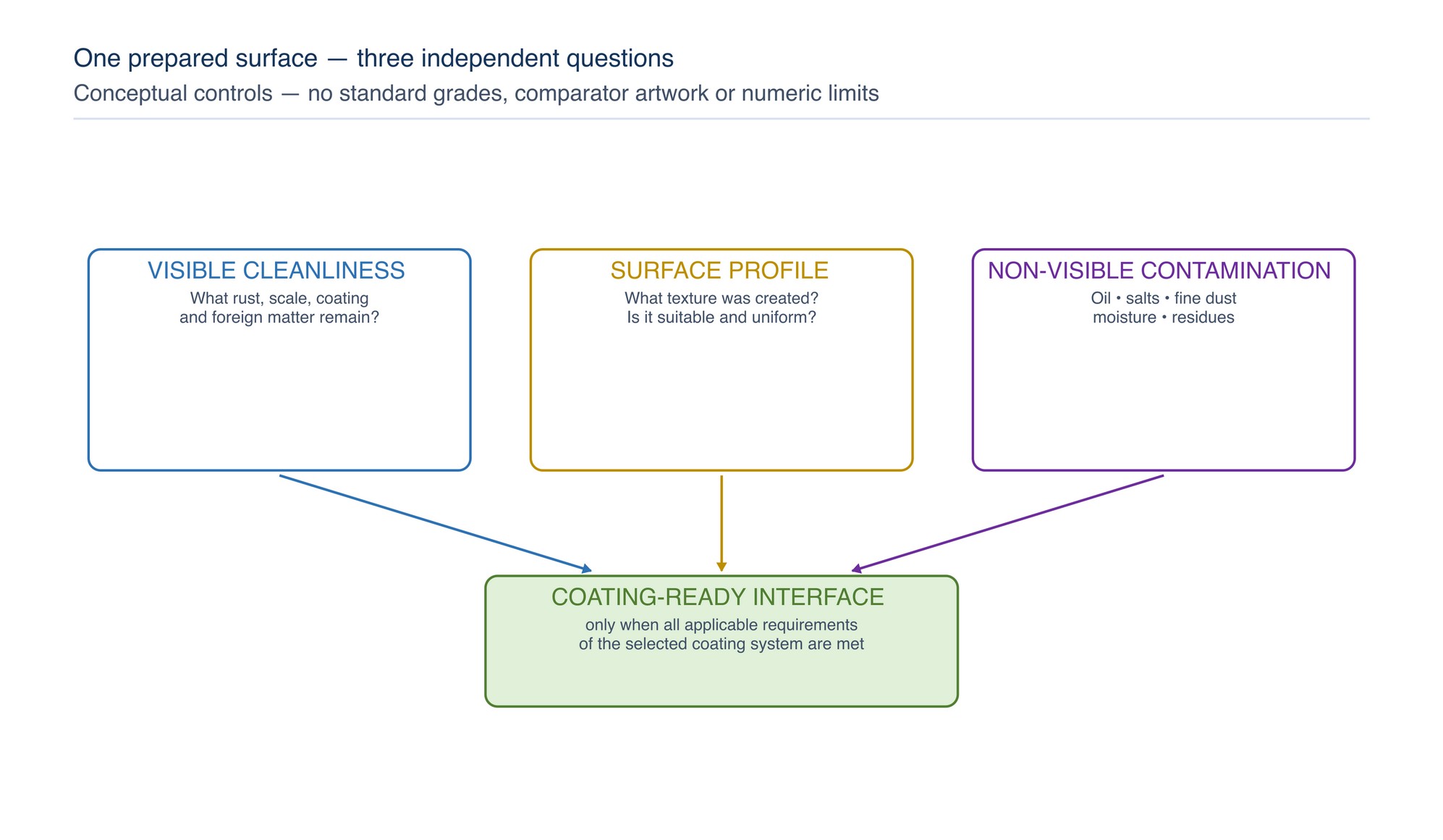
Visible cleanliness describes the extent to which visible rust, mill scale, coating and foreign matter have been removed under the stated assessment method. Surface profile describes the texture produced on the substrate. One does not prove the other. [S111–S113]
A surface can be visibly clean yet too smooth for the coating, or it can have a pronounced profile while still carrying dust, oil or soluble salts. Likewise, ISO 8501 photographs are not profile comparators, and a roughness value from general machining metrology is not automatically the coating system's required blast-profile result.
Control the surface profile
The profile provides a textured interface for the coating, but deeper is not universally better. A profile that is too low may give inadequate mechanical key for the selected system. A profile that is too high may leave peaks insufficiently covered, increase coating demand or create local weak points. The acceptable range belongs to the coating system and project specification.
Profile is influenced by substrate hardness, preparation method, abrasive type and size, impact condition, tool geometry, wear state and technique. Do not attempt to control it by abrasive label alone.
Use the inspection method named in the specification. ISO 8503-1 addresses comparator assessment for abrasive blast-cleaned steel; AMPP SSPC-PA 17 describes procedures for assessing conformance to a specified steel profile range using several recognised measurement approaches. [S112; S142]
Refer to the product label, Technical Data Sheet, or MKTECH representative.
Remove dust and preparation debris
Dust can block intimate coating contact, absorb moisture and collect in pits, welds and horizontal ledges. Remove spent abrasive, corrosion residue, loose coating, swarf and cleaning debris after preparation. Work from clean areas toward collection points and prevent settled dust from returning to accepted surfaces.
Visual inspection alone may not reveal the amount or size of fine particulate. ISO 8502-3 describes a pressure-sensitive tape method for assessing dust remaining on cleaned steel surfaces prepared for painting. It provides ratings for dust quantity and descriptive classes for particle size. Use the method and acceptance level specified for the job. [S134]
Control soluble salts and other non-visible contamination
Chlorides and other water-soluble salts can remain after a surface looks clean. Under a coating, they can attract moisture and contribute to osmotic blistering, underfilm corrosion or early loss of adhesion. Their importance depends on the substrate, exposure and coating system.
Where the specification requires testing, use the stated extraction, measurement, locations and acceptance criteria. ISO 8502-9 describes field conductometric assessment of the surface density of various water-soluble salts on steel; it does not identify individual salt species. [S135]
Do not treat conductivity, chloride concentration or a single field result as interchangeable measures. Record the method, units, area, instrument and surface condition used by the governing inspection plan.
Manage moisture, condensation and flash rust
In Malaysian industrial conditions, a steel surface can be below the local dew point even when the air feels warm. Condensation may be visible, microscopic or intermittent as weather, ventilation and substrate temperature change. ISO 8502-4 provides guidance for estimating the probability of condensation before paint application. [S137]
Measure the conditions at the work surface, not at a distant office or weather station. Continue monitoring when conditions can change. Protect prepared work from rain, wash water, process vapour, compressor moisture, wet floors and overnight cooling.
Water-cleaned or waterjetted steel may develop flash rust. Its permitted condition depends on the waterjet cleanliness requirement and the coating system. Do not remove, accept or coat over flash rust solely by colour judgement. Confirm the permitted condition and time-to-coat from the governing coating information. [S141]
Respect coating compatibility and overcoating windows
A sound existing coating may be retained only when the new system permits it and the retained film is clean, dry, firmly adherent and suitably prepared. Feather repair edges to remove weak transitions without exposing or thinning adjacent protection unnecessarily. Check that cleaners, abrasive residues and dust-removal methods are compatible with both retained and new coatings.
On galvanized steel, aluminium, stainless steel and thermally sprayed metal, preparation must balance adhesion with preservation of the substrate or metallic layer. A method suitable for heavy carbon-steel rust removal can be too aggressive or contaminating for these surfaces. [S139; S144]
Observe the preparation-to-coating and intercoat windows stated for the coating system. Re-inspect any surface exposed to dust, moisture, handling, salts or delay. Coating manufacturer guidance commonly requires a sound, clean, dry and contaminant-free surface, with preparation and atmospheric controls read together with the relevant TDS and SDS. [S147]
Final inspection and coating-release gate
Release the surface only after all applicable checks are satisfactory.
| Inspection point | Confirm | Typical instrument or method |
|---|---|---|
| Substrate and repair condition | Required defects, edges, welds and damaged areas have been treated | Visual and tactile inspection; drawing or repair specification |
| Visible cleanliness | Specified rust, scale, old coating and foreign matter have been removed | Named visual preparation standard and reference |
| Surface profile | Texture is within the specified range and uniformly produced where required | Named comparator or measurement method |
| Dust and loose residue | Prepared surface, pits, ledges and welds are acceptably free of particulate | Visual inspection and specified dust assessment |
| Oil and grease | No visible or otherwise specified contamination remains | Specified cleaning and inspection method |
| Soluble contamination | Required locations and results meet the stated criterion | Specified extraction and measurement method |
| Dryness and environment | Surface is dry and application conditions meet coating requirements | Surface temperature, air condition and dew-point assessment |
| Time and protection | Surface remains accepted at coating start | Time record, area identification and final re-inspection |
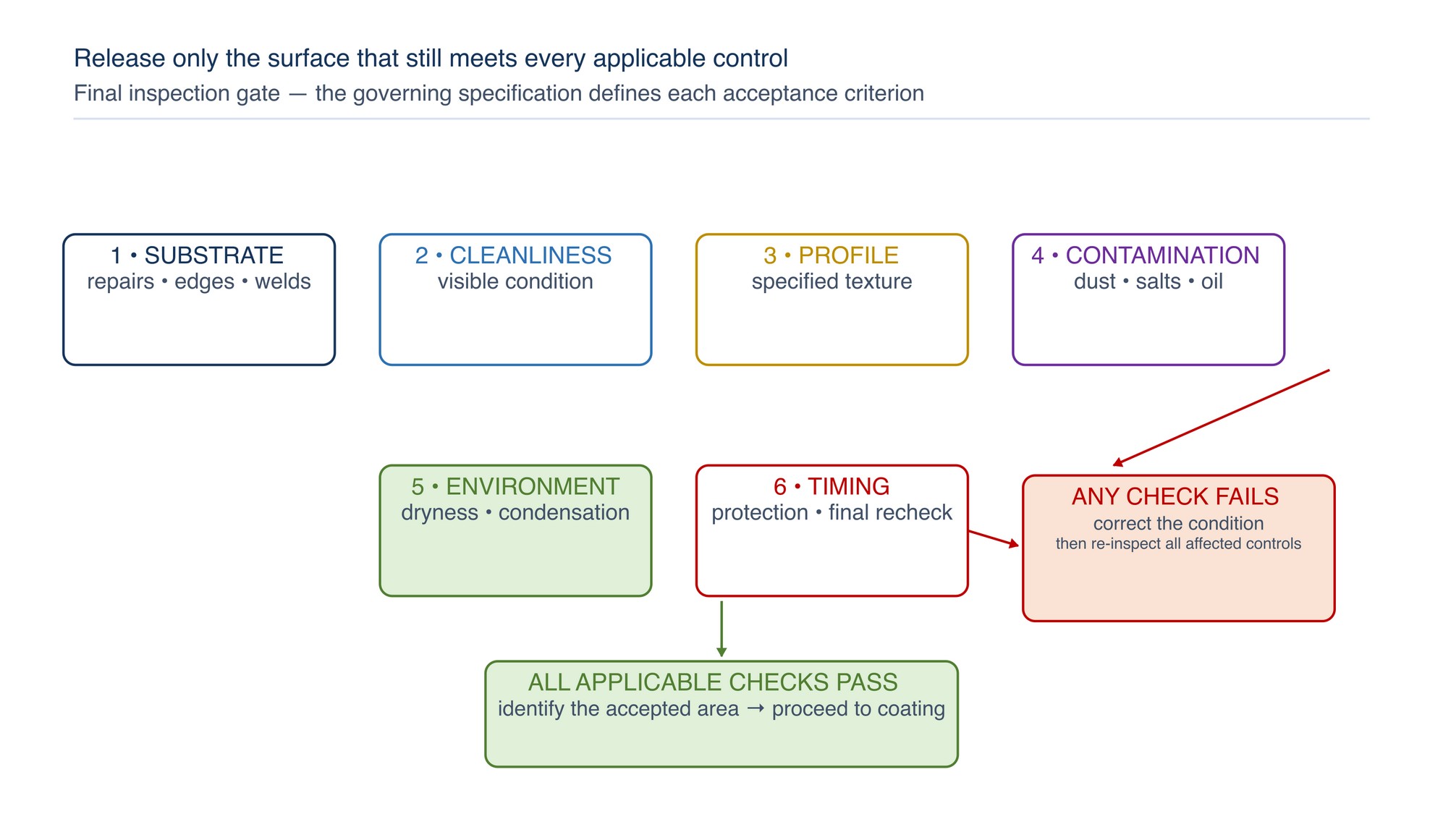
Troubleshooting surface preparation
| Symptom | Likely process cause | Practical correction |
|---|---|---|
| Oil smears or fisheyes appear during preparation | Degreasing was incomplete; contaminated wipes, air or abrasives redistributed oil | Stop, isolate the source, clean with compatible fresh materials and re-prepare the affected zone |
| Rust or coating remains in pits and weld details | Access or method is inadequate; broad-face appearance was accepted too early | Change the access tool or specified method and inspect recesses separately |
| Surface is bright but coating key is uncertain | Tool polished or burnished the surface; profile was not verified | Use the specified preparation route and measure or compare the resulting profile |
| Deep grooves or rounded edges develop | Tool contact is too concentrated, aggressive or poorly supported | Change product form or support, restore controlled motion and protect critical geometry |
| Dust returns after cleaning | Extraction, enclosure or cleaning sequence is ineffective | Clean from source to collection, improve containment and re-inspect immediately before coating |
| Soluble contamination remains | Washing or extraction is ineffective; contaminated water or environment is high reintroducing salts | Correct the source and repeat the specified cleaning and test sequence |
| Flash rust forms before coating | Water remains, humidity or condensation is uncontrolled, or delay is excessive | Restore dry controlled conditions and prepare to the coating system's permitted condition |
| Prepared steel darkens overnight | Condensation, airborne contamination or early corrosion has altered the surface | Re-inspect all acceptance points and restore the required condition before coating |
| New coating lifts from retained paint | Existing film was weak, incompatible, contaminated or inadequately keyed | Remove unsound material and prepare the retained boundary to the coating system requirement |
| Early blistering or underfilm corrosion occurs | Moisture, salts, dust, poor profile or hidden corrosion remained at application | Trace the failure by location and layer, then correct cleaning, testing, profile and environmental controls |
Concise safety reminders
- Identify the substrate, old coating and contamination hazards before disturbing the surface.
- Contain and extract dust, spent abrasive, paint debris, rust and contaminated wash water.
- Treat unknown legacy coating as a potential hazardous-material source until properly assessed.
- Use only abrasive products, tools, machines, hoses, nozzles, guards and attachments intended for the task.
- Secure the work and control sparks, ricochet, high-pressure water, flying debris, noise and line of fire.
- Keep blasting air clean and dry; inspect hoses, couplings, deadman controls and containment before work.
- Select eye, face, hearing, respiratory, hand, body and foot protection for the complete exposure.
- Segregate stainless-steel and non-ferrous tools where cross-contamination matters.
- Control combustible dust, ignition sources and mixed-metal residues through the workplace risk assessment.
- Isolate energy and depressurise equipment before cleaning, changing, clearing or inspecting it.
- Follow current Malaysian workplace requirements, the machine instructions and the coating and abrasive product information. [S032; S145; S146]
Practical application sequence
- Identify the substrate, existing coating, contamination, defects and service environment.
- Confirm the coating system's required preparation grade, profile, tests, environment and application window.
- Establish containment, access, work support, extraction, waste controls and PPE.
- Remove dirt, oil and grease using a compatible cleaning method.
- Treat welds, edges, burrs and other specified surface imperfections.
- Select and confirm the preparation method, abrasive family, machine and attachment.
- Prepare the surface without unacceptable grooving, polishing, contamination or geometry loss.
- Remove dust, spent abrasive and all preparation debris.
- Assess visible cleanliness and surface profile as separate controls.
- Test dust and soluble contamination where specified.
- Verify that the surface is dry and environmental conditions are suitable.
- Protect the accepted area from handling, moisture, dust and delay.
- Complete the final inspection and release the identified area for coating.
- Re-inspect whenever conditions change or the permitted preparation-to-coating interval is exceeded.
Polishing Fundamentals
The Polishing Fundamentals chapter begins on the following page of the printed handbook (page 220), outside this chapter extract.