
Fabricators, welders, maintenance teams, production supervisors, quality personnel, safety and environmental personnel and technical sales personnel
Practical selection and control of stainless-steel cleaning, decontamination, pickling, passivation, electrochemical cleaning and electropolishing.
Stainless surface treatment can combine corrosive chemicals, hydrofluoric-acid hazards in some pickling products, fumes, splashes, electrical energy, heated surfaces, pressurised rinsing and confined geometry. Establish the controls before work starts. Do not formulate or mix a pickling product in the workshop. Use the supplied system only on compatible alloys and surfaces, with the specified application equipment, ventilation, exposure controls, first-aid readiness, rinsing and waste arrangements. Stop work if ventilation, containment, PPE, emergency equipment or rinse recovery is not ready.
Core principle - A bright surface is not automatically clean, passive or corrosion-ready. Identify the contamination and fabrication history, preserve the specified finish, select the correct treatment family and verify the property that matters.
Stainless steel depends on a thin chromium-rich passive surface for corrosion resistance. This film can reform naturally on a clean surface exposed to oxygen, but fabrication can leave oil, heat tint, oxide scale, embedded iron, abrasive residue or smeared metal that obstructs or undermines the intended condition. Cleaning, pickling and passivation have different purposes and must not be treated as interchangeable workshop terms. [S212; S213; S217]
Chapter objectives
After this chapter, the reader should be able to:
- distinguish soil, free-iron contamination, rust staining, heat tint, scale and finish damage;
- prevent carbon-steel transfer during fabrication, handling and storage;
- separate cleaning, decontamination, pickling, passivation and electropolishing;
- select a treatment family from alloy, geometry, finish and service duty;
- preserve brushed, satin, polished and functional surfaces;
- control rinsing, drainage, drying and protected handling;
- select verification methods for visible condition, soil, free iron, staining and finish;
- recognise corrosive-chemical, electrical, fume, splash and confined-space hazards;
- route spent treatment solution, rinsate, sludge and contaminated materials correctly; and
- troubleshoot rust bloom, uneven colour, etching, residue and recurring contamination.
Understand the stainless surface
Stainless steel is corrosion resistant because sufficient chromium in the alloy supports formation of a thin passive oxide film. The film is not a thick coating and cannot be judged reliably by brightness or colour alone. A clean stainless surface can self-passivate in air or aerated water, while chemical passivation is a controlled treatment used where the governing specification requires it. [S213; S217]
The base alloy still controls the attainable corrosion resistance. Cleaning cannot upgrade an unsuitable grade, restore metal lost to pitting or compensate for damaging service conditions. Surface treatment can remove contamination and affected surface material; it does not change the bulk alloy.
Identify the actual surface condition
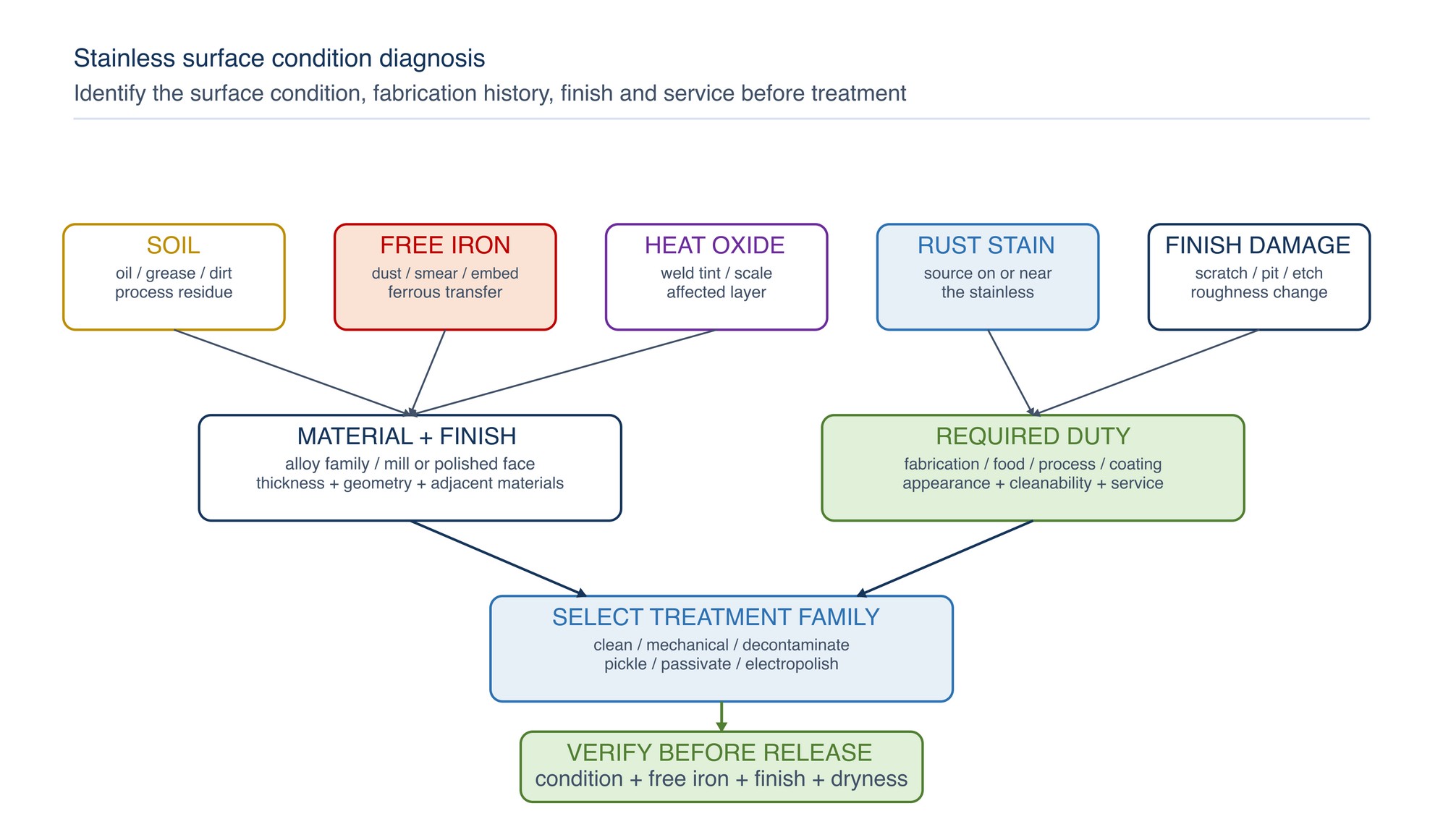
Start with the visible condition, fabrication history, alloy family, finish and intended service.
| Surface condition | Typical origin | Treatment implication | Important distinction |
|---|---|---|---|
| Oil, grease or shop soil | Forming, machining, handling, maintenance or storage | Preclean with a compatible cleaner and rinse or wipe as specified | Acid treatment is not a substitute for degreasing |
| Loose dirt and embedded iron | Nearby carbon-steel work, dirty tables, lifting gear or poor housekeeping | Remove without spreading; inspect for embedded particles and rust marks | Loose iron or grinding dust are different conditions |
| Embedded or smeared iron | Shared tools, steel brushes, contaminated abrasives, clamps or rollers | Decontaminate using a finish-compatible route | Mechanical brightness does not prove iron removal |
| Heat tint and weld oxide | Welding, heat treatment or inadequate shielding | Remove oxide and the affected surface layer where required | Passivation alone is not a descaling process |
| Rust staining | Corroding transferred iron, external run-off or service deposit | Identify the source before cleaning the stain | Staining can originate above or beside the observed area |
| Surface damage or pitting | Aggressive abrasion, chemical attack, chloride exposure or service corrosion | Assess geometry and remaining condition before restoration | Cleaning does not replace an integrity assessment |
Examine welds, heat-affected zones, crevices, drain points, tube interiors, fastener interfaces and shadowed faces. Rust colour on stainless steel may come from transferred carbon steel, external run-off, contaminated water or corrosion of the stainless itself. Treating the colour without finding the source often produces recurrence.
Prevent contamination before it requires removal
Prevention is usually more controllable than restoration. Segregate stainless work from carbon-steel grinding and cutting where practical. Use clean dedicated brushes, abrasives, blasting media, racks, slings, clamps and handling surfaces. Protect sheet and finished parts from floors, traffic, ferrous strapping and dirty storage supports. [S214; S220; S221]
Good fabrication controls include:
- identifying stainless-only tools and storage positions;
- cleaning worktables, rolls, clamps and lifting contact points;
- removing carbon-steel grinding dust before it settles on stainless work;
- keeping abrasive products dry, clean and separated by material family;
- protecting finished faces during transport and assembly;
- using compatible markers, tapes, lubricants and temporary coverings; and
- preventing dirty gloves, rags or racks from recontaminating a cleaned part.
Dedicated does not mean permanently clean. A stainless-only tool can still carry oil, chloride, abrasive residue or damaged bristles and must be inspected before use.
Preclean before chemical or electrochemical treatment
Oil and grease can shield metal and oxide from uniform treatment. Remove interfering soil before pickling, passivation or electropolishing using a cleaner compatible with the alloy, finish, seals and downstream process. Chapter 037 explains cleaner-family selection in detail. ASTM A380/A380M treats cleaning and precleaning as integral to controlled stainless surface treatment. [S212]
Control the whole clean-rinse-dry sequence. Avoid merely moving soil from an open face into a lap, tube, threaded hole or crevice. Where exact cleaner chemistry, dilution, temperature, contact time or compatibility is required, Refer to the product label, Technical Data Sheet, or MKTECH representative.
After precleaning, use clean handling. Fingerprints, dirty rinse fixtures or a contaminated workbench can defeat the next operation.
Control free-iron contamination
Free iron can rust on the stainless surface and create local staining. Common pathways include shared carbon-steel brushes, previously used abrasive media, steel shot, dirty handling equipment, ferrous grinding dust and contact with corroding supports. [S220; S221]
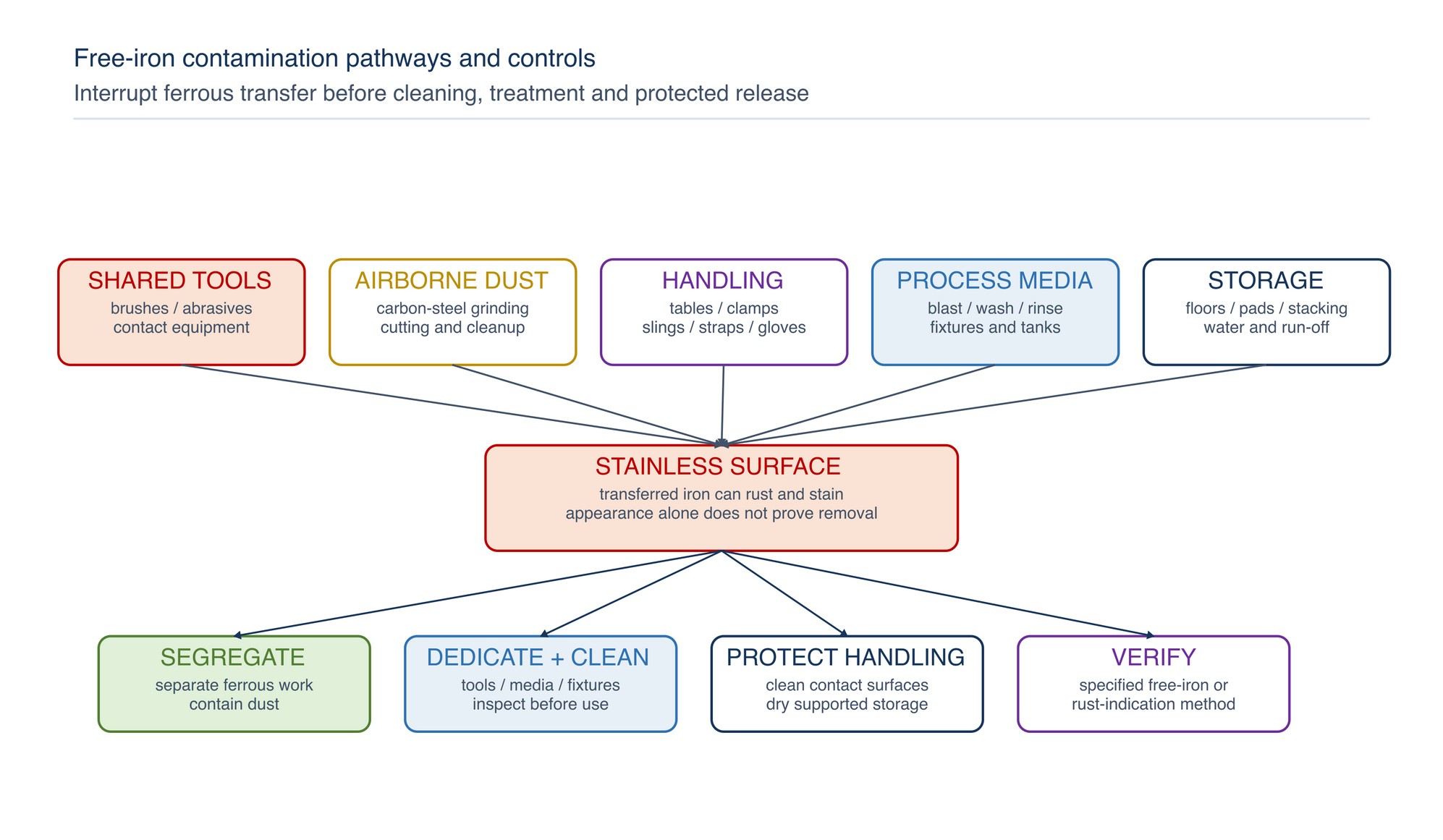
| Transfer pathway | Warning sign | Practical control |
|---|---|---|
| Shared wire brush or abrasive | Rust specks follow tool marks or local dressing | Use a clean compatible tool reserved for stainless work |
| Carbon-steel grinding nearby | Fine orange bloom appears over broad exposed faces | Separate work or contain and remove ferrous dust at source |
| Tables, rolls, clamps or slings | Marks repeat at contact points | Clean, cover or change the contact material |
| Reused blast media | Widespread embedded residue or unexpected staining | Use clean media and equipment controlled for the stainless duty |
| Wash or rinse system | Marks follow drainage paths or water spots | Verify water, fixtures, tanks, nozzles and drying arrangement |
| Storage and transport | Stains form beneath bands, pads or stacked contact areas | Use clean compatible supports and keep surfaces dry and protected |
Do not repeatedly polish rust spots until the transfer source is known. Polishing can smear contamination, change the finish and remove sound metal while leaving the cause in place.
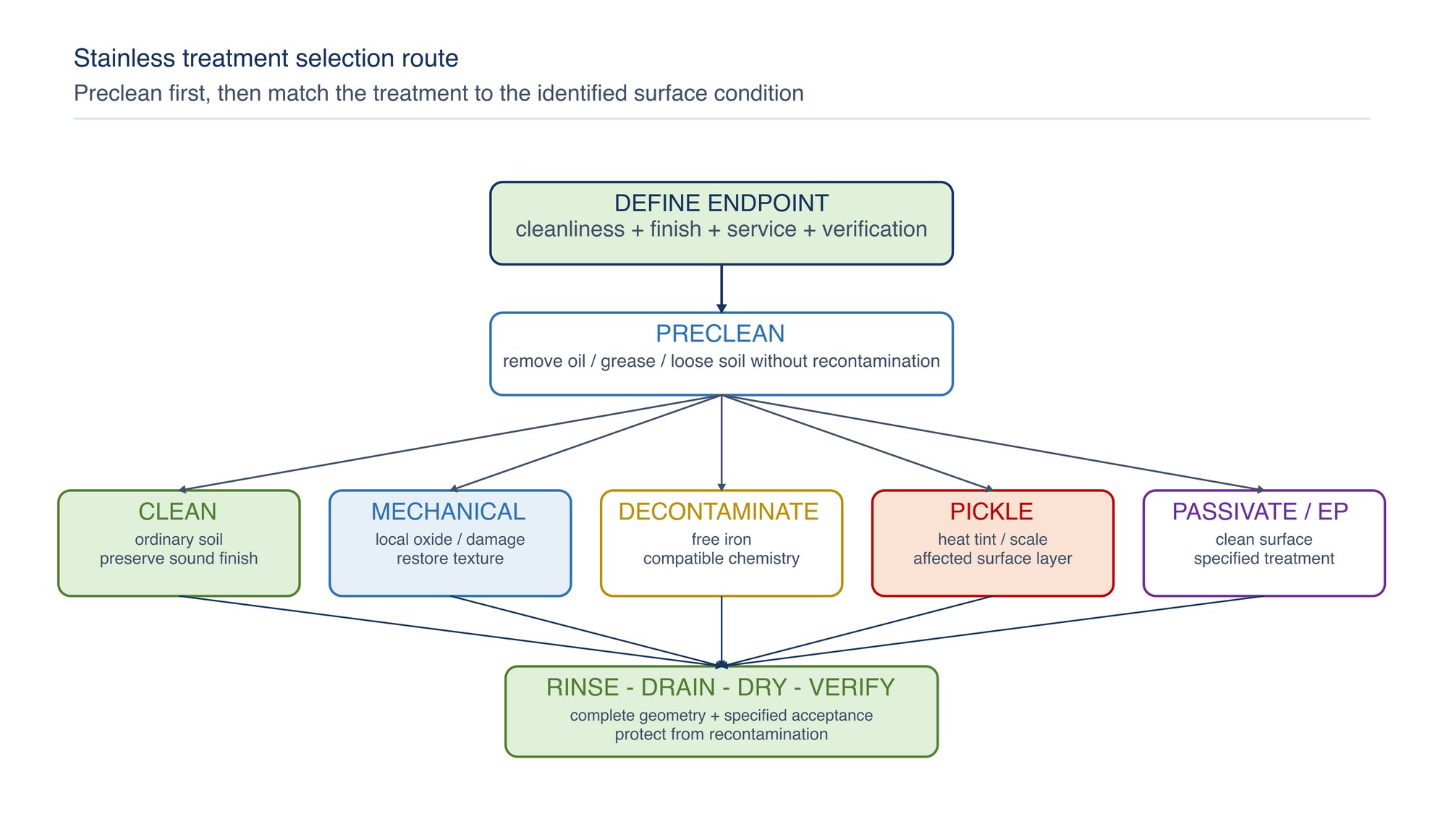
Select the treatment family
Choose the treatment from the surface condition and required endpoint, not from a general instruction to “passivate stainless.”
| Treatment family | Primary purpose | Suitable starting condition | Main limitations and controls |
|---|---|---|---|
| Detergent or compatible cleaner | Remove oil, grease, dirt and process soil | Soiled but otherwise sound stainless surface | Must reach hidden geometry and leave a compatible residue condition |
| Mechanical cleaning | Remove local oxide, staining or damage and restore a defined finish | Accessible local areas where geometry and texture can be controlled | Can smear metal, embed particles, round edges or alter roughness |
| Chemical decontamination | Remove free iron or compatible surface contamination | Chemically clean surface with suspected ferrous transfer | Does not replace descaling where heat oxide remains |
| Pickling | Remove oxide scale, heat tint and a thin affected metal layer | Welded or heat-affected stainless requiring oxide removal | Etches the surface; alloy, finish, access, fumes, rinsing and waste are critical |
| Chemical passivation | Treat a clean stainless surface under a specified system | Clean, oxide-free surface where passivation is required | Not a degreaser or scale remover; exact treatment and verification are specification dependent |
| Electrochemical cleaning | Local controlled removal of weld discolouration using suitable equipment | Accessible weld zones suited to the equipment and finish requirement | Electrical, electrolyte, fume, contact-pad, rinse and appearance controls apply |
| Electropolishing | Smooth, brighten, deburr and passivate by controlled anodic removal | Clean components requiring a specified functional or visual finish | Removes metal and can affect dimensions, edges, appearance and part-to-part uniformity |
Use mechanical cleaning without damaging the finish
Mechanical cleaning may use stainless-compatible brushes, non-woven products, abrasive sheets, flap products, grinding products, blasting media or polishing systems. Select the action for the defect, alloy, existing texture and required appearance. A tool suitable for removing heavy heat tint may be too aggressive for a fine satin finish or thin component.
Key controls are:
- use clean products compatible with stainless steel;
- match the direction of an existing directional finish;
- use controlled progressive passes and avoid local dwell;
- prevent heat tint, gouging, undercut, edge rounding and dimensional loss;
- remove abrasive debris before inspection;
- compare texture and colour across representative lighting angles; and
- complete any required decontamination or passivation step separately.
Wire brushing can remove loose surface material but may burnish oxide or smear metal rather than remove the affected layer. HSE guidance recognises mechanical alternatives to pickling paste but also notes that the resulting surface quality depends on the selected method and duty. [S214]
Refer to the product label, Technical Data Sheet, or MKTECH representative.
Use pickling for oxide and affected-layer removal
Pickling is a controlled chemical removal process for heat tint, oxide scale and a thin surface layer beneath the oxide. It differs from ordinary cleaning and from passivation. The method may be an immersion, local gel or paste, spray under engineered controls, or another specified system. [S212; S217; S223]
Do not formulate or mix a pickling product in the workshop. Use the supplied system only on compatible alloys and surfaces, with the specified application equipment, ventilation, exposure controls, first-aid readiness, rinsing and waste arrangements.
Pickling can dull or etch the finish, attack the base metal, remain trapped in joints and generate hazardous fumes or acidic rinsate.
Before treatment, confirm:
- the alloy and finish are compatible with the selected product;
- the surface is free from oil and interfering soil;
- all treated faces, crevices and internal surfaces can be rinsed completely;
- adjacent metals, coatings, seals and equipment are protected;
- the work area controls splashes, fumes and unauthorised access;
- emergency and first-aid arrangements match the current safety information; and
- rinsate and residues have a contained route.
Where exact chemistry, application amount, temperature, contact time, neutralisation sequence or rinse endpoint is required, Refer to the product label, Technical Data Sheet, or MKTECH representative.
Apply passivation only to a clean surface
Chemical passivation treats a clean stainless surface under defined conditions. It can remove compatible surface contamination and support formation of the passive condition, but it does not replace degreasing or removal of adherent weld oxide and scale. ASTM A967/A967M provides a treatment and verification framework for stainless-steel parts. [S213]
Passivation selection depends on the alloy family, metallurgical condition, surface finish, previous treatment, geometry, service environment and governing specification. Some grades or hardened components can be sensitive to unsuitable chemistry or hydrogen-producing conditions. The specified system controls treatment, rinsing and verification.
Do not describe a part as “passivated” solely because it is bright, has been exposed to acid or has dried without visible staining. Record the specified treatment and the applicable verification result.
Distinguish electrochemical cleaning and electropolishing
Electrochemical weld cleaning uses an electrical circuit and electrolyte at a local contact tool to remove weld discolouration. Electropolishing treats the component as the anode in a controlled process that removes surface metal, reduces micro-roughness and can passivate the stainless surface. They are not interchangeable processes. [S214; S218; S219; S222]
ISO 15730:2023 and ASTM B912-26 address electropolishing as a specified process with preparatory cleaning, controlled treatment, post-treatment, rinsing and verification. The alloy, component geometry, dimensional tolerance, rack contact, electrical conditions, bath condition and required finish all affect the outcome. [S218; S219]
Electropolishing can change edges, dimensions, reflectivity and texture even when its purpose is functional. Use representative components or agreed inspection areas where appearance and dimensional control are important.
Treat the complete geometry
The visible face is only part of the cleaning problem. Tubes, vessels, manifolds, threads, blind holes, crevices, lap joints, weld roots and drain points can retain soil, treatment chemistry or rinse water. Design the sequence so every treated surface can be contacted, rinsed, drained, dried and inspected.
For assemblies with dissimilar metals, coatings, elastomers, bearings or electrical components, assess the complete assembly before exposure. Where practical, dismantle sensitive items or select a local method that prevents ingress.
Protect downstream product-contact, high-purity or coating surfaces from transfer during handling.
Do not introduce a chemical into a closed or poorly drained assembly unless the defined process provides controlled access, ventilation, circulation, recovery, rinse and verification.
Rinse, drain, dry and protect
Rinsing removes cleaner, dissolved metal, reacted oxide and treatment chemistry. Use the water quality and sequence required by the selected system and service. Rinse with enough access and movement to reach the same hidden features as the treatment. [S212; S213; S219]
Drain before drying. Rotate or position parts so tubes, pockets, threads and crevices empty. Dry with clean compatible air or another specified method, then handle with clean gloves, racks and packaging. Water marks, retained chemistry and dirty fixtures can create defects after an otherwise satisfactory treatment.
Neutralisation is product and process specific. Do not improvise by combining opposing chemicals on the workpiece, in a tank or in a spill. Refer to the product label, Technical Data Sheet, or MKTECH representative.
Verify the property that matters
No single observation proves every required property. Select verification from the governing specification and the actual risk.
| Verification focus | What it can indicate | Example method family | Limitation |
|---|---|---|---|
| Visible condition | Remaining soil, tint, oxide, staining, etching and finish mismatch | Controlled lighting and representative visual comparison | Cannot prove absence of invisible free iron or chemical residue |
| Residual oil or soil | Interfering organic or particulate contamination | Specified wipe, water-break or service-specific cleanliness method | Method sensitivity and interpretation depend on the surface and process |
| Free iron | Ferrous contamination capable of producing rust indications | Specified water, humidity, copper-sulfate or ferroxyl-type method | Test suitability varies by alloy, finish, product-contact duty and acceptance rule |
| Corrosion indication | Tendency to develop visible rust under a defined exposure | Specified immersion, humidity or salt-spray method | A pass does not certify every service environment or corrosion mechanism |
| Finish and geometry | Texture, roughness, gloss, direction, edge and dimension | Visual comparator or specified instrument | Appearance and roughness do not by themselves prove chemical cleanliness |
| Rinse and drying result | Retained water, streaking, residue or inaccessible pockets | Drainage inspection and specified rinse-quality check | Visible dryness does not prove hidden cavities are dry |
ASTM A967/A967M and ASTM B912 identify several verification-method families. The governing drawing, purchase specification or quality plan selects the applicable method and acceptance criterion; do not substitute a convenient test without confirming its suitability. [S213; S219]
Control safety, effluent and waste
Stainless surface treatment can combine corrosive chemicals, hydrofluoric-acid hazards in some pickling products, fumes, splashes, electrical energy, heated surfaces, pressurised rinsing and confined geometry. Establish the controls before work starts. [S198; S214]
Practical controls include:
- eliminate or substitute the hazardous method where the required result permits;
- use the current safety data and workplace chemical-risk assessment;
- segregate incompatible chemicals and retain them in labelled compatible containers;
- provide containment, ventilation and restricted access appropriate to the application;
- protect eyes, face, skin, respiratory system and body as required by the assessment;
- provide the specified eyewash, shower, spill and first-aid arrangements;
- isolate electrical equipment before cleaning, inspection or maintenance;
- prevent uncontrolled spray, pressure-wash splash and contaminated mist; and
- stop work if ventilation, containment, PPE, emergency equipment or rinse recovery is not ready.
Spent cleaner, pickling or passivation solution, electropolishing bath residue, sludge, wipes, absorbents and rinsate must be characterised by actual composition and generating process. Malaysian DOE controls govern industrial effluent and scheduled-waste classification, compatible packaging, labelling, storage and authorised routing. [S199; S216]
Troubleshoot from the source
| Symptom | Likely causes | Practical correction |
|---|---|---|
| Rust spots return after cleaning | Ferrous source remains; contamination is embedded; rinse fixture or handling reintroduced iron | Trace the transfer pathway, isolate it, restore the surface and repeat the specified verification |
| Heat tint remains | Treatment cannot reach the oxide; contact is incomplete; mechanical action only burnished the surface | Reassess access, oxide severity and the selected oxide-removal route |
| Uneven colour or dull patches | Non-uniform cleaning, local over-treatment, mixed finish or retained residue | Stop, identify whether the change is soil, etching or texture and correct the deficient stage |
| Surface is bright but test fails | Polishing improved appearance without removing contamination | Use the specified free-iron or cleanliness route instead of further cosmetic polishing |
| Water marks or streaks | Poor rinse quality, dirty fixtures, slow drainage or incomplete drying | Correct water, rinse access, drainage, drying and protected handling |
| Pitting or dark attack appears | Incompatible chemistry, excessive exposure, retained chemical or unsuitable alloy condition | Stop treatment, rinse as specified, assess damage and correct the selected process |
| Finish becomes too rough or glossy | Abrasive or electropolishing action does not match the required texture | Re-establish the finish specification and use a controlled representative-area method |
| Staining follows joints or holes | Soil, chemistry or water remains in hidden geometry | Improve access, circulation, rinsing, drainage and inspection of internal features |
Repeating a stronger or longer treatment without diagnosis can deepen etching, change dimensions and create more waste. Correct the verified cause and repeat only the deficient stage.
Release the cleaned stainless surface
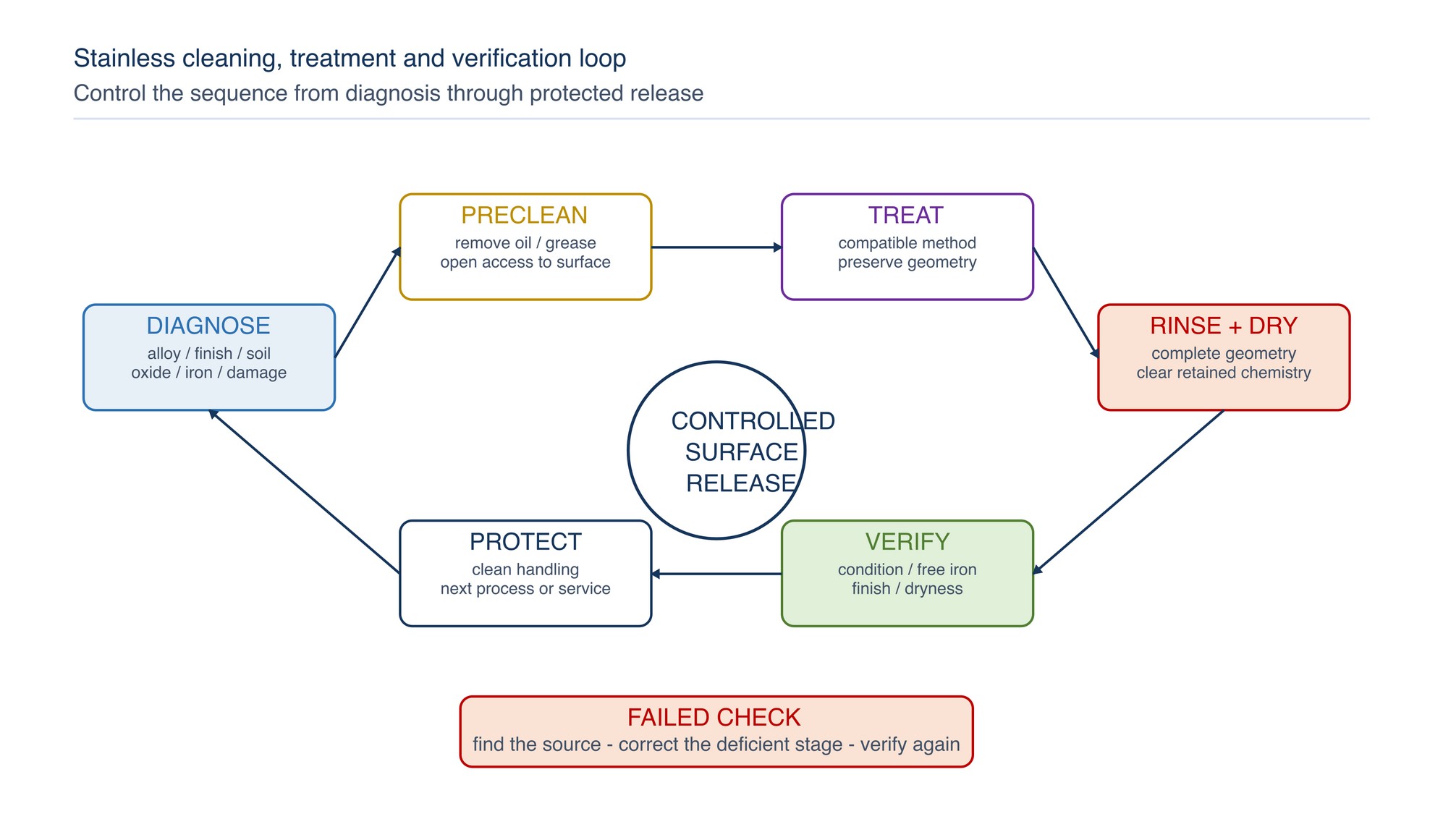
Before release, confirm:
- the alloy family, finish, fabrication history and service duty were considered;
- oil, grease and interfering soil were removed;
- carbon-steel transfer pathways were controlled;
- heat tint and scale were removed by a suitable route where required;
- cleaning, pickling, passivation and electropolishing were not treated as interchangeable;
- the complete geometry was rinsed, drained and dried;
- appearance, free iron, residue, finish or corrosion indication was checked as specified;
- adjacent materials, dimensions, edges and functional surfaces remain acceptable;
- waste and effluent streams are contained and routed correctly; and
- the part is protected from recontamination until its next process or service condition.
Chemical Storage and Handling
Chemical Storage and Handling opens on the following page of the printed handbook (page 335), outside this chapter extract.