
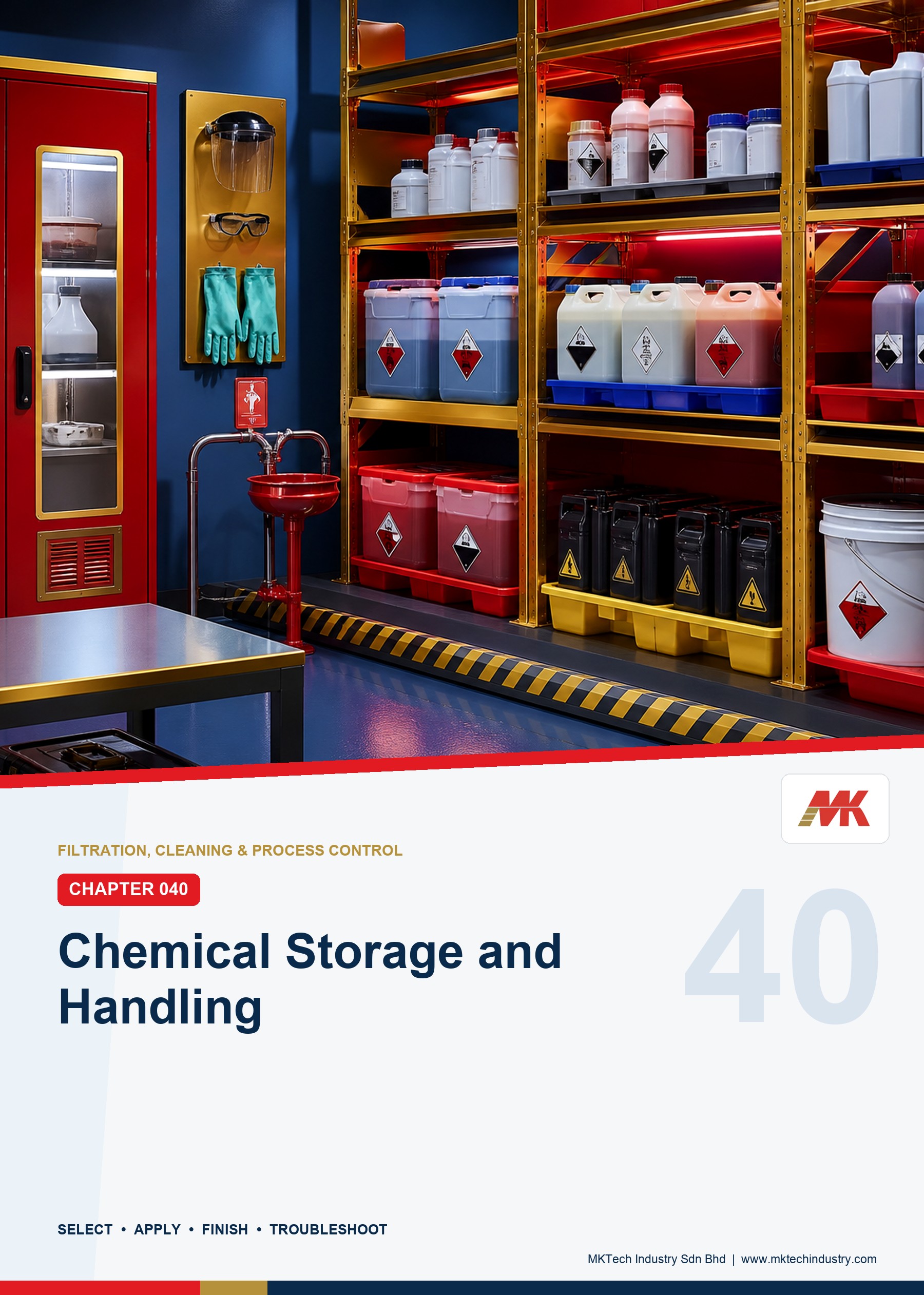
Storekeepers, production teams, maintenance personnel, supervisors, safety and environmental personnel, quality personnel and technical sales personnel
Practical control of packaged industrial chemicals from receipt and segregation through point-of-use storage, inspection, stock rotation, spill readiness and controlled disposition.
Core principle - Store chemicals by hazard compatibility and consequence, not by alphabet, convenience or container colour. A leak must remain contained without reaching an incompatible chemical, drain, work area or ignition source. Do not accept a leaking package into ordinary stock. Do not pour chemical waste into sinks, drains, soil or general refuse. [S224; S225; S226]
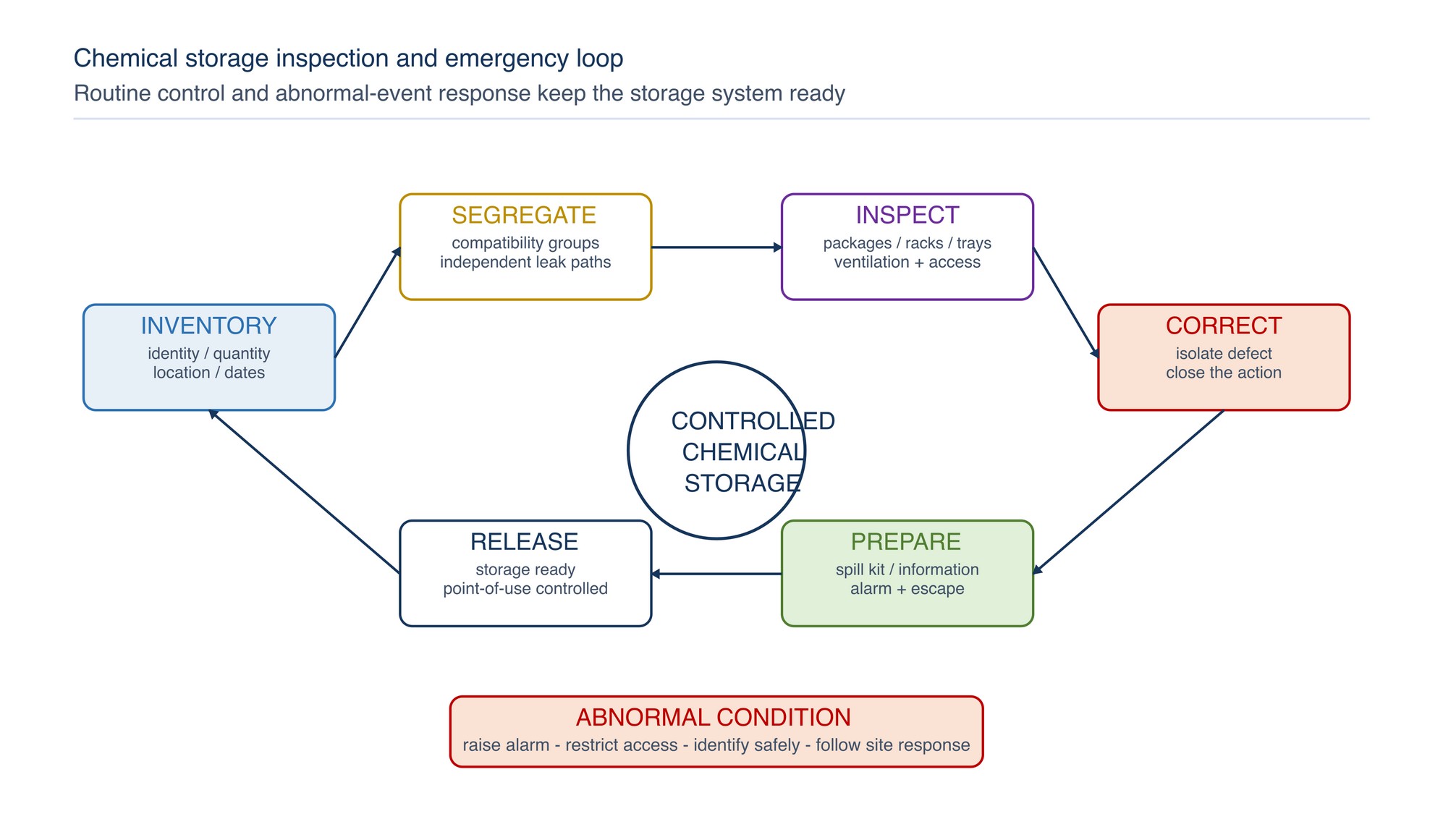
Chemical storage is an active control system. The label and Safety Data Sheet identify the product and its hazards; the storage arrangement separates incompatible groups, protects containers, limits release pathways and keeps emergency information accessible. Good storage also prevents aged, damaged or unidentified stock from entering production. [S224; S225; S226]
Chapter objectives
After this chapter, the reader should be able to:
- read the label and Safety Data Sheet before assigning a storage location;
- inspect deliveries and reject or isolate damaged packages;
- segregate incompatible chemical groups and their leak paths;
- select compatible cabinets, racks, trays, bunds and secondary containers;
- control ignition, heat, sunlight, moisture and ventilation according to the stored hazard;
- maintain positive identification of every primary, secondary and working container;
- minimise point-of-use quantity and keep containers closed when not in use;
- rotate stock by expiry priority and then first-in-first-out where appropriate;
- inspect storage conditions, containment and emergency arrangements systematically;
- select spill equipment and first-response actions from the actual hazard information; and
- route damaged stock, residues and contaminated materials correctly.
Define the storage duty
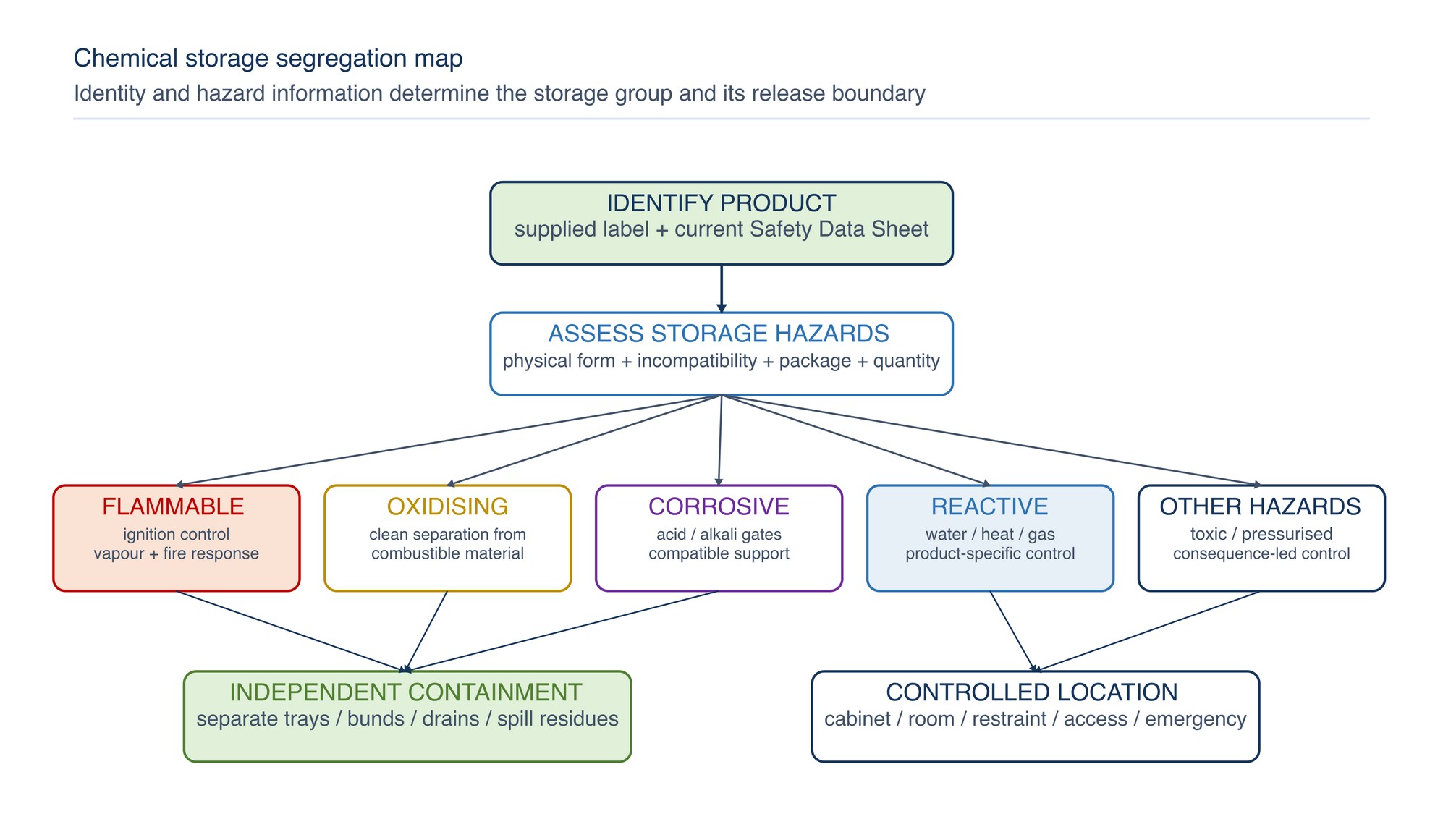
Begin with the current inventory, not with the empty shelves. For each chemical, establish its identity, physical form, package type, quantity, location, storage conditions, incompatibilities and emergency information. The same product can present different consequences in a small sealed bottle, a drum, a pressurised package or an open working container.
| Storage decision input | Question to answer | Control produced |
|---|---|---|
| Product identity | Is the container positively identified by its supplied label? | Correct SDS, inventory entry and storage group |
| Hazard classification | Is it flammable, oxidising, corrosive, toxic, water-reactive, pressurised or otherwise hazardous? | Cabinet, room, ventilation, ignition and emergency controls |
| Incompatibility | What materials, products and conditions must be avoided? | Physical segregation and separate spill pathways |
| Physical form | Is it a liquid, solid, aerosol, compressed gas or temperature-sensitive material? | Suitable support, restraint and release control |
| Package and quantity | Can the closure, shelf and containment carry the package safely? | Storage height, load control, tray or bund arrangement |
| Product condition | Is the package intact, in date and free from swelling, corrosion or leakage? | Acceptance, quarantine or controlled disposition |
| Use location | How much is needed at the workstation and how will it remain protected? | Minimum point-of-use stock and return-to-store discipline |
Keep the chemical register and Safety Data Sheets current and accessible to workers and emergency responders. Critical information should be obtainable without entering the affected storage area. [S160; S198; S224]
Read the label and Safety Data Sheet
Use the supplied label to confirm identity, hazard information and precautionary statements. Use the current Safety Data Sheet to review handling, storage, incompatibilities, fire response, accidental-release measures, exposure controls, first aid and disposal considerations. Do not assign compatibility from trade name, colour, odour or previous familiarity.
The storage section of the Safety Data Sheet is the starting point, not the entire decision. Cross-check fire, stability and reactivity, physical properties, transport information and the site chemical-risk assessment. Where exact storage temperature, ventilation, package compatibility or shelf-life information is required, Refer to the product label, Technical Data Sheet, or MKTECH representative.
If the label is unreadable or the product identity is uncertain, do not smell, taste, mix or open the container to identify it. Secure it against use and arrange controlled identification or disposition.
Receive and inspect deliveries
Inspect chemical deliveries before they enter general storage. Confirm the ordered identity and quantity, readable labels, intact closures, sound packaging and any required handling orientation. Look for wet patches, crystalline deposits, staining, corrosion, dents, bulging, pressure damage, odour or temperature abnormality.
Do not accept a leaking package into ordinary stock. Keep people clear, protect drains and ignition controls, and apply the site response plan using the product's current emergency information. Do not place an unidentified leaking package beside a known chemical merely because both containers look similar.
Record the receipt date and manufacturer expiry or retest date where provided. Place newly received stock so that older suitable stock remains accessible and is not hidden behind it.
Segregate incompatible chemicals
Compatibility is chemical-specific. Common storage families include flammable liquids, oxidisers, acids, alkalis, toxic materials, water-reactive materials and compressed gases, but these are decision groups rather than a complete universal matrix. Products within one broad family may still be incompatible. [S224; S225; S226]
| Broad storage group | Keep separate from | Storage focus | Decision gate |
|---|---|---|---|
| Flammable liquids | Oxidisers, ignition sources and incompatible reactives | Approved storage arrangement, closed containers and vapour control | SDS fire and storage information |
| Oxidising materials | Flammables, organic materials, reducing agents and incompatible contaminants | Clean dedicated area and prevention of combustible contamination | SDS reactivity information |
| Acids | Alkalis and any product that can produce hazardous gas or heat on contact | Corrosion-resistant support and independent containment | Product-specific incompatibility list |
| Alkalis | Acids and incompatible metals or reactives | Compatible packaging, low stable storage and independent containment | Product-specific incompatibility list |
| Water-reactive materials | Water, moisture, aqueous chemicals and unsuitable fire media | Dry protected storage and fire response plan matched to the product | SDS handling, storage and fire sections |
| Toxic or highly hazardous materials | General access, food and personal items; incompatible reactives | Restricted access, clear identity and consequence-led containment | Workplace risk assessment and SDS |
| Aerosols and gases | Heat, impact, damaged valves and incompatible gas groups | Upright restraint, ventilation and temperature control as specified | Cylinder/package label and SDS |
Do not store chemicals alphabetically until compatibility groups have already been established. Never place an oxidiser over a flammable liquid, an acid over an alkali, or any leaking container above another chemical.
Separate containment and leak paths
Segregation must continue below the shelf. Separate trays, bunds, floors, drains, sumps and spill-residue containers so that an escaped chemical cannot combine with an incompatible product. A cabinet divider does not control a release if both sides drain into one common tray. [S224; S225]
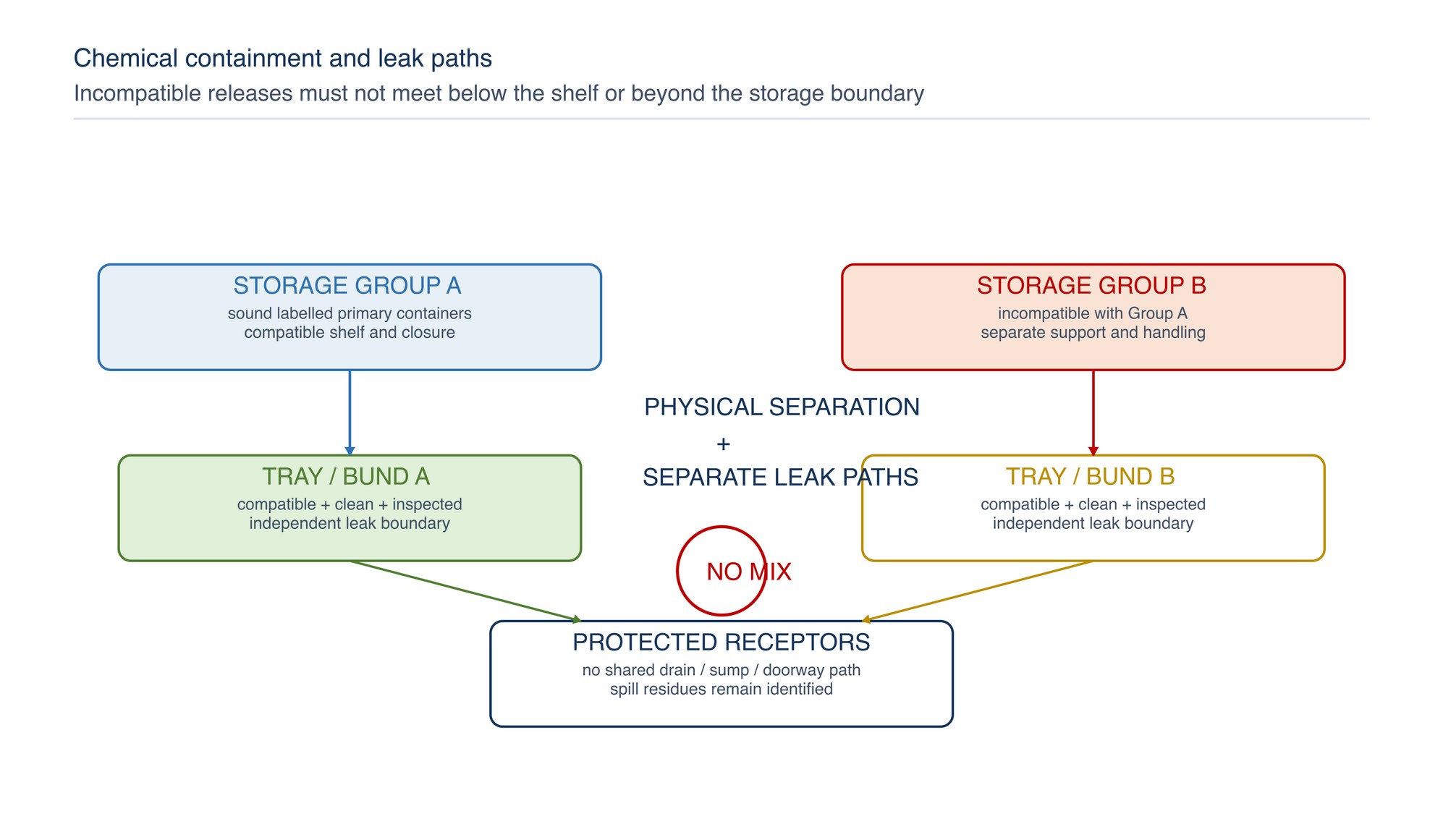
Keep containment clean, dry where required and available for its intended capacity. Do not use a bund as general storage space, allow rainwater or washwater to occupy it, or route it to an open drain. Where a release could spread under shelving or through a doorway, consider the whole floor and threshold arrangement, not only the individual tray.
Choose the storage room, cabinet and rack
The storage location must support the hazard, quantity, package and emergency access. Use stable, chemically compatible shelves with load ratings suited to the stored packages. Restrain cylinders and other tall packages. Keep heavy or corrosive containers low enough for controlled handling, but not directly on a floor where damage, water or unnoticed leakage is likely.
Protect packages from vehicle impact, falling objects, vibration, sharp edges and unauthorised access. Maintain clear aisles and keep exits, fire equipment, eyewash points, electrical panels and ventilation openings unobstructed. Labels should face outward where practical so identity and condition can be checked without moving every package. [S225; S229]
Do not use ordinary domestic cupboards, timber shelves or improvised racks where the hazard requires a purpose-designed chemical-storage arrangement.
Control ventilation, heat and ignition
Ventilation must control the actual vapour, gas, dust or heat load and must not transfer hazardous emissions into occupied areas, ignition zones or neighbouring processes. An open door or portable fan is not automatically an adequate control. Air intake, discharge, low or high vapour behaviour, package breathing and spill conditions all matter.
Keep flammable materials away from ignition sources, hot work, unsuitable electrical equipment and hot surfaces. Protect temperature-sensitive, pressurised and light-sensitive packages from conditions that can degrade the product or package. Where exact temperature, ventilation duty, hazardous-area equipment or fire-protection requirements are needed, Refer to the product label, Technical Data Sheet, or MKTECH representative.
Ventilation systems, alarms and fire-protection equipment require competent design, inspection and maintenance. Do not defeat interlocks or block vents to reduce odour.
Protect primary containers and secondary containment
Keep chemicals in the original supplied package whenever practical. The closure, liner, vent and container material form a compatible system. Do not transfer a chemical into a food, beverage or unverified household container. Do not reuse an apparently empty chemical container for another product.
| Container or containment layer | Selection requirements | Routine checks |
|---|---|---|
| Supplied primary package | Product-compatible material, closure and venting arrangement | Label, corrosion, swelling, cracks, cap, seal and residue |
| Secondary or working container | Positive identity and verified compatibility with contents and use date where relevant | Label, closure, cleanliness, condition and return |
| Shelf tray | Compatible with the stored group and large enough for credible leakage | Cracks, contamination, available capacity and drainage route |
| Bunded floor or cabinet sump | Independent from incompatible groups and resistant to expected contents | Integrity, penetrations, valves, rainwater, waste and obstruction |
| Rack or shelf | Stable, load-rated and resistant or protected against likely exposure | Corrosion, fasteners, deformation, anchoring and load distribution |
| Cylinder restraint | Compatible chain, strap or frame that protects the valve and prevents falling | Upright condition, restraint, cap where applicable and impact protection |
Secondary containment is not a substitute for sound primary packaging. Replace or manage a deteriorated container through an approved route before it fails; do not depend on a tray to make damaged stock acceptable.
Label secondary and working containers
Every secondary and working container must remain positively identified throughout use. Apply the workplace label immediately after an authorised transfer. Include the product identity and hazard information required by the applicable system; keep the label legible and resistant to the working environment. [S227]
Do not identify chemicals by cap colour, bottle shape, shelf position or memory. Keep containers closed when not actively in use and return them to the correct storage group promptly. Where exact label content, package markings or supplied-container requirements apply, Refer to the product label, Technical Data Sheet, or MKTECH representative.
Funnels, pumps and dispensing tools can carry residue between containers. Dedicate or clean them under a defined compatible procedure and keep them protected from dust and mistaken use.
Control point-of-use storage
Keep only the minimum practical quantity at the workstation. Reserve stock belongs in the controlled store, while point-of-use stock needs the same identity, compatibility, containment, ignition and housekeeping discipline as the main store. [S228]
Separate storage from dispensing and from chemical mixing. Use only the authorised closed-transfer or dispensing arrangement for the product and task. Do not decant over a sink, floor drain, unprotected bench or incompatible tray. Do not leave open containers, soaked rags or residue-bearing tools at the workstation after the task.
Return suitable stock to its assigned location after use. If contamination, wrong-product contact or package damage is suspected, isolate the container rather than returning it to clean stock.
Rotate stock and control expiry
Use earliest-expiry-first-out when packages have different expiry or retest dates. Where no date takes priority, first-in-first-out helps prevent new deliveries from burying older stock. Stock rotation must never override product condition, storage-history concerns or manufacturer instructions. [S228]
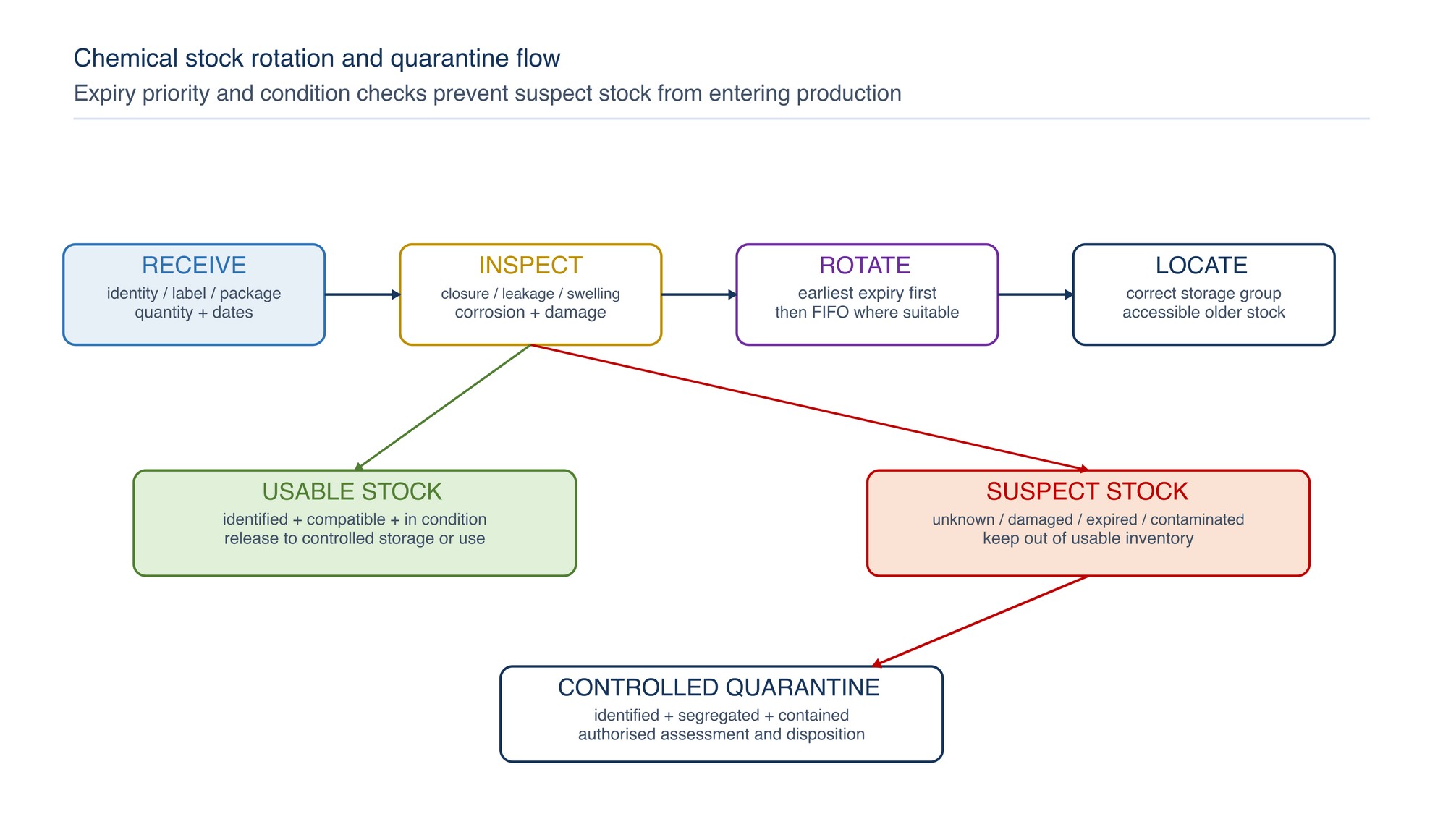
Track product identity, location, quantity, receipt date, opening date where relevant, expiry or retest date and responsible area. Review slow-moving and excess stock so it can be reduced before it deteriorates. Do not combine partial containers to simplify inventory unless the product system and authorised procedure specifically permit it.
Expired does not automatically mean safe, inert or suitable for disposal as ordinary waste. Keep it identified and segregated while the correct disposition route is arranged.
Inspect storage systematically
Inspection frequency should reflect hazard, inventory turnover, package condition, environment and previous findings. High-consequence or frequently handled areas need closer attention than stable reserve stock.
| Inspection level | Typical focus | Corrective response |
|---|---|---|
| Before use or handling | Identity, label, closure, obvious leak, swelling, corrosion and correct location | Stop use and isolate any suspect package |
| Routine area check | Housekeeping, segregation, containment capacity, aisle access and ignition control | Correct safe defects promptly; restrict the area when consequence is significant |
| Scheduled detailed inspection | Inventory, expiry, racks, bunds, ventilation, emergency equipment and SDS access | Assign and verify corrective actions to completion |
| After delivery or stock movement | Package damage, overload, wrong location and blocked labels or access | Restore the approved arrangement before release |
| After spill, fire alarm or abnormal event | Contamination, package exposure, hidden damage and control-system condition | Keep the area controlled until competent assessment and recovery are complete |
Document significant findings and completed actions. Repeated leaks, label damage or wrong-location events indicate a system problem in purchasing, handling, shelving, training or supervision—not merely poor housekeeping.
Prepare spill kits and first response
Spill equipment must match the chemicals present. A universal absorbent or neutralising agent is not safe for every release. Select compatible absorbents, drain covers, non-sparking or corrosion-resistant tools, waste containers and protective equipment from the current hazard assessment and emergency information. [S224; S225; S229]
Keep spill kits visible, identified, inspected and accessible without crossing the likely release zone. Where exact PPE, absorbent compatibility, first-aid treatment or fire-extinguishing media are required, Refer to the product label, Technical Data Sheet, or MKTECH representative.
For a release: raise the alarm, keep people away, identify the product from a safe position, remove ignition only when this can be done safely, protect drains without entering the hazard, and use trained responders under the site plan. Do not touch, smell, walk through, neutralise or wash away an unknown spill.
Maintain emergency readiness
Emergency arrangements should cover alarm, isolation, evacuation, fire response, first aid, eyewash and shower access, spill control, environmental protection and external assistance. Display emergency contacts and a storage plan where responders can reach them even when the store itself is inaccessible.
Inspect eyewash and shower arrangements, alarms, ventilation status, fire equipment and escape routes on the defined schedule. Keep doors, access panels and emergency equipment clear. Consider after-hours access, lone work, power failure, flooding and loss of ventilation in the response plan.
Drills should test communication and decision-making as well as equipment. A responder must know when a spill exceeds the site's safe capability and requires evacuation or specialist assistance.
Control damaged, unknown and waste stock
Isolate damaged, leaking, swollen, corroded, expired, contaminated or unknown stock from usable inventory. The quarantine location must maintain compatibility, containment, identification and restricted access. Do not casually overpack, open, vent, transfer or combine suspect chemicals.
Spill residues, absorbents, contaminated PPE, rinsate and damaged packaging can have different hazards from the original product. Characterise and segregate them by actual composition and generating process. Malaysian DOE requirements govern classification, compatible packaging, labelling, storage and authorised routing of scheduled waste. [S216]
Do not pour chemical waste into sinks, drains, soil or general refuse. Empty packaging may retain hazardous residue or vapour and must follow the applicable product and waste controls.
Troubleshoot and release the storage system
| Observation | Likely causes | Practical correction |
|---|---|---|
| Containers are in alphabetical order but incompatible | Shelving was organised for convenience rather than hazard | Reassign compatibility groups from the SDS and separate their leak paths |
| Tray contains mixed residues or standing liquid | Shared containment, poor housekeeping or an unnoticed leak | Control the area, identify contents safely, recover correctly and restore independent clean containment |
| Labels repeatedly become unreadable | Unsuitable label material, splash exposure or handling damage | Improve label durability and placement; verify identity before release |
| Strong odour appears near the store | Open or damaged package, inadequate ventilation or unsuitable storage condition | Restrict access, identify from a safe position and apply the site response plan |
| Expired stock accumulates | Over-purchasing, hidden inventory or weak rotation | Reduce purchase quantity, use FEFO/FIFO and review slow-moving stock |
| Containers deform or corrode | Incompatible package, heat, sunlight, moisture, age or external contamination | Isolate the package and correct the storage condition and supply route |
| Spill kit is incomplete or unsuitable | No ownership, use without replenishment or generic kit selection | Assign inspection ownership and match contents to the stored hazards |
| Chemical appears at a drain or doorway | Containment breach, shared leak path or unsuitable floor gradient | Activate response, protect receptors and redesign the containment boundary |
Before the storage system is released for routine use, confirm:
- every container is positively identified and linked to a current Safety Data Sheet;
- compatibility groups and incompatible leak paths are separated;
- shelves, cabinets, restraints, trays and bunds are compatible and serviceable;
- ventilation, temperature, sunlight and ignition controls match the stored hazards;
- containers are closed, labels face outward where practical and aisles remain clear;
- point-of-use quantities are minimised and stored under equivalent controls;
- expiry priority, FIFO, inventory and quarantine controls are active;
- spill kits, alarms, emergency information, eyewash and fire equipment are accessible;
- damaged stock and chemical waste have identified controlled routes; and
- inspection findings are closed and the storage arrangement remains ready for abnormal events.
Basic Dimensional Measurement
The next chapter, Basic Dimensional Measurement, appears on the following page of the printed handbook (page 344), outside this chapter extract.