Production managers, workshop supervisors, safety and health personnel, operators, maintenance teams, technical buyers and application personnel involved in grinding, cutting, sanding, polishing, weld preparation and industrial surface finishing
Spark and hot-particle control; hot surfaces; flammable liquids and vapours; used containers and pipework; combustible dust; collectors and ducting; housekeeping; hot-work release; fire watch; emergency response and troubleshooting.
Grinding, cutting and polishing can produce sparks, incandescent particles, hot swarf, frictional heating and hot workpieces. These can ignite packaging, insulation, coatings, oil, solvent vapour, gas, residues inside equipment or accumulated dust well beyond the visible contact point. A fire can begin after the tool stops, while a combustible-dust event can spread through ducts, collectors, rooms or connected equipment. Malaysian DOSH incident alerts involving polishing operations and accumulated process dust demonstrate why ignition control, housekeeping and suitable engineered protection must function as one system. [S319; S320]
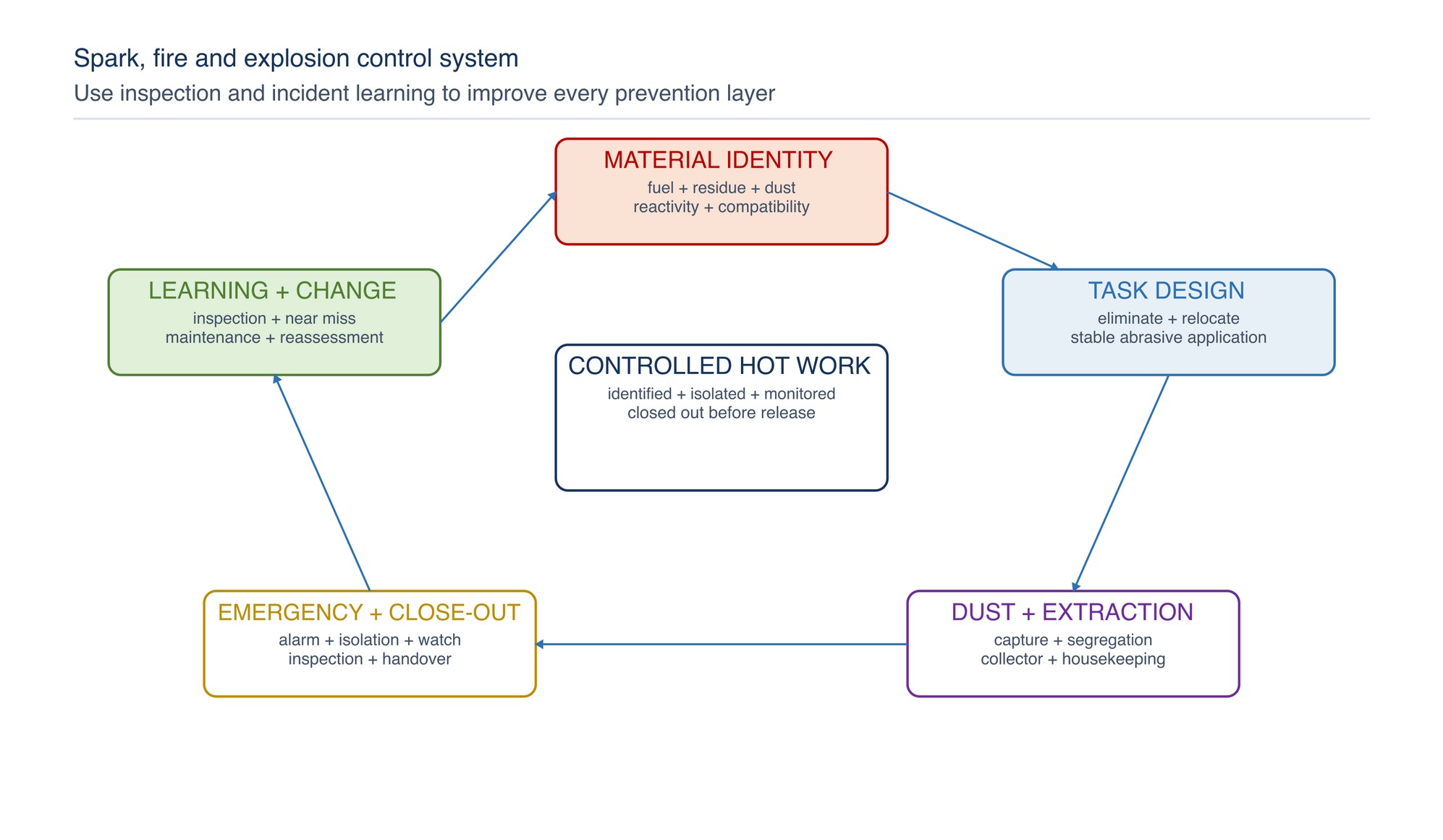
A spark is an ignition source, not a harmless sign that grinding is taking place. Control the fuel, ignition source, atmosphere, dust dispersion and confinement before work starts, then monitor the complete area until delayed ignition is no longer credible.
Chapter objectives
After this chapter, the reader should be able to:
- distinguish fire conditions from dust-explosion conditions;
- identify abrasive-process ignition sources and potential fuels;
- map the complete travel path of sparks, hot particles and heat;
- decide whether work should be eliminated, relocated or controlled as hot work;
- prepare an area and protect adjacent levels, cavities and equipment;
- control grinding and cutting on tanks, drums, pipes and enclosed sections;
- recognise when dust may be combustible or reactive;
- explain how accumulated layers can support a secondary explosion;
- separate incompatible dusts and processes;
- coordinate extraction, collectors and spark control;
- use suitable housekeeping without re-suspending dust;
- apply fire-watch, close-out and restart controls;
- recognise conditions requiring an immediate controlled stop; and
- troubleshoot fire and explosion hazards systematically.
Understand fire and explosion conditions
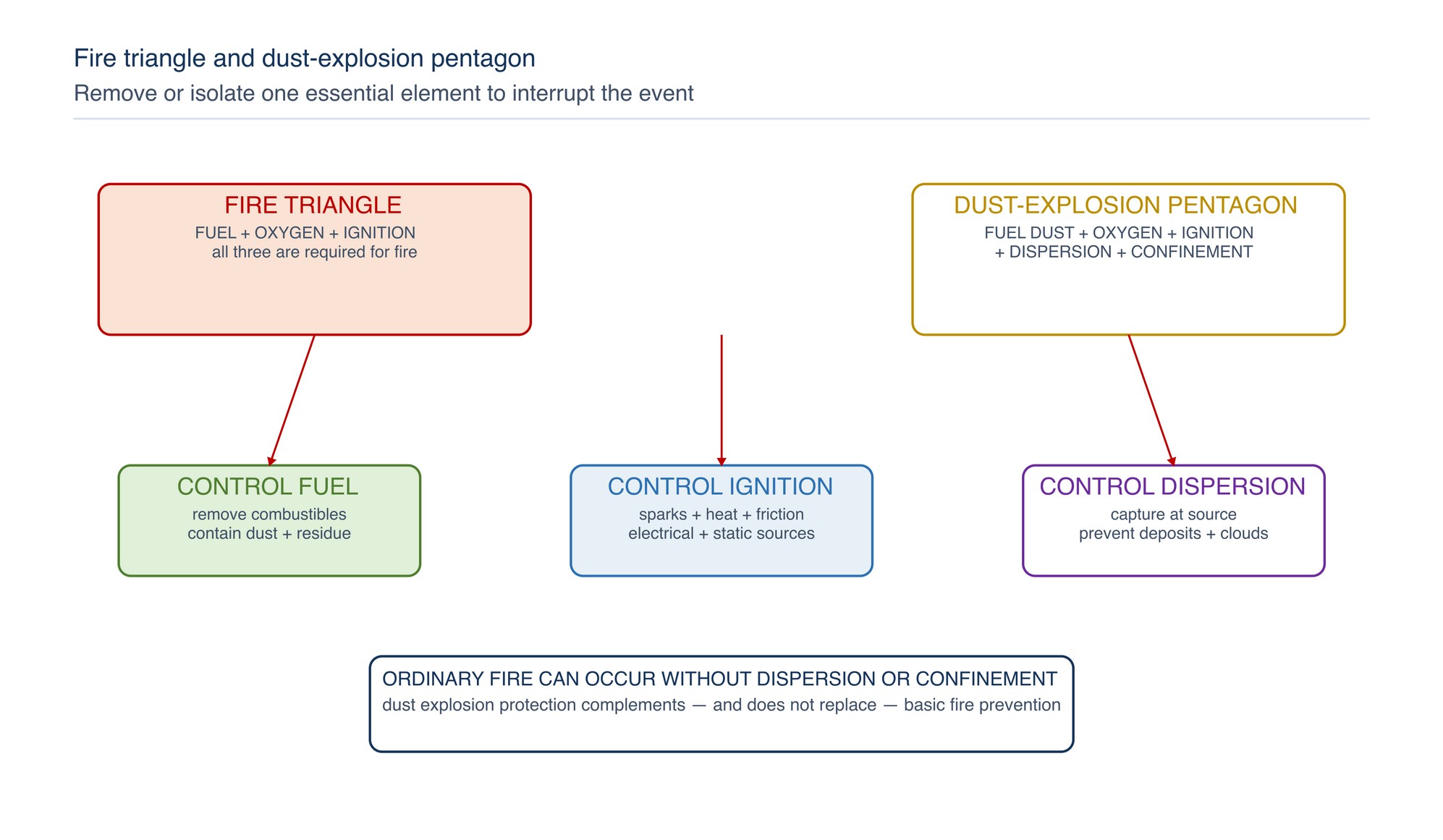
Fire requires fuel, oxygen and a sufficiently energetic ignition source. A dust explosion additionally requires combustible particles dispersed in air within a hazardous range and sufficient confinement for pressure to develop. Removing any required element interrupts the event.
| Event condition | Required elements | Abrasive-work examples | Primary control direction |
|---|---|---|---|
| Surface or ordinary fire | Fuel, oxygen and ignition | Spark enters cardboard, oily waste, insulation or coating | Remove or protect fuel; contain sparks; monitor for smouldering |
| Flammable-vapour fire or explosion | Flammable vapour, oxygen, ignition and hazardous concentration | Grinding near solvent use, fuel system or inadequately cleaned container | Eliminate ignition; isolate, clean, ventilate and verify atmosphere |
| Dust flash fire | Combustible dust cloud, oxygen and ignition | Fine dust released at a sander, polisher or during cleaning | Prevent release and dispersion; control ignition; capture safely |
| Dust explosion | Combustible dust cloud, oxygen, ignition, dispersion and confinement | Dust cloud in collector, duct, enclosure, ceiling void or room | Control dust and ignition; provide correctly engineered containment or protection |
| Reactive-material event | Incompatible materials, water, | Reactive metal dust mixed with another material or exposed to air or heat | Identify chemistry; segregate; use a compatible collection and unsuitable wet control emergency method |
The absence of a visible cloud does not prove that dust deposits are harmless. A layer can burn, conceal hot material or become dispersed by an initial fire, pressure wave, cleaning jet or equipment failure.
Identify ignition sources from the complete process
Visible grinding sparks are only one ignition source. Inspect the whole process for:
- incandescent particles, hot swarf and cut-off fragments;
- hot workpieces, sharp offcuts and recently ground edges;
- friction from binding, rubbing, poor tracking or seized components;
- overheated bearings, motors, brakes, drives and cables;
- damaged electrical equipment, loose connections and arcing;
- static discharge from powders, hoses, filters, containers or clothing;
- welding, gouging, flame cutting, brazing and soldering nearby;
- smoking, open flames, heaters and vehicle exhausts;
- chemical reaction, self-heating or contaminated waste; and
- hot particles transported through extraction ducting.
Abnormal heat, odour, smoke, colour change, noise or vibration is a warning condition. Stop and investigate rather than increasing airflow, contact force or production speed to continue the task.
Map spark and heat travel
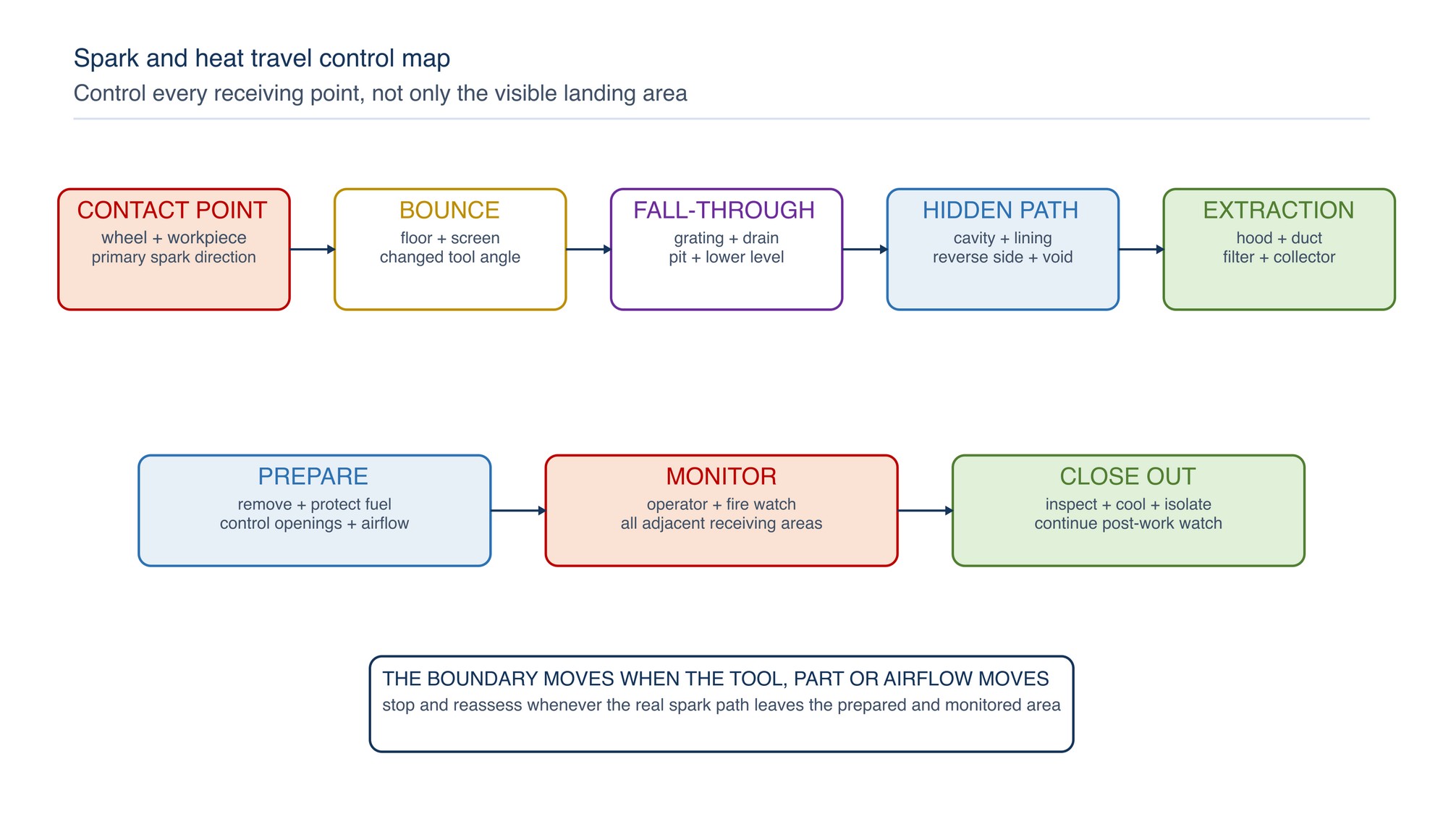
Sparks rarely stop where they first land. They can bounce from floors, pass through grating, enter cable trenches, settle behind machines, lodge in insulation, travel inside hollow sections or be pulled into extraction.
Observe the process from first contact to shutdown and ask:
- What direction does the wheel or belt throw particles?
- How does the direction change as the tool or workpiece moves?
- Can sparks fall through openings or reach another floor?
- Are there hidden cavities, wall penetrations, roof spaces or combustible linings?
- Can extraction carry hot particles to ducts, filters or collectors?
- Can wind, fans or vehicle movement extend the travel path?
- Where will hot offcuts and spent abrasives be placed?
- What could smoulder after visible work ends?
Inspect the opposite side of partitions, floors and workpieces where heat may conduct through. Spark screens should contain and direct particles toward a controlled landing area without trapping heat, blocking ventilation, obstructing escape or creating rebound toward the operator.
Decide whether the task is hot work
Treat grinding, abrasive cutting and any other process that produces sparks or significant heat as hot work wherever combustible, flammable or explosive material may be affected. A designated grinding bay can simplify control, but designation alone does not make it safe when fuel, dust or process conditions change.
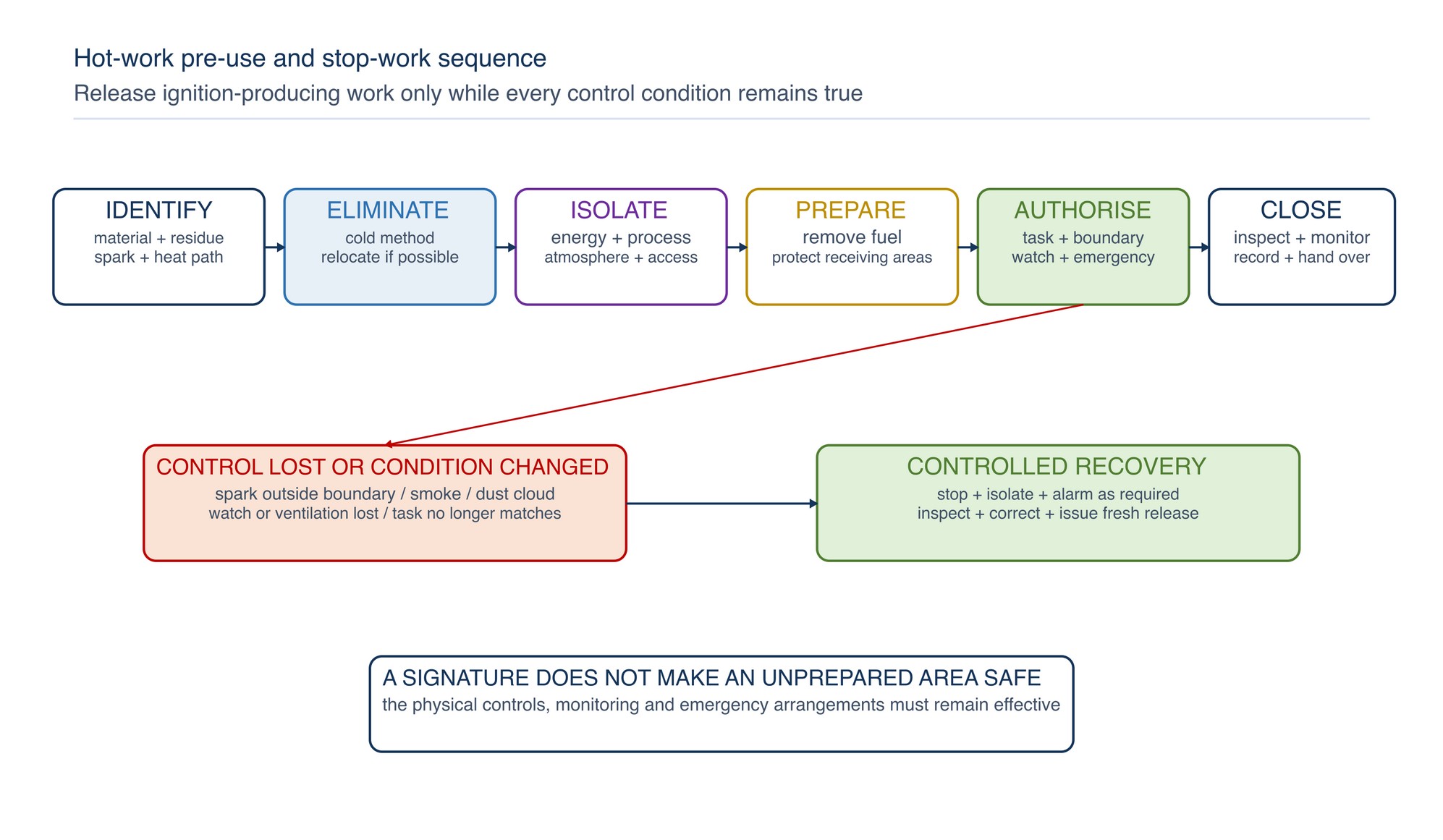
Use this decision sequence:
- Eliminate: Can the part be replaced, unbolted, mechanically separated or repaired without ignition-producing work?
- Relocate: Can the item be moved to a prepared hot-work area away from fuel and occupied operations?
- Isolate: Can connected equipment, lines, energy, material flow and hazardous atmosphere be positively controlled?
- Prepare: Can combustibles, residues and dust be removed or protected and receiving areas inspected?
- Authorise: Does the site hot-work system release the defined task, location, time, personnel and precautions?
- Monitor: Are fire watch, communication, alarm, extinguishing readiness and post-work inspection established?
If the task changes location, material, tool, duration, atmosphere, collector connection or spark direction, return to the decision point. Do not extend an authorisation by assumption.
Prepare the work area
| Area element | Preparation action | Release check |
|---|---|---|
| Loose combustibles | Remove packaging, paper, timber, textiles, plastic, waste and portable flammable material | Work and spark-receiving zones are clear |
| Fixed combustibles | Protect with a suitable non-combustible system and prevent particles passing behind it | Covers are secure, complete and compatible with heat |
| Floors and openings | Clean deposits; cover or control grating, drains, pits and penetrations where appropriate | No path leads sparks to hidden fuel or another level |
| Adjacent equipment | Stop, isolate or protect processes that release dust, vapour, gas or combustible material | Simultaneous operations cannot create a hazardous combination |
| Walls and reverse side | Check for insulation, concealed voids, coatings, cables and heat conduction | Both sides can be monitored and remain accessible |
| Extraction | Confirm system suitability for hot particles and collected material | Spark path and collector compatibility are controlled |
| Emergency arrangements | Establish alarm, access, escape, communication and suitable response equipment | Assigned personnel understand actions and boundaries |
Keep the work zone orderly. Hoses, leads, screens and extinguishing equipment should remain accessible without crossing escape routes or creating trip hazards.
Control flammable liquids, gases and vapours
Flammable material may be present in containers, process equipment, drains, pits, coatings, cleaning stations, fuel systems, aerosols or nearby storage. Vapours can travel away from a leak or open container and ignite at the hot-work location.
Before work:
- identify products, residues and decomposition hazards;
- stop transfer, spraying, cleaning and dispensing that can release vapour;
- close, remove or isolate portable containers;
- prevent leakage from connected pipes, valves and equipment;
- control low points, drains and enclosed spaces where vapour may collect;
- use suitable atmospheric testing where the assessment requires it;
- maintain ventilation without spreading vapour toward ignition; and
- prevent reintroduction while hot work and close-out remain active.
Oxygen enrichment increases the ease and intensity of combustion. Keep oxygen equipment, hoses and fittings clean and suitable for oxygen service, protect them from sparks and oil contamination, and never use oxygen for ventilation, cooling or blowing dust from clothing or equipment.
Never assume an empty container is safe
Drums, tanks, vessels, pipes, ducts and hollow sections can retain flammable vapour, combustible residue or pressure after appearing empty. Rinsing, leaving a lid open or waiting several days does not by itself establish safe conditions.
| Container condition | Hazard | Required direction |
|---|---|---|
| Unknown history or label | Unidentified residue, coating, pressure or atmosphere | Do not grind or cut; identify and route through competent preparation |
| Previously held flammable or combustible material | Vapour or residue can ignite when heated or disturbed | Prefer cold dismantling or replacement; use a controlled cleaning and gas-freeing system where hot work is unavoidable |
| Connected to pipework or process | Material can re-enter through valves, drains, vents or trapped sections | Positively isolate and control every connection under the site procedure |
| Closed or partly closed section | Heat and pressure can build rapidly | Establish an engineered method; do not rely on a small opening or puncture |
| Lined, coated or insulated item | Hidden fuel and hazardous decomposition products | Identify construction and remove or control affected material before release |
| Documented prepared item | Condition can change before or during work | Maintain isolation, ventilation, monitoring and time-limited release conditions |
HSE identifies grinding and disc cutting as hot work capable of igniting residues in drums and containers, including materials such as oils, solvents and fuels. [S323] Use cold cutting or dismantling methods wherever they remove the ignition hazard.
Recognise combustible dust
Many finely divided materials can burn even when the bulk material appears difficult to ignite. Relevant materials may include aluminium, magnesium, titanium and other metals; polymer, paint and coating dust; wood, textile or organic material; polishing lint and compound; and mixed process residues.
Combustibility cannot be decided reliably from:
- whether the parent metal normally burns;
- spark colour or quantity;
- particle colour or visible fineness;
- a previous job that did not ignite;
- the absence of a warning on an unrelated product; or
- an ordinary dust-extraction rating.
ISO/IEC 80079-20-2 specifies test methods for identifying combustible dust and dust-layer characteristics used in hazardous-area and equipment decisions. [S321] Material identity, process history, representative testing and competent engineering determine the required controls.
Understand primary and secondary dust events
A primary event may begin inside a machine, enclosure, duct or collector. The pressure wave can disturb deposits on beams, lights, cable trays, roofs and equipment, creating a larger secondary cloud. Ignition of that cloud can produce a more destructive secondary explosion.
DOSH’s motorcycle-rim manufacturing alert describes a polishing-machine fire followed by a chain of dust explosions and highlights dust control, ignition-source control and explosion-damage control. [S319]
Prevent escalation by:
- containing dust release at the process;
- preventing deposits on horizontal and elevated surfaces;
- inspecting concealed and difficult-to-reach areas;
- keeping collectors and ducts suitable and maintained;
- avoiding work that disperses accumulated dust;
- controlling ignition throughout the connected system; and
- providing engineered fire and explosion protection where the assessment requires it.
Do not wait for a thick visible layer. The significance of a deposit depends on the material, area, process and potential for dispersion.
Separate incompatible and reactive dusts
Mixing dusts can change combustibility, reactivity, waste classification and extinguishing strategy. Keep collection routes separately assessed where processes involve:
- different combustible metals;
- metal and organic or polymer dust;
- reactive metal and water or aqueous slurry;
- iron or steel sparks entering a light-metal dust system;
- oil-, solvent- or compound-contaminated dust;
- oxidising materials; or
- residues with unknown composition.
Use dedicated tools, extraction, containers and cleaning equipment where cross-contamination would create a hazard.
Label waste by source and prevent hot material entering the receptacle. A container suitable for ordinary steel swarf may be unsuitable for fine reactive metal dust.
When an exact abrasive, collector, filter, container or extinguishing-system value is required, Refer to the product label, Technical Data Sheet, or MKTECH representative.
Control sparks at the machine and workpiece
Good application control reduces unnecessary heat and erratic particle throw:
- select the correct tool and abrasive type for the material and operation;
- keep the guard installed and correctly positioned;
- mount the abrasive with clean, compatible components;
- secure the workpiece and support offcuts;
- maintain a stable contact angle and controlled entry;
- avoid binding, twisting, side loading and excessive force;
- replace damaged, loaded, glazed or inefficient abrasives;
- maintain bearings, belts, contact wheels and drives; and
- allow hot workpieces and offcuts to cool in a controlled non-combustible location.
A spark-reduction measure must not weaken guard coverage, cause tool overload, reduce visibility or direct fragments toward people. Wet methods require full compatibility with the abrasive, electrical tool, workpiece, reactive dust and waste system.
Integrate extraction and collector safety
Local extraction can control airborne dust while also transporting hot particles and combustible material into a confined system. Ordinary capture performance does not establish fire or explosion suitability.
| System element | Fire or explosion concern | Control question |
|---|---|---|
| Hood or enclosure | Receives sparks, hot fragments and dust together before transport | Can ignition be prevented or safely controlled? |
| Duct | Accumulates deposits and transmits flame or pressure | Is the material, geometry, cleaning method and pressure isolation arrangement suitable? |
| Fan | Can create heat, friction or ignition and spread burning material | Is its construction and location appropriate to the assessed hazard? |
| Filter or separator | Concentrates fine dust in a confined volume | Are fire, deflagration, isolation and discharge protections engineered for the material? |
| Waste container | Can retain hot material or incompatible mixtures | Is it compatible, closed, identified and emptied by a controlled method? |
| Recirculated air | Can return smoke, flame, contaminants or pressure effects | Is recirculation permitted and protected for the actual process? |
| Discharge location | Can expose people, buildings or air intakes | Does discharge remain controlled during normal and emergency conditions? |
Do not connect a new polishing, sanding or metal-grinding process to an existing collector because the hose fits. Review material, spark loading, dust properties, branch balance, collector location, protection systems and waste route before change.
Keep housekeeping from creating a dust cloud
Housekeeping is an explosion-control measure when it removes deposits without dispersing them.
Use a planned method that:
- captures dust at the source before it settles;
- defines accessible and elevated inspection areas;
- uses equipment documented as suitable for the material and hazardous area;
- isolates production where cleaning can disturb deposits;
- avoids dry sweeping or uncontrolled compressed air;
- prevents dust falling from one level onto workers or ignition sources;
- keeps incompatible dusts and cleaning equipment separate;
- empties collectors and vacuums before overfilling;
- contains filters, bags and waste during change; and
- records recurring deposits as a control fault to correct.
Do not clean a large area by blowing dust toward extraction. The resulting cloud may reach ignition sources, penetrate inaccessible spaces and overload the collector. DOSH guidance on chemical-processing dust events specifically discourages compressed-air blowing and sweeping in favour of suitable industrial vacuum cleaning. [S320]
Use a controlled hot-work release
A hot-work permit or equivalent release coordinates the conditions that must remain true during the job. It should identify:
- exact task, item and location;
- authorised time window and shift handover;
- materials, residues and connected processes;
- isolation and atmosphere-control method;
- combustible removal and protection;
- spark, heat and extraction controls;
- fire watch and receiving-area coverage;
- alarm, communication and emergency actions;
- close-out inspection and monitoring period; and
- responsible persons for release, suspension and closure.
The release ends when conditions change, the time expires, the work moves or control is lost. Suspend the job and issue a fresh release after reassessment. A signature does not compensate for an unprepared area or an uncontrolled dust hazard.
Assign an effective fire watch
The fire watch monitors areas the operator cannot continuously observe, including adjacent rooms, reverse sides, lower levels, penetrations and extraction receiving points. The person must understand the task hazards and have authority to stop work.
The fire watch should:
- confirm the prepared boundary before ignition-producing work;
- maintain communication with the operator and permit controller;
- watch spark travel, hot surfaces, smoke, odour and changing conditions;
- keep access and escape routes clear;
- know how to raise the alarm and initiate evacuation;
- use available response equipment only within training and the emergency plan;
- continue post-work monitoring for the defined period; and
- record closure or escalate any abnormal condition.
DOSH confined-space guidance emphasises combustible removal, suitable protection and a trained fire watch for hot work within confined spaces. [S322] Apply the same disciplined observation principle wherever hidden or delayed ignition is credible.
Select emergency response by assessed material
Different fuels and reactive materials require different response methods. Water, foam, carbon dioxide, dry chemical or specialised media may be effective for some hazards and dangerous or ineffective for others. Selection must follow the identified material, equipment, atmosphere and facility emergency plan.
Before release, confirm:
- alarm method and who receives it;
- emergency isolation and shutdown points;
- evacuation route and assembly arrangements;
- suitable response equipment and trained users;
- restrictions for reactive metal, electrical or confined-space hazards;
- access for emergency services;
- control of smoke and contaminated run-off; and
- preservation of the scene after people are safe.
If fire enters a collector, duct, container or enclosed machine, do not open it casually. Opening can admit oxygen, release flame, disperse dust or expose the person to pressure and toxic products.
Close out the work completely
Stopping the tool does not close the fire risk. At completion:
- remove hot offcuts, spent abrasives and waste to controlled locations;
- inspect the immediate area and full spark-travel path;
- inspect reverse sides, cavities, lower levels and penetrations;
- check extraction, ducts, collectors and waste containers for abnormal heat or smoke;
- verify that temporary screens and covers did not conceal ignition;
- restore fire detection or suppression systems that were controlled for the task;
- maintain fire watch for the assessed post-work period;
- record findings and close the hot-work release; and
- hand over unresolved conditions to the next responsible person.
Thermal imaging can support inspection where suitable, but it does not replace physical access, material knowledge or continued observation. A surface temperature image may not reveal a concealed ember behind insulation or inside a duct.
Know when to stop work
Stop grinding, cutting, sanding or polishing when:
- unidentified combustible, flammable or reactive material is found;
- spark travel extends beyond the prepared and monitored boundary;
- a screen, cover, extraction control or isolation is displaced;
- smoke, flame, smouldering, unusual odour or abnormal heat appears;
- dust becomes visibly dispersed or deposits are disturbed;
- a collector, duct, filter or waste container becomes hot, damaged or abnormal;
- incompatible material enters the collection or waste route;
- atmosphere monitoring, ventilation or required fire watch is lost;
- a used container, pipe or enclosed section is not under a documented release;
- work conditions no longer match the hot-work authorisation;
- emergency equipment, alarm or escape route becomes unavailable; or
- the operator cannot identify where sparks and hot material are landing.
Isolate the task as required, raise the alarm when indicated, control access and follow the site emergency plan. Do not restart until the cause is understood, controls are restored and the complete area has been released again.
Troubleshoot fire and explosion controls
| Observation | Likely contributors | Corrective direction |
|---|---|---|
| Sparks pass beyond the screen | Wrong screen position, rebound, changing tool angle or airflow | Stop; remap the full trajectory and reposition or redesign containment |
| Workpiece remains unusually hot | Excessive force, inefficient abrasive, poor support, rubbing or prolonged contact | Review selection, technique and cooling method; control the hot item after work |
| Burning odour but no visible flame | Concealed smouldering, hot coating, insulation, dust deposit or extraction event | Stop; isolate and inspect all receiving areas under the emergency plan |
| Dust repeatedly accumulates | Ineffective source capture, leakage, poor transport or unsuitable cleaning frequency | Correct the generating and collection system; do not normalise repeated cleanup |
| Collector temperature or sound changes | Hot material entry, filter event, bearing fault, friction or internal fire | Stop connected processes and follow the collector emergency procedure |
| Static shocks occur during dust handling | Inadequate bonding or grounding, unsuitable hose or dry powder transfer | Stop and obtain competent review of the complete electrostatic-control system |
| Fire watch loses sight of receiving area | Task movement, obstruction, staffing or communication failure | Suspend work until full coverage and communication are restored |
| Permit conditions change mid-task | New material, process, location, shift, ventilation or adjacent activity | Stop and reassess; issue a fresh controlled release |
| Hot waste is placed in ordinary bin | Poor close-out planning or unsuitable receptacle | Isolate the waste, control any ignition and establish a compatible cooling and disposal route |
Investigate from fuel and ignition source through dispersion, confinement, extraction, work practice and emergency readiness. Correct the system cause rather than relying on a larger screen, more PPE or more frequent cleanup alone.
Spark, fire and explosion release checklist
Before ignition-producing work begins, confirm:
- [ ] the exact task, workpiece, material and location are identified;
- [ ] elimination, cold methods and relocation have been considered;
- [ ] ignition sources and fuels are mapped through the complete work cycle;
- [ ] the full spark, bounce, fall-through and extraction path is controlled;
- [ ] combustibles, flammable materials, residues and dust deposits are removed or protected;
- [ ] containers, pipes, ducts and enclosed sections are prepared and isolated through the site system;
- [ ] atmosphere and ventilation controls match the assessed hazard;
- [ ] the abrasive, tool, guard, support and technique minimise unnecessary heat and spark spread;
- [ ] extraction and collectors are suitable for the material and hot-particle exposure;
- [ ] incompatible or reactive dusts have separate collection and waste routes;
- [ ] housekeeping will remove dust without dispersing it;
- [ ] the hot-work release defines task, boundary, time and responsible persons;
- [ ] fire watch covers hidden, adjacent and lower receiving areas;
- [ ] alarm, isolation, evacuation and suitable response equipment are ready;
- [ ] post-work monitoring and handover are defined; and
- [ ] everyone understands the stop-work conditions.