
Paint-shop managers, supervisors, booth operators, maintenance technicians, production engineers, safety and environmental personnel, QA/QC teams and technical buyers
Maintenance planning; isolation and clearance; residue control; booth enclosure; doors, seals and glazing; intake and exhaust filtration; gauges; fans and drives; plenums and ducts; make-up air; heating and curing; electrical equipment; grounding; interlocks; fire-protection interfaces; water-wash systems; compressed and breathing air; records; troubleshooting and return to service.
Never use compressed air to scatter dry deposit. Do not use an unapproved flammable cleaner, create sparks by grinding hardened residue, or mix wastes that may react or self-heat. Do not enter early because visible mist has disappeared. Do not defeat a door switch to keep production running. Never bypass purge, airflow proof, flame supervision, high-limit or door-control functions. Do not replace a motor, light, switch, sensor or fan component with a general-purpose item simply because its voltage and size match. [S174; S175; S176; S177; S185]
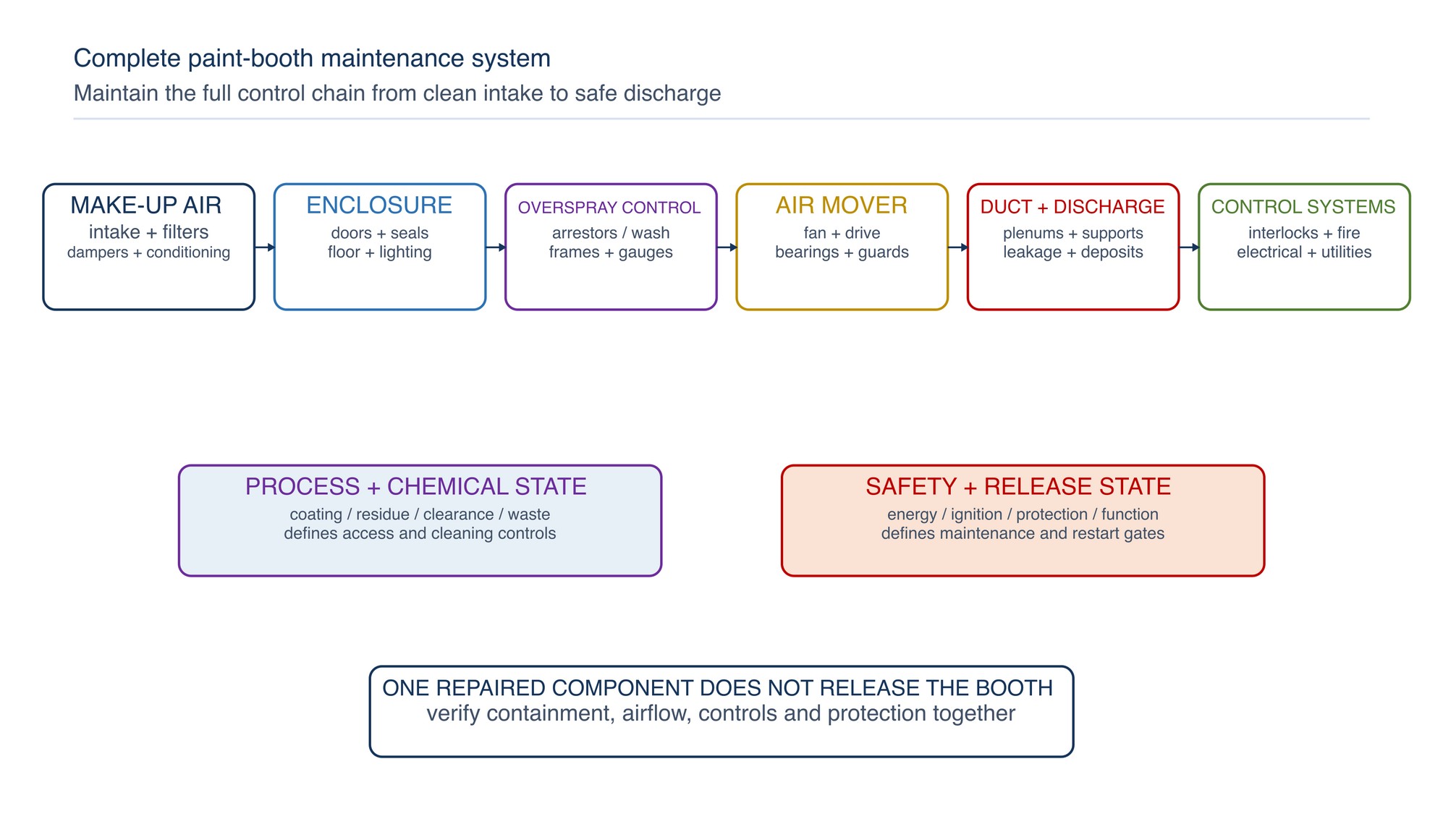
Core principle — A paint booth is a connected process-safety system. Maintain the enclosure, airflow path, filtration, fan, controls, fire protection and supporting utilities together; releasing one repaired component does not release the complete booth.
Maintenance protects coating quality, worker exposure control, fire safety, environmental control and production reliability at the same time. Overspray residue, loaded filters, air leakage, loose drives, blocked pressure taps, damaged seals or bypassed interlocks can interact. A useful programme therefore combines routine care, condition evidence, competent specialist work and a controlled functional release. [S171; S172; S175; S195]
Chapter objectives
After this chapter, the reader should be able to:
- map the complete booth and its supporting systems;
- plan maintenance around chemical, electrical, pressure, thermal and mechanical hazards;
- apply post-spray clearance, shutdown, isolation and verification;
- clean overspray residue without creating a new fire or exposure hazard;
- inspect the enclosure, doors, seals, glazing and access routes;
- maintain filters, gauges, fans, drives, plenums and ductwork;
- coordinate make-up-air, heating, electrical and fire-protection specialists;
- maintain water-wash equipment where fitted;
- distinguish compressed process air from breathing-air support;
- diagnose airflow, contamination, noise, leakage and control faults systematically; and
- complete a controlled return-to-service check.
Maintain the booth as one system
| System zone | Main function | Maintenance focus |
|---|---|---|
| Make-up-air intake | Supplies replacement air | Screens, weather entry, dampers, filters, fan |
| Supply plenum and diffusion | Distributes clean air | Cleanliness, seals, uniform delivery, access |
| Booth enclosure | Contains spray and directs airflow | Panels, doors, seals, floor, glazing, openings |
| Exhaust filtration or wash stage | Captures overspray | Media or wash condition, bypass, pressure loss |
| Exhaust fan and drive | Moves contaminated air | Rotation, bearings, belts, vibration, guarding |
| Duct and discharge | Conveys and releases exhaust | Deposits, leakage, corrosion, supports, obstruction |
| Controls and instruments | Indicate and coordinate operation | Gauges, sensors, alarms, interlocks, timers |
| Fire and electrical systems | Control ignition and consequence | Integrity, classification, grounding, specialist service |
| Heating or curing equipment | Conditions air or coating | Burners/heaters, limits, airflow proof, shutdown |
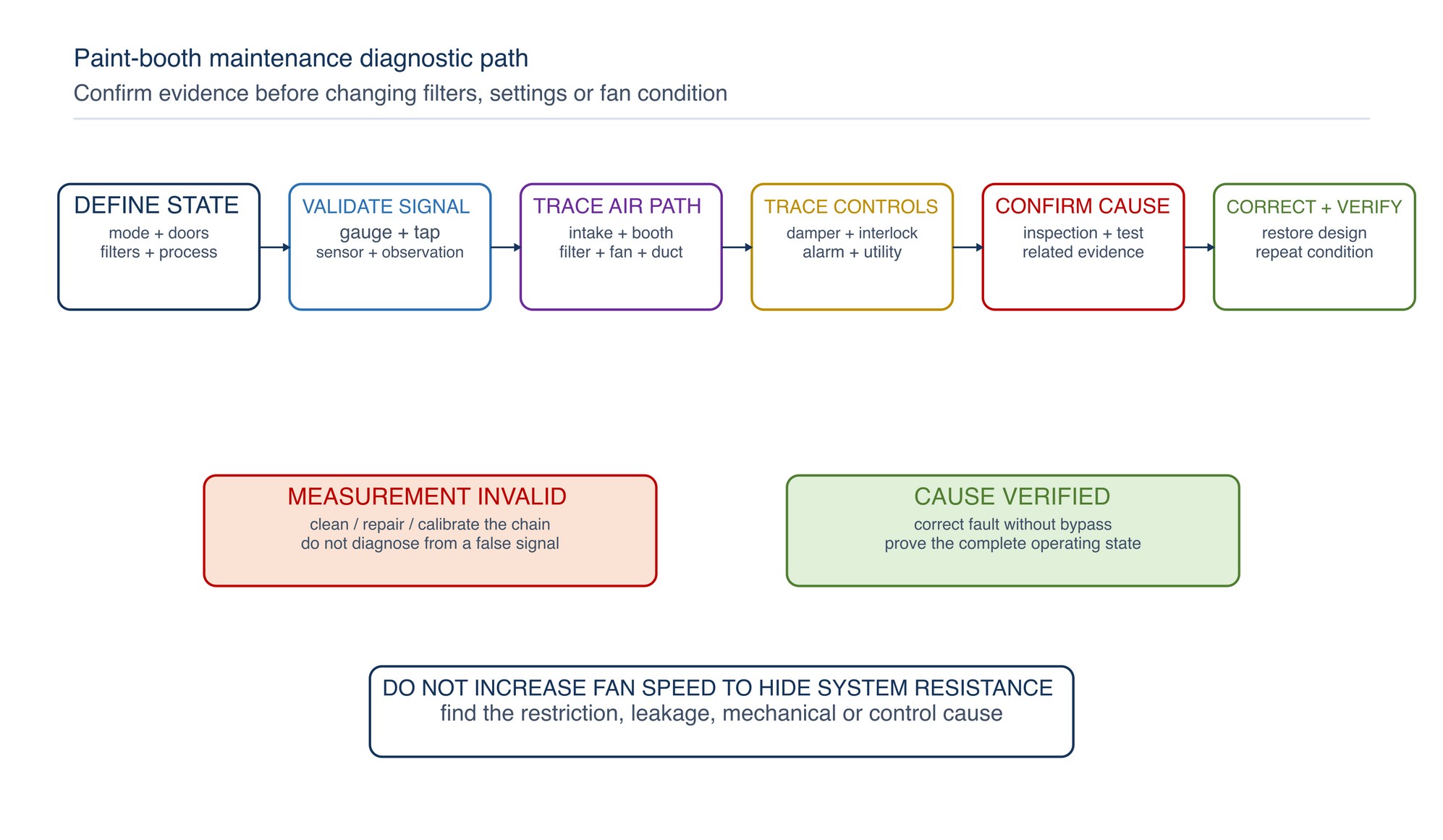
A fault in one zone can appear elsewhere. Low booth flow may come from a loaded intake, closed damper, exhaust-filter resistance, slipping belt, wrong fan rotation, duct obstruction or open access panel. Diagnose from the complete airflow route before changing settings or components.
Establish the maintenance basis
Confirm before planning work:
- booth identity, manufacturer, model and serial information;
- process type, coating families and normal operating modes;
- airflow arrangement and intended direction;
- drawings, schematics, manuals and previous modifications;
- filter stages and declared installation arrangement;
- fan, motor, drive, damper and make-up-air configuration;
- heating, curing, water-wash or recovery equipment where fitted;
- electrical classification, grounding and control philosophy;
- fire-detection, alarm, sprinkler or suppression interfaces;
- pressure, airflow, clearance-time and condition baselines; and
- maintenance history, recurring defects and responsible specialists.
Do not identify components from appearance alone or assume a similar booth uses the same sequence. When an exact part, filter, pressure, airflow, temperature, clearance time, lubricant, adjustment or test value is required, Refer to the product label, Technical Data Sheet, or MKTECH representative.
Define maintenance roles and boundaries
- Operator care: approved housekeeping, visual checks, gauge observation and defect reporting.
- Routine maintenance: planned inspection, filter service, mechanical checks and cleaning within established authority.
- Competent technical work: fan, drive, instruments, controls, isolation, testing and system balancing.
- Specialist work: hazardous-area electrical equipment, burners, gas trains, fire protection, breathing air and statutory or authority-controlled examinations.
The person who can clean a booth safely may not be competent to adjust a burner, test an interlock or alter a fan. Define who may isolate, dismantle, test, override for diagnosis and authorise release.
Plan shutdown, clearance and isolation
Maintenance can expose electrical energy, fan inertia, compressed air, hot surfaces, fuel, automatic dampers, stored pressure, elevated work and hazardous coating residue. Review the actual job before shutdown.
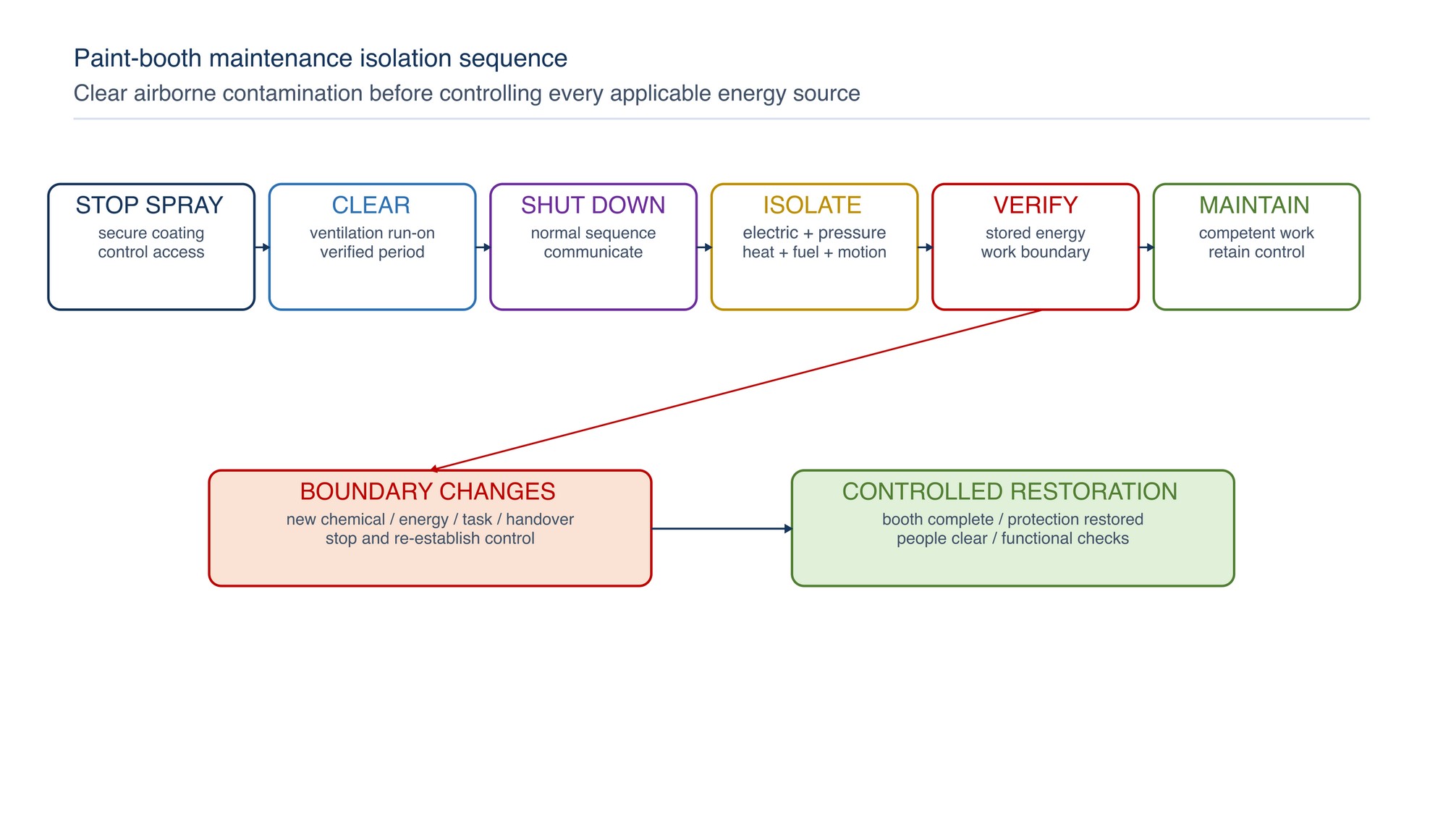
Use this sequence:
- stop spraying and secure coating delivery;
- keep ventilation operating for the established post-spray clearance period;
- restrict access while airborne contamination may remain;
- shut down through the normal sequence;
- isolate all applicable energy and material sources;
- release or secure stored energy;
- verify isolation at the work location; and
- retain control until the task and restoration are complete.
Do not enter early because visible mist has disappeared. Clearance depends on the booth, airflow, loading and test basis; HSE guidance illustrates why verified clearance and leakage observation matter for hazardous spray processes. [S176; S177]
Control residue before maintenance
Overspray deposits may be combustible, chemically hazardous, reactive with other coatings or easily dispersed during cleaning. Identify the coating and cleaner before disturbing residue.
Prefer methods that collect residue at source and minimise airborne dust or solvent vapour. Use approved scrapers, non-sparking or otherwise suitable tools where required, compatible cleaning materials and controlled waste containers. Never use compressed air to scatter dry deposit. Do not use an unapproved flammable cleaner, create sparks by grinding hardened residue, or mix wastes that may react or self-heat.
Maintain clear access around the booth and remove accumulated combustible residue before it affects filters, lights, sprinklers, fan parts or exits. [S175; S185]
Inspect enclosure panels, floors and openings
Check:
- panel joints, fasteners, corrosion and impact damage;
- floor condition, grating, pits and drainage;
- penetrations for pipes, cables, conveyors and hoses;
- loose masking, temporary sheet or combustible lining;
- overspray build-up on walls, ceilings and ledges;
- sharp edges and damaged internal finishes;
- pedestrian and product access routes; and
- evidence of spray escaping through unintended openings.
Restore cleanability and containment. Do not seal a required air path, drain or pressure-relief feature while closing an unintended gap.
Maintain doors, seals and glazing
Doors should close freely, latch correctly and preserve their intended airflow and emergency function. Inspect hinges, rollers, tracks, handles, vision panels, perimeter seals and door interlocks.
Clean glazing and light panels before heavy residue raises temperature, reduces visibility or encourages operators to open doors during spraying. Replace cracked or unsuitable transparent panels through the specified arrangement. Do not defeat a door switch to keep production running.
Maintain filters and pressure indication
Filter condition must be read with airflow, pressure, physical integrity and downstream cleanliness. Chapters 033–035 give detailed selection and change-out guidance.
During booth maintenance:
- confirm stage identity and airflow direction;
- inspect frames, clips, gaskets and supports;
- look for bypass, collapse, breakthrough and uneven loading;
- clean pressure taps and verify tubing condition;
- check gauge zero and response by the specified method;
- record comparable readings in the defined booth state; and
- control contaminated media and residue as process waste.
Do not substitute a filter only because it fits the opening. Capture duty, resistance, holding capacity, coating compatibility, installation and disposal basis all matter. [S178; S195]
Inspect fans, shafts and drives
Isolate and secure rotating equipment before access. Inspect:
- fan blades or wheel for deposits, damage and contact;
- shaft alignment, play and seal condition;
- bearings for noise, heat, lubrication and mounting;
- belts for wear, contamination, tension and matched condition;
- pulleys, keys, couplings and guards;
- motor mounts, flexible connectors and vibration isolators;
- rotation after electrical work; and
- inlet and outlet conditions that disturb flow.
Do not scrape a fan unevenly, add balance weights by trial, fit unmatched belts or increase fan speed to hide system resistance. Fan cleaning and repair should preserve clearances, alignment, balance and the applicable ignition-control arrangement. [S175; S179; S180; S197]
Inspect plenums, ducts and discharge
Follow the route from the booth to the final discharge. Check access doors, joints, flexible sections, supports, drains, corrosion, internal deposits, leakage marks and foreign objects. Confirm that maintenance has not left tools, rags or loose material inside.
Unexpected deposit downstream of a filter can indicate bypass, damage or unsuitable capture. A crushed flexible connection, closed damper or accumulated residue can raise system resistance. Repair the cause and verify the full path rather than adjusting only the fan.
Maintain make-up air and air balance
Inspect outdoor screens, weather louvres, dampers, filters, coils, fans, drives, plenums and controls. Water entry, blocked intakes or a stuck damper can disturb booth balance and carry contamination into the finish.
After relevant maintenance, compare pressure relationships, airflow direction and containment with the established operating basis. A closed door, open service panel or changed filter stage can alter the result. Do not balance the booth by permanently opening an unintended gap.
Control heating and curing equipment
Heating and curing equipment may include electric heaters, burners, fuel trains, heat exchangers, temperature limits, airflow-proving devices, purge sequences and high-temperature shutdowns. These are specialist systems.
Keep burners, heaters and heat-transfer surfaces free of incompatible residue. Inspect visible damage, leakage, wiring, sensors, fans and seals within authorised scope. Never bypass purge, airflow proof, flame supervision, high-limit or door-control functions. Test affected safety functions before heating or spraying is released.
Preserve electrical and grounding integrity
Electrical suitability depends on equipment location, enclosure, wiring method, coating process and hazardous-area design. Maintenance must preserve the installed classification and certification basis.
Check for damaged luminaires, cracked panels, loose glands, open covers, overspray on cooling surfaces, unauthorised sockets, portable equipment, degraded cables and altered control boxes. Verify grounding and bonding through the applicable competent test method. Do not replace a motor, light, switch, sensor or fan component with a general-purpose item simply because its voltage and size match. [S174; S175]
Test controls, alarms and interlocks
Controls may coordinate ventilation, spraying, heat, conveyors, doors, pressure, filter alarms, fire systems and emergency stops.
| Control function | Maintenance question | Release evidence |
|---|---|---|
| Ventilation proof | Does spraying remain prevented when required airflow is unavailable? | Defined functional test passes |
| Post-spray run-on | Does extraction continue for the established sequence? | Timer or control sequence verified |
| Door or access interlock | Does the response match the booth design? | Switch and resulting action verified |
| Pressure or filter alarm | Are sensing line, setpoint control and indication serviceable? | Simulated or specified test passes |
| Emergency stop | Does it produce the intended safe state? | Stop and reset sequence verified |
| Heating permissive | Are airflow, purge and limit conditions satisfied? | Specialist functional test passes |
Record temporary overrides used for diagnosis, control access to them and remove them before release.
Coordinate fire-protection maintenance
Sprinklers, suppression, detection, alarms, dampers and system shutdown interfaces should be inspected and serviced through the responsible fire-protection programme. Booth cleaning and repairs must not coat, paint over, obstruct, isolate or damage these devices.
Before taking protection out of service, use the site's impairment-control process. Control ignition sources and spraying status, notify responsible persons and restore protection promptly. Confirm that filter changes, new duct access, curtains or stored items do not obstruct the intended protection.
Maintain water-wash systems where fitted
Water-wash booths may include pumps, strainers, tanks, troughs, weirs, nozzles, eliminators, level controls, treatment chemicals and sludge removal.
Inspect circulation, leakage, blockage, corrosion, foam, odour, deposit and pump condition. Maintain the water curtain or wash pattern through the specified method. Control chemistry from measured system condition and coating compatibility; do not add treatment chemical by colour or habit. Isolate pumps and control chemical exposure before cleaning tanks or removing sludge.
Classify wastewater and sludge from the actual materials and process. [S188; S189]
Separate process air and breathing air
Spray-gun air, control air and supplied breathing air are different services. Trace each line, connection, filter and regulator so cross-connection is prevented.
Maintain process-air traps and filters to protect coating quality. Maintain breathing-air supply, alarms and hoses through the dedicated respiratory-protection programme and specified test method. Do not use an ordinary shop-air assumption as evidence that breathing air is suitable.
Troubleshoot maintenance symptoms
| Symptom | Possible system causes | Corrective direction |
|---|---|---|
| Weak or reversed containment | Filter loading, damper, fan, door, duct or make-up-air fault | Trace intake to discharge in the defined operating state |
| Dust or debris on finish | Intake leakage, dirty plenum, damaged seal, clothing or internal deposit | Separate incoming, internal and process sources |
| Rising vibration or noise | Deposit, bearing, belt, alignment, loose panel or duct system effect | Isolate; inspect mechanical and airflow causes |
| Pressure reading unchanged | Blocked tap, failed tubing, gauge fault or stable resistance filters | Verify the measurement chain before interpreting |
| Overspray downstream | Bypass, damage, wrong installation or unsuitable capture stage | Stop spraying; inspect media, frame and downstream path |
| Door difficult to open | Pressure imbalance, seal, hinge or control fault | Verify booth state; correct airflow and mechanical cause |
| Heating fails to enable | Airflow proof, purge, limit, sensor, burner or control fault | Use competent sequence-based diagnosis; do not bypass |
| Repeated short filter life | Spray transfer, loading distribution, stage selection or fan condition | Review process and whole-system duty |
| Exact value uncertain | Component-specific information is required | Refer to the product label, Technical Data Sheet, or MKTECH representative. |
Complete a controlled return to service
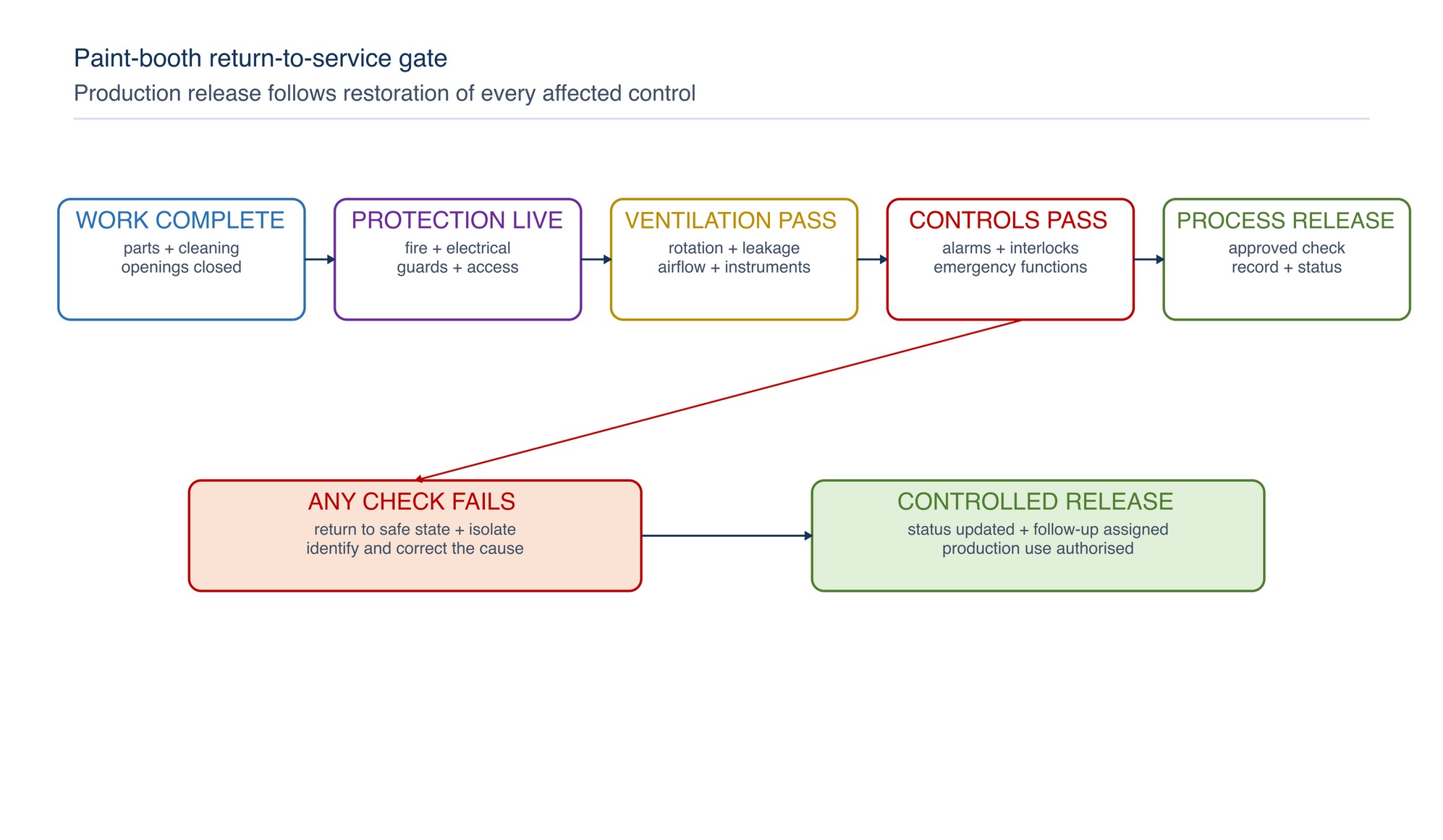
- confirm the work scope and parts are complete;
- remove tools, residue, temporary covers and waste;
- restore panels, doors, seals, filters, guards and access covers;
- confirm fire-protection systems are in service;
- clear people and remove maintenance isolation through the authorised process;
- start ventilation in the normal sequence;
- check rotation, leakage, noise, vibration and instruments;
- verify airflow direction, containment and alarms;
- test affected interlocks and emergency functions;
- test heating or wash systems separately where applicable;
- conduct the approved process check; and
- record release, readings and follow-up action.
Any abnormal result returns the booth to a safe state and investigation.
Paint-booth maintenance checklist
- [ ] Booth identity, process duty, drawings and maintenance instructions are confirmed.
- [ ] Spraying has stopped and the established clearance sequence is complete.
- [ ] Electrical, pressure, thermal, mechanical, fuel and material energy are controlled.
- [ ] Residue and cleaning chemicals are identified and handled safely.
- [ ] Enclosure, floor, doors, seals, glazing and access routes are serviceable.
- [ ] Intake, diffusion and exhaust filters are correctly installed and sealed.
- [ ] Pressure taps, tubing, gauges and airflow indicators are serviceable.
- [ ] Fan, shaft, bearings, drive, guards and flexible connections are serviceable.
- [ ] Plenums, ducts, supports, access doors and discharge are clear and intact.
- [ ] Make-up-air and booth balance checks are satisfactory.
- [ ] Heating, curing or water-wash equipment passes the applicable specialist checks.
- [ ] Electrical classification, grounding and enclosure integrity are preserved.
- [ ] Alarms, interlocks, emergency stops and run-on sequence pass.
- [ ] Fire-protection impairment is closed and protection is restored.
- [ ] Process air and breathing-air systems remain correctly separated and controlled.
- [ ] Functional and process verification pass before production release.
- [ ] Work, parts, readings, defects and next maintenance action are recorded.
Maintenance Planning
The following chapter, Maintenance Planning, appears on the next page of the printed handbook (page 490), outside this chapter extract.