

Maintenance managers, production managers, supervisors, planners, technicians, reliability engineers, safety personnel, QA/QC teams, storekeepers, contractors and technical buyers
Maintenance objectives; asset register; criticality; daily, weekly and monthly planning bands; task and interval selection; condition monitoring; planned shutdowns; job packs; hazardous-energy control; critical spares; backlog; work completion; return to service; failure history; maintenance KPIs; troubleshooting and programme review.
Deferring a deteriorating guard, isolation point, fan bearing, filter seal or pressure component may not be. Do not normalise bypassed guards, defeated interlocks or informal “quick tests.” Temporary measures must be explicit, time-bound and reviewed. They are not permanent repairs by another name. [S331; S337]
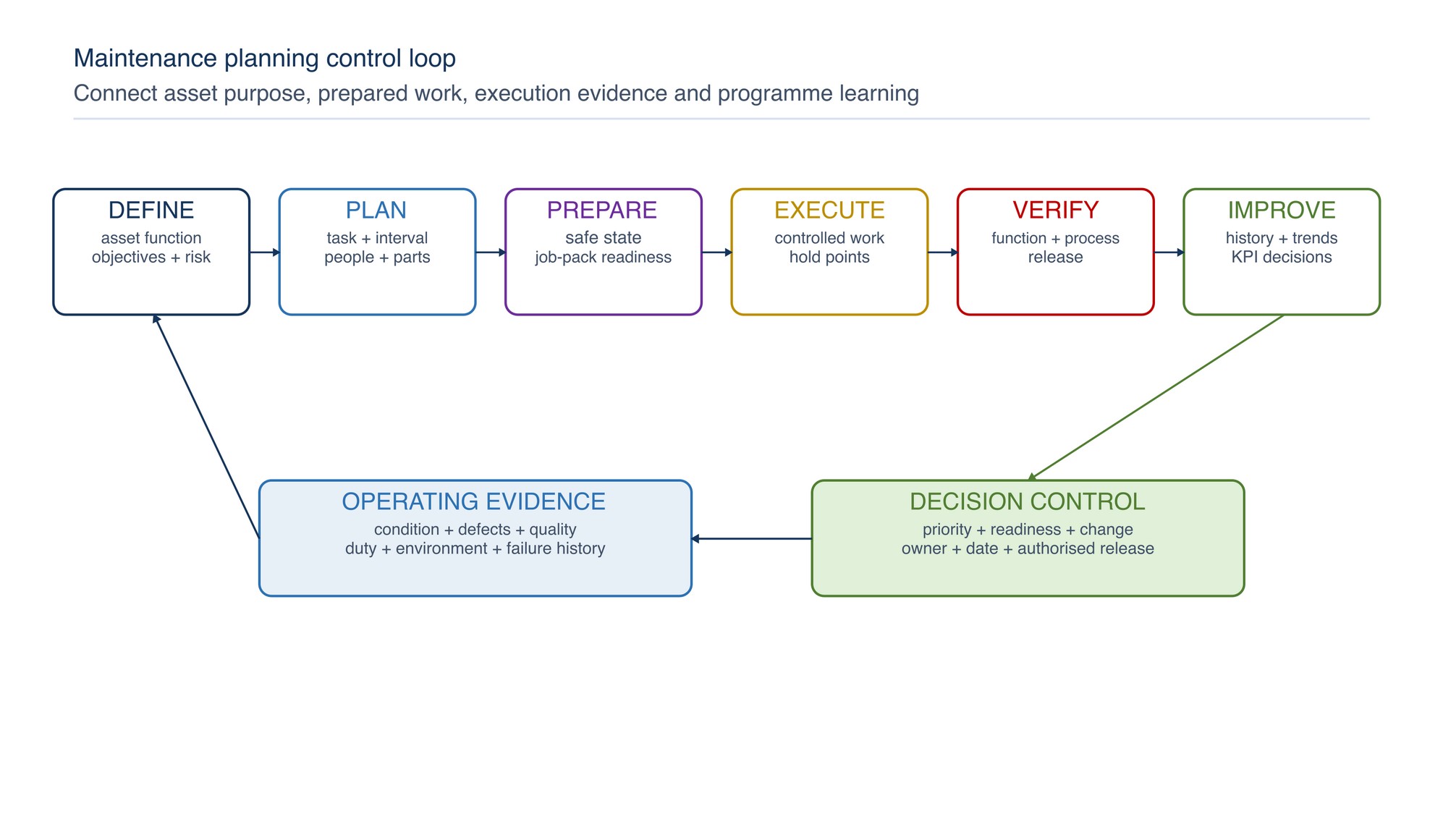
Good maintenance planning connects the right task, competent people, safe access, correct parts, reliable evidence and a suitable production window. A calendar entry alone does not make work planned or effective.
Maintenance supports safe operation, product quality, environmental control, equipment availability and asset life. The most useful programme is neither purely calendar-based nor purely reactive. It combines routine operator care, planned preventive tasks, condition evidence, defect history, competent inspection, corrective work and improvement action. [S275; S329; S330; S332; S337]
Chapter objectives
After this chapter, the reader should be able to:
- define maintenance objectives for an industrial grinding and surface-finishing operation;
- build a usable asset register and rank equipment criticality;
- translate daily, weekly and monthly planning bands into equipment-specific tasks;
- select task triggers and intervals from manufacturer instructions, risk, duty and condition;
- prepare a complete maintenance job pack before scheduling downtime;
- coordinate isolation, contractors, parts, access equipment and production release;
- identify critical spares without creating uncontrolled stock;
- use condition trends and failure history to improve the programme;
- prioritise backlog by consequence and deterioration risk; and
- use balanced maintenance KPIs that support decisions rather than reward superficial compliance.
Define what maintenance must achieve
Set objectives that reflect the actual operation. Common objectives include:
- keeping guards, controls, interlocks, extraction and other safety functions effective;
- maintaining tool, machine and process capability;
- preventing contamination, heat damage, vibration, leakage and unplanned stoppage;
- preserving coating, grinding, sanding and polishing quality;
- controlling dust, fume, overspray, noise and waste;
- reducing repeat failures and emergency work;
- coordinating planned downtime with production needs; and
- protecting equipment condition without unnecessary intervention.
A maintenance decision normally balances performance, risk and expenditure across the asset life cycle. The cheapest immediate action is not always the lowest-cost or lowest-risk decision. Deferring a low-consequence cosmetic repair may be reasonable; deferring a deteriorating guard, isolation point, fan bearing, filter seal or pressure component may not be. [S337]
Build an asset register that technicians can use
The asset register is the planning foundation. It should identify equipment consistently across the workshop, maintenance system, drawings, spare-parts store and work permits.
| Register field | Practical content | Why it matters |
|---|---|---|
| Asset identity | Unique number, equipment name, location | Prevents work on the wrong item |
| Manufacturer identity | Manufacturer, model, serial number | Links the asset to correct instructions and parts |
| Function and duty | Process served, material, operating pattern | Establishes consequence and maintenance demand |
| Energy sources | Electrical, pneumatic, hydraulic, thermal, gravity, stored energy | Supports isolation planning |
| Safety and environmental functions | Guard, interlock, extraction, filter, alarm, containment | Identifies safety-critical work |
| Configuration | Motor, drive, spindle, fan, control, filter or accessory arrangement | Preserves the approved equipment state |
| Technical information | Manual, drawing, parts list, inspection method, baseline | Provides the work basis |
| Responsible roles | Asset owner, operator group, maintainer, release authority | Clarifies decisions and handover |
| History | Defects, repairs, modifications, condition results | Supports learning and interval review |
Use durable, readable asset identification. Record relocations, substitutions and modifications so the physical machine and the maintenance record remain aligned. Similar-looking grinders, fans, booths or extraction units may use different components and procedures.
When an exact part, lubricant, filter, setting, operating value, test method or acceptance limit is required, Refer to the product label, Technical Data Sheet, or MKTECH representative.
Rank criticality by credible consequence
Criticality helps decide where planning effort, condition monitoring, spares and shutdown protection are most valuable. Consider credible failure consequences rather than equipment price alone.
| Criticality consideration | Questions for the planning team |
|---|---|
| People | Could failure expose a person to moving parts, hazardous energy, dust, fume, chemicals, fire or loss of protection? |
| Environment | Could failure release dust, overspray, contaminated liquid, oil, chemical or waste? |
| Quality | Could deterioration create scratches, dimensional error, contamination, coating defects or undetected nonconformance? |
| Production | Is there a standby asset, alternate route or recoverable buffer? |
| Deterioration | Will continued operation accelerate damage or turn a minor defect into a major repair? |
| Detectability | Is the developing fault visible to the operator, measurable, alarmed or hidden? |
| Recovery | Are competent people, parts, access equipment and specialist support available? |
Do not convert the discussion into an arbitrary score that hides judgment. Record the reason for the ranking and the controls it drives. A small extraction fan or inexpensive pressure switch can be more critical than a high-cost machine if its failure removes an important control.
Review criticality after process changes, new materials, significant failures, repeated defects or changes in production dependency.
Separate maintenance work types
| Work type | Trigger | Typical purpose |
|---|---|---|
| Operator care | Before, during or after use | Cleanliness, obvious condition, correct setup and early defect reporting |
| Planned inspection | Time, usage, event or risk basis | Find deterioration before loss of function |
| Preventive maintenance | Defined interval or usage trigger | Restore or preserve condition before expected deterioration |
| Condition-based maintenance | Trend, alarm or measured change | Act when evidence shows deterioration |
| Corrective maintenance | Confirmed defect | Restore the required function and configuration |
| Breakdown response | Functional failure | Make safe, diagnose, repair and recover control |
| Examination or specialist test | Applicable requirement or technical basis | Confirm integrity using competent methods |
| Improvement work | Recurrence, risk or performance opportunity | Remove causes, improve maintainability or strengthen control |
Keep these categories distinct in planning and reporting. Calling emergency repair “preventive maintenance” hides programme weakness. Treating every inspection finding as a completed repair hides backlog.
Use daily, weekly and monthly planning bands correctly
Daily, weekly and monthly headings are useful organising bands, but they are not universal equipment intervals. Convert each band into tasks suited to the asset, duty, environment, manufacturer instructions, risk and observed deterioration.
Daily or shift-based attention
Use this band for conditions that can change quickly or should be observed by the people closest to the process:
- damage, unusual noise, vibration, heat, smell or leakage;
- guards, handles, switches, hoses, cables, plugs and couplings;
- cooling openings, extraction connections and visible airflow condition;
- tool, wheel, belt, pad, disc, filter or consumable condition;
- pressure, differential-pressure, temperature or status indications;
- cleanliness around intakes, machines, booths and work areas;
- safety devices, alarms or interlocks included in an approved check; and
- defects carried from the previous shift.
Operator checks should be short, observable and connected to clear action. A tick without looking has no maintenance value. Define when the asset must be removed from service, when a supervisor may assess it and when a work request is required.
Weekly planning band
Use this band for broader condition reviews and recurring care that needs more access or coordination:
- inspect fasteners, mounting, guards, supports and accessible drive components;
- review filter loading, seals, drains, collection points and dust or residue accumulation;
- inspect hoses, reels, couplings, electrical leads and strain relief;
- clean approved ventilation paths and equipment surfaces;
- check lubrication or service points where specified;
- compare condition indicators with the established baseline or recent trend;
- review open defects, temporary measures and repeated operator observations; and
- confirm that planned jobs, parts and specialist support remain ready.
Monthly planning band
Use this band for system-level review, deeper planned tasks and management control:
- perform equipment-specific preventive tasks due in the period;
- inspect extraction, booth, compressor, fan, drive and utility systems as complete systems;
- review vibration, temperature, pressure, airflow or other condition trends;
- inspect safety-critical functions using approved methods and competent personnel;
- reconcile critical-spares condition and stock status;
- review repeat failures, overdue work and long-standing defects;
- confirm upcoming shutdown scope and job-pack readiness; and
- review KPI signals and adjust plans where evidence supports a change.
These bands may be shortened, extended or supplemented by usage, event or condition triggers. Document the task basis so the next planner understands why it exists.
Select the task and interval from evidence
Start with the manufacturer’s instructions and the actual equipment configuration. Then consider risk, operating duty, environment, condition evidence, defect history and the consequence of late or intrusive maintenance. [S329; S330; S333; S334]
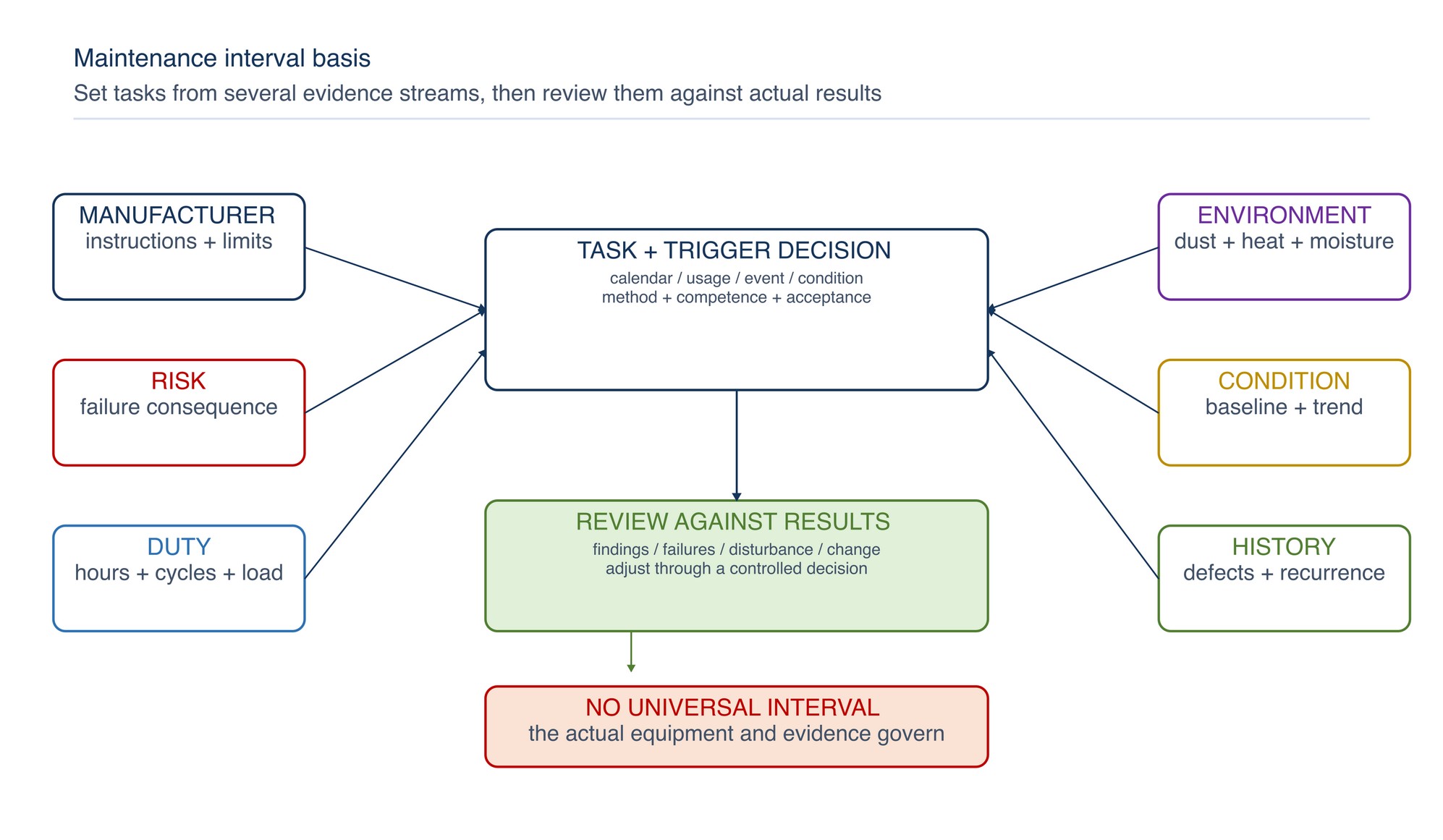
| Interval input | Planning implication |
|---|---|
| Manufacturer instructions | Establish specified tasks, parts, service limits and competent-work boundaries |
| Operating hours or cycles | Use where deterioration relates more closely to use than calendar time |
| Duty severity | Increase attention for high load, long duration, frequent starts or demanding process conditions |
| Environment | Consider dust, moisture, chemicals, heat, contamination and outdoor exposure |
| Failure consequence | Use greater planning assurance where loss of function has serious consequences |
| Condition trend | Advance, defer or investigate work only through a controlled decision |
| Defect history | Address recurring components, causes and weak task content |
| Post-maintenance disturbance | Avoid unnecessary intrusive work that can introduce error or contamination |
Do not extend an interval merely because no failure occurred. Confirm that inspections were capable of detecting the relevant deterioration, results were credible and the consequence remains controlled. Likewise, shortening every interval after one failure may add cost without treating the cause.
Review the interval when duty changes, a new material is introduced, the asset is relocated, the environment changes, a significant failure occurs, condition results drift or maintenance repeatedly finds no deterioration.
Write tasks that produce a clear result
Weak instruction: “Check grinder.”
Useful instruction: identify the asset and safe state; inspect the specified cable, plug, switch, guard, spindle, flange, cooling path and abnormal-vibration indicators; record defects; complete the defined functional check; and apply the stated release route.
Each task should define:
- trigger and due basis;
- asset and component boundary;
- required safe state and isolation;
- competence and authorisation;
- tools, test equipment and access equipment;
- consumables, controlled parts and replacement criteria;
- inspection, cleaning, adjustment or replacement steps;
- measurements and recording method;
- acceptance criteria and escalation route;
- restoration, functional check and release authority; and
- waste, housekeeping and handover requirements.
Keep task detail proportional to risk and complexity. A simple cleaning task may need a short instruction; a fan overhaul, electrical intervention, booth service or extraction examination needs a controlled work pack.
Build a job pack before booking downtime
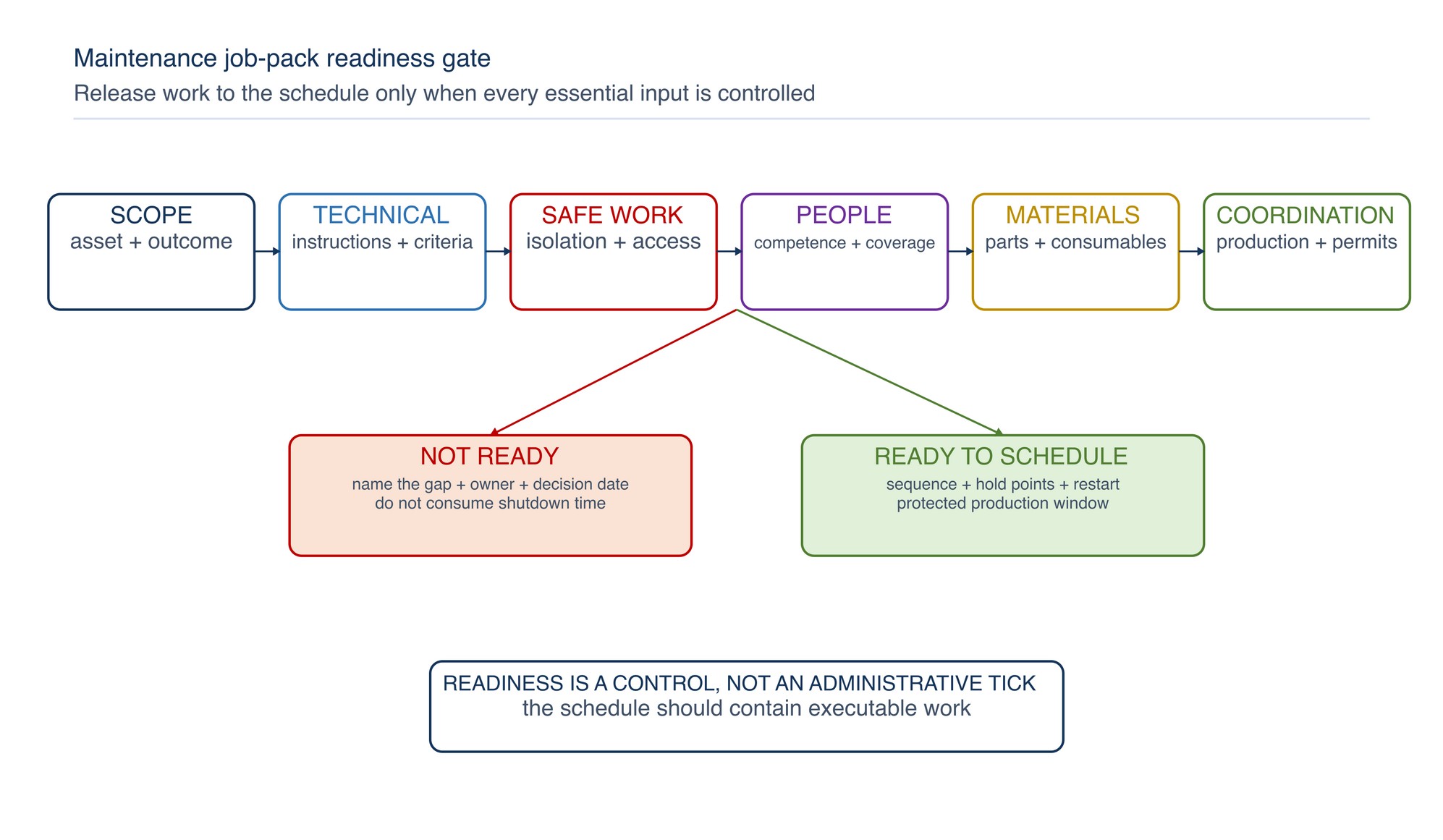
| Job-pack element | Ready condition |
|---|---|
| Scope | Asset, fault or task boundary and required outcome are clear |
| Technical basis | Current instructions, drawings, parts and acceptance method are available |
| Safe work | Isolation, access, residue, pressure, temperature and adjacent-work controls are planned |
| Labour | Required competence, number of people and shift coverage are available |
| Materials | Correct parts, consumables, lubricants, filters and fasteners are verified |
| Tools and tests | Suitable tools, lifting/access equipment and valid measuring equipment are ready |
| Coordination | Production, permits, contractors, utilities and simultaneous work are aligned |
| Release | Functional test, process check, documentation and release authority are defined |
Do not schedule an incomplete job merely to fill a shutdown plan. Flag the readiness gap, assign an owner and protect the decision date. Planned work that waits for a seal, permit, drawing or specialist after the machine stops is avoidable downtime.
Plan hazardous-energy control and safe access
Maintenance may expose electrical supply, battery energy, compressed air, hydraulic pressure, gravity, rotating inertia, springs, hot surfaces, fuel, automatic movement and chemical residue. Plan the complete boundary, including connected equipment and stored energy. [S331]
The work plan should address:
- normal shutdown and communication with affected people;
- identification of every relevant energy source;
- isolation and control under the workplace procedure;
- dissipation, restraint or blocking of stored energy;
- verification of the safe state before work;
- control of keys, locks, tags, permits and group work;
- boundary changes, shift transfer and contractor handover;
- inspection for completeness before restoration; and
- controlled re-energisation, functional check and release.
Temporary energisation for diagnosis or testing requires a specific controlled method. Do not normalise bypassed guards, defeated interlocks or informal “quick tests.”
Coordinate planned shutdown work
Build shutdown scope early enough to prepare it. Separate mandatory work, condition-driven work, opportunity work and optional improvements. Protect the jobs that control safety, environment, quality or the critical path.
Shutdown preparation sequence
- Freeze a preliminary scope and confirm asset boundaries.
- Review task dependencies and shared isolations.
- Validate job packs, drawings, parts, labour and specialist support.
- Confirm access, lifting, ventilation, cleaning, waste and permit needs.
- Sequence work to prevent congestion, contamination and conflicting activities.
- Define inspection hold points and who can accept them.
- Prepare restart and production-verification plans.
- Conduct a readiness review before the shutdown begins.
- Control emerging work through an authorised scope-change process.
- Close the shutdown with defects, lessons, parts usage and follow-up actions recorded.
Avoid overloading the shutdown with low-readiness work. Emergency additions can delay critical tasks and compress testing time. New findings should be assessed by consequence, required resources and effect on the restart path.
Identify and control critical spares
A critical spare is not simply an expensive part. It is a part whose absence could create unacceptable safety, environmental, quality or production consequences before a replacement can be obtained.
| Spare decision factor | Planning question |
|---|---|
| Failure consequence | What happens while the part is unavailable? |
| Lead time | How long from verified order to usable receipt? |
| Failure predictability | Is deterioration detectable early enough to order? |
| Commonality | Can a verified part serve several assets? |
| Preservation | Does the part age, corrode, deform, absorb moisture or require rotation? |
| Configuration control | Could a similar-looking but incompatible part be selected? |
| Repair option | Is a safe, competent and timely repair route available? |
| Obsolescence | Is the part or supporting control becoming unavailable? |
Control spare identity, storage condition, shelf life where applicable, inspection, preservation and issue history. Protect bearings, seals, belts, filters, electronic modules, motors and precision components from contamination, moisture, impact and distortion. Keep safety-critical parts linked to the correct asset and technical information.
When a precise spare identity or storage condition is required, Refer to the product label, Technical Data Sheet, or MKTECH representative.
Use condition monitoring as a decision system
Condition monitoring is more than collecting readings. A useful programme defines the failure mode, measurement point, method, operating state, baseline, trend, review responsibility and action route. [S332]
Common evidence may include:
- vibration, noise or bearing-condition indicators;
- temperature and thermal pattern;
- electrical current or power behaviour;
- pressure, differential pressure or airflow;
- speed, run-down behaviour or rotational stability;
- oil, moisture, particle or contamination condition;
- belt, seal, hose, cable, filter and surface condition;
- process quality, finish, dimensional drift or defect rate; and
- operator observations linked to a repeatable operating state.
Compare like with like. Record asset, location, instrument, operating mode, load, process condition and measurement point. A changed reading may reflect a changed process, sensor, mounting point or operating state rather than asset deterioration.
Set action logic before the trend becomes urgent: continue monitoring, repeat and validate, inspect at the next opportunity, plan corrective work, reduce duty or remove from service. Exact limits require the applicable technical basis. Refer to the product label, Technical Data Sheet, or MKTECH representative.
Turn failure history into better work
Record enough information to learn from failures:
- asset and operating state;
- symptom, time and detection method;
- immediate safe action;
- confirmed failed function or component;
- evidence supporting the cause;
- repair and parts used;
- functional and production verification;
- downtime and operational consequence; and
- follow-up action, owner and due date.
Use repeat-failure review when the same symptom, component or process loss returns. Ask whether the cause relates to contamination, alignment, overload, installation, lubrication, utility quality, environment, wrong part, weak inspection, poor task design, inadequate competence or an unresolved system condition.
Replacing the same part repeatedly is not a complete corrective action if the cause remains active.
Prioritise backlog by consequence and urgency
Backlog includes identified work not yet completed. It should be visible, technically described and actively controlled.
| Priority signal | Planning response |
|---|---|
| Immediate uncontrolled danger or loss of required protection | Stop or restrict use, make safe and escalate through the workplace system |
| Deteriorating safety, environmental or quality control | Define interim control, responsible owner and earliest competent correction |
| High production consequence with limited warning | Secure parts, labour and planned window before deterioration becomes failure |
| Stable defect with controlled consequence | Plan into an efficient work window and monitor condition |
| Improvement or convenience work | Rank against benefit, readiness and available capacity |
Temporary measures must be explicit, time-bound and reviewed. They are not permanent repairs by another name. Record operating restrictions, inspection needs, expiry or review date and the person authorised to remove the measure.
Review ageing backlog, repeated deferrals and jobs with missing scope. A large backlog may contain duplicates, obsolete requests, poorly described work and hidden high-consequence defects. Clean the data without deleting valid obligations.
Distinguish work completion from equipment release
The technician may complete the assigned task, but the asset is not ready until affected controls and functions have been restored and verified.
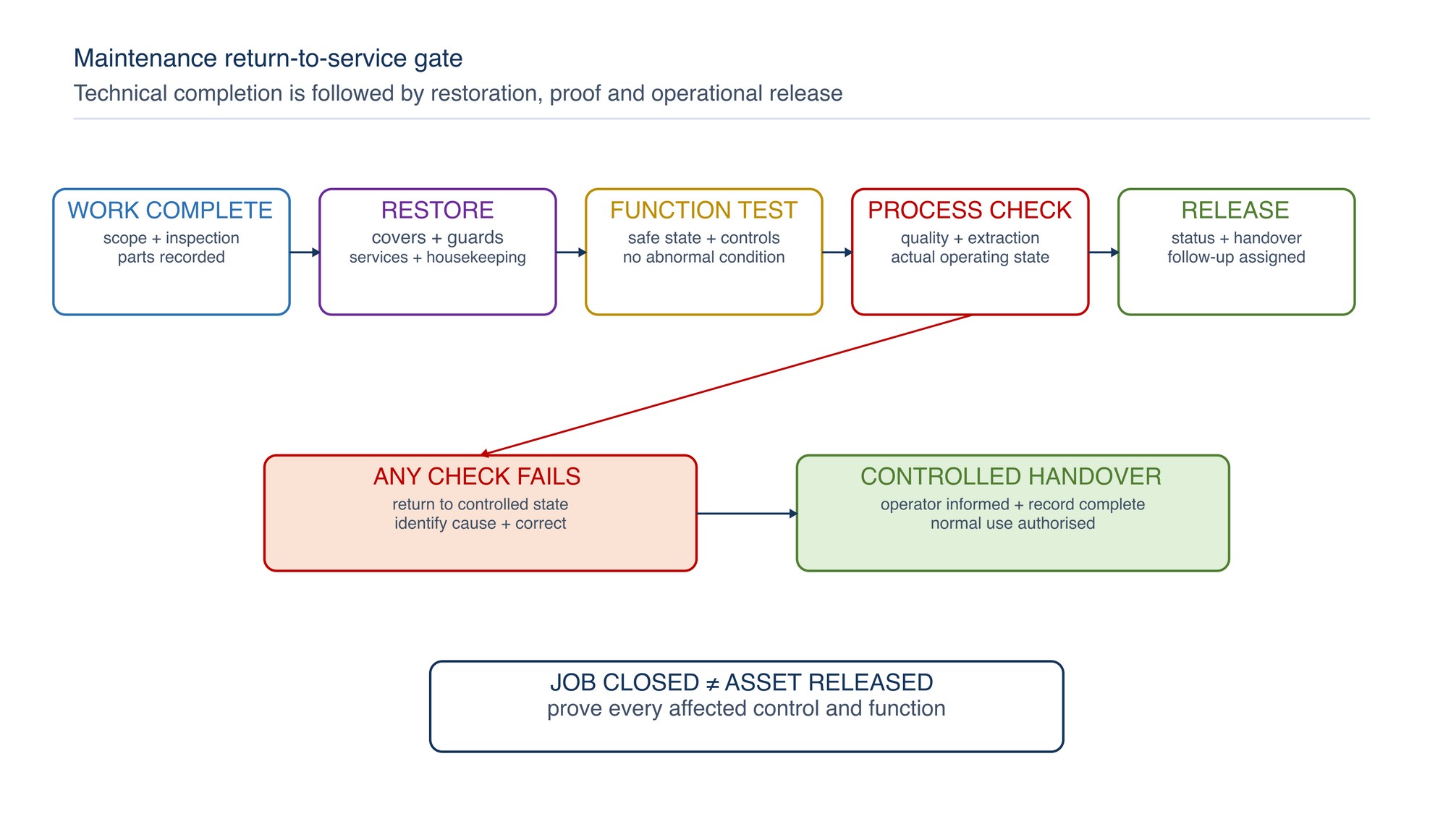
Return-to-service checks
- tools, rags, loose parts, waste and temporary supports removed;
- covers, guards, handles, fasteners, access panels and services restored;
- controlled parts and configuration confirmed;
- lubricants, fluids, filters and connections correctly installed;
- isolation removed through the approved restoration sequence;
- people clear and affected teams informed;
- abnormal noise, vibration, heat, leakage and smell absent;
- safety devices, alarms, interlocks and extraction functions checked as applicable;
- unloaded and loaded functional checks completed where authorised;
- product or process quality verified where maintenance could affect it; and
- asset status, readings, defects and follow-up work recorded.
If a release check fails, return the asset to a controlled state, identify the cause and correct it before normal use.
Manage contractors and specialist work
Provide contractors with accurate scope, asset identity, hazards, isolation arrangements, site rules, interfaces and acceptance requirements. Confirm competence for the actual work rather than relying on a general company description.
Coordinate:
- site induction and responsible contact;
- permits, isolation ownership and group-control method;
- chemical, dust, residue, fire and confined-space interfaces where applicable;
- drawings, settings, software backups and configuration access;
- lifting, access and test-equipment responsibilities;
- parts supplied by each party;
- inspection hold points and change authorisation;
- waste, housekeeping and reinstatement; and
- service reports, test results and final handover.
Review proposed substitutions and modifications before installation. A physically fitting component is not automatically technically suitable.
Use balanced maintenance KPIs
No single KPI proves maintenance effectiveness. Use a small set that connects work execution with equipment condition and operational outcome.
| KPI | Useful interpretation | Common misuse to avoid |
|---|---|---|
| Planned-work percentage | Shows how much completed work came through a prepared route | Counting poorly scoped calendar tasks as planned work |
| Schedule attainment | Indicates whether ready work was completed in the agreed window | Penalising justified emergency or safety intervention |
| Emergency-work share | Signals reactive demand and planning instability | Reclassifying emergency jobs to improve the number |
| Repeat-failure rate | Highlights ineffective correction or persistent causes | Counting only identical part numbers and missing repeated symptoms |
| Backlog age by consequence | Shows exposure from deferred work | Reporting one average that hides old critical jobs |
| Preventive-task findings | Shows whether tasks detect meaningful deterioration | Rewarding “no defects” without checking inspection quality |
| Condition-warning closure | Tests response from detection to controlled action | Closing the alert before corrective action or accepted monitoring |
| Post-maintenance defect rate | Indicates maintenance-induced failure or weak release | Excluding faults discovered during restart |
| Critical-spares readiness | Shows whether verified spares are usable when needed | Counting unverified, damaged or obsolete stock |
| Availability or downtime | Shows operational outcome | Attributing every production loss solely to maintenance |
Define each KPI’s numerator, denominator, exclusions, data owner and review action. Trend it over a meaningful period and examine the underlying jobs. Targets should not encourage unsafe deferral, superficial closure or excessive low-value maintenance.
Hold an effective planning meeting
Keep the meeting focused on decisions. Review:
- new high-consequence defects and safe operating status;
- work due in the planning horizon;
- job-pack readiness and missing resources;
- production windows and asset dependencies;
- contractor, permit and isolation interfaces;
- critical-spares constraints;
- condition warnings and trend changes;
- overdue work, ageing backlog and temporary measures;
- repeat failures and improvement actions; and
- shutdown readiness and restart risks.
Finish with named owners, dates and decisions. Do not use the meeting to read every work order aloud.
Troubleshooting the maintenance programme
| Programme symptom | Likely planning causes | Practical response |
|---|---|---|
| Frequent emergency work | Weak defect capture, poor task basis, overloaded schedule, unavailable parts | Review failure modes, operator reporting, task effectiveness and spares |
| Many overdue tasks | Unrealistic frequencies, insufficient capacity, low readiness, unclear priorities | Risk-review tasks, prepare work earlier and protect critical capacity |
| Repeated same-component failure | Cause not removed, wrong part, installation error, contamination, misalignment or overload | Preserve evidence, verify cause and review the complete system |
| Shutdown overruns | Scope growth, missing parts, shared isolations, access conflict, weak restart plan | Strengthen readiness gate, sequencing and scope-change control |
| Inspections always report “OK” | Vague task, poor access, weak competence or unsuitable method | Rewrite task with failure-specific checks and acceptance logic |
| Condition data is noisy | Inconsistent point, mode, load, instrument or technique | Standardise collection and validate the measurement chain |
| High schedule attainment but poor reliability | Easy tasks dominate; defects and causes remain open | Balance execution metrics with repeat failures, backlog and outcomes |
| Spare is in stock but unusable | Wrong configuration, corrosion, damage, expired material or missing preservation | Strengthen identification, storage, inspection and stock review |
| Maintenance creates quality defects | Contamination, wrong configuration, incomplete cleaning or weak process release | Add cleanliness, configuration and production-verification hold points |
Maintenance-planning checklist
- [ ] Asset identity, function, duty and responsible owner are clear.
- [ ] Criticality reflects people, environment, quality, production, deterioration and recovery consequence.
- [ ] Daily, weekly and monthly bands have equipment-specific tasks and action routes.
- [ ] Task and interval basis reflects manufacturer instructions, risk, duty, environment, condition and history.
- [ ] Job packs define scope, safe state, competence, parts, tools, acceptance and release.
- [ ] Planned shutdowns have controlled scope, sequencing, hold points and restart plans.
- [ ] Critical spares are correctly identified, preserved and linked to the right assets.
- [ ] Condition monitoring uses repeatable points, operating states, trends and action logic.
- [ ] Failure history records confirmed evidence, repair, verification and follow-up.
- [ ] Backlog priorities and temporary measures remain visible and reviewed.
- [ ] Work completion is followed by functional and process release where applicable.
- [ ] KPIs are defined, balanced and connected to management action.
Practical planning takeaway
Start with the asset’s function and credible failure consequence. Build the task from the correct technical basis, prepare the work before downtime, control every energy and work interface, verify the result and use operating evidence to improve the next plan. The strongest maintenance programme is not the one with the most tasks; it is the one that consistently preserves required function and detects deterioration before consequence.
Tool and Abrasive Storage
The Tool and Abrasive Storage chapter begins on the following page of the printed handbook (page 501), outside this chapter extract.