
Storekeepers, production supervisors, grinding and finishing personnel, maintenance teams, safety personnel, QA/QC teams and technical buyers
Receiving; identification; storage environment; racks and cabinets; bonded wheels; cutting wheels; coated abrasives; belts; flap discs; non-woven products; polishing materials; power tools; batteries; pneumatic tools; stock rotation; issue and return; mobile storage; segregation; inspection and troubleshooting.
Handle every bonded wheel as breakable. Do not roll wheels along the floor. Do not use abrasive cartons as workbenches or seats. Prevent ignition sources and incompatible materials from entering controlled chemical or battery areas. Inspect product condition again before mounting or use. Do not mount or issue a product that has been dropped, struck, wetted, visibly damaged or separated from reliable identification.
An abrasive product can be damaged before it ever reaches a machine. Correct storage preserves identity, shape and condition while preventing impact, moisture, heat, contamination and uncontrolled ageing.
Chapter objectives
After this chapter, the reader should be able to:
- organise a clean, controlled tool and abrasive store;
- inspect deliveries and separate suspect products;
- select suitable support for different abrasive forms;
- protect coated abrasives from environmental distortion;
- maintain product identity and stock rotation;
- control open packs, returns and mobile storage;
- store tools and accessories without creating hidden damage; and
- recognise storage symptoms and correct their likely causes.
Treat storage as a safety and quality control
Bonded wheels can crack or chip through impact and poor support. Thin cutting wheels can warp. Paper, cloth and fibre backings can change shape as moisture conditions change. Adhesive-backed discs can lose protective liners or collect contamination. Polishing compounds can harden, soften or become contaminated. Tools can suffer cable, hose, spindle, battery or bearing damage when piled together.
A controlled store therefore protects four things:
| Control objective | Practical result |
|---|---|
| Identity | The user can verify product type, dimensions, marking and intended application |
| Physical condition | The product remains supported, clean, dry and protected from impact |
| Environmental stability | Temperature and moisture changes do not unnecessarily distort or degrade the product |
| Traceability | Receipt, batch or date information remains connected to the product through issue |
Design the store around the product flow
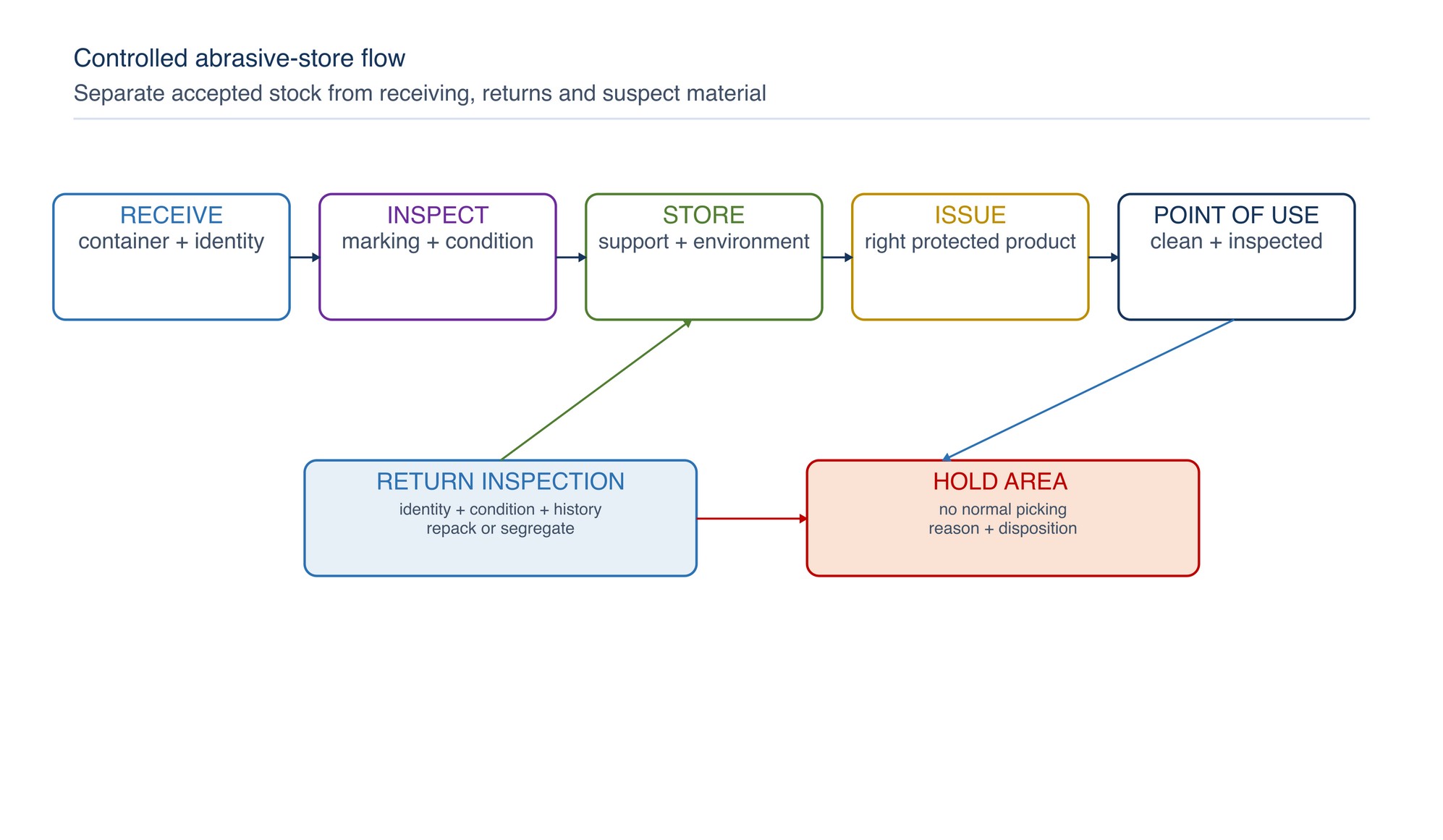
Use a one-direction flow where practical: receiving, inspection, accepted stock, issue, point of use, controlled return and segregation. Keep new deliveries out of normal pick locations until their identity, quantity and visible condition have been checked.
Locate abrasive storage away from vehicle routes, crane loads, heavy vibration, water ingress, wash areas, chemical vapour, direct sunlight and strong heat sources. Provide enough aisle and shelf space for safe handling without rolling wheels, dragging cartons or balancing products on edges.
Keep the store clean and well lit. Avoid bare floor storage. Use shelves, drawers, bins or cabinets that prevent products from falling and allow selection with minimal handling. Heavy items belong at a practical lifting height with suitable handling assistance.
Control the storage environment
Stable conditions matter more than a generic room-temperature statement. Repeated movement between cool air-conditioned storage and a warm humid workshop can create condensation. Damp walls or floors can transfer moisture to cartons. Sunlight, ovens, steam lines and hot-air ducts can create local heating even when the room average appears acceptable.
Monitor the actual store where environmental variation could affect product condition. Respond to water leaks, condensation, damaged packaging, mould, corrosion, curling or softened cartons promptly. Do not assume that a dehumidifier or air conditioner provides control unless its operation and room conditions are checked.
For an exact storage temperature, humidity range, shelf life or conditioning period, Refer to the product label, Technical Data Sheet, or MKTECH representative.
Receive and inspect deliveries
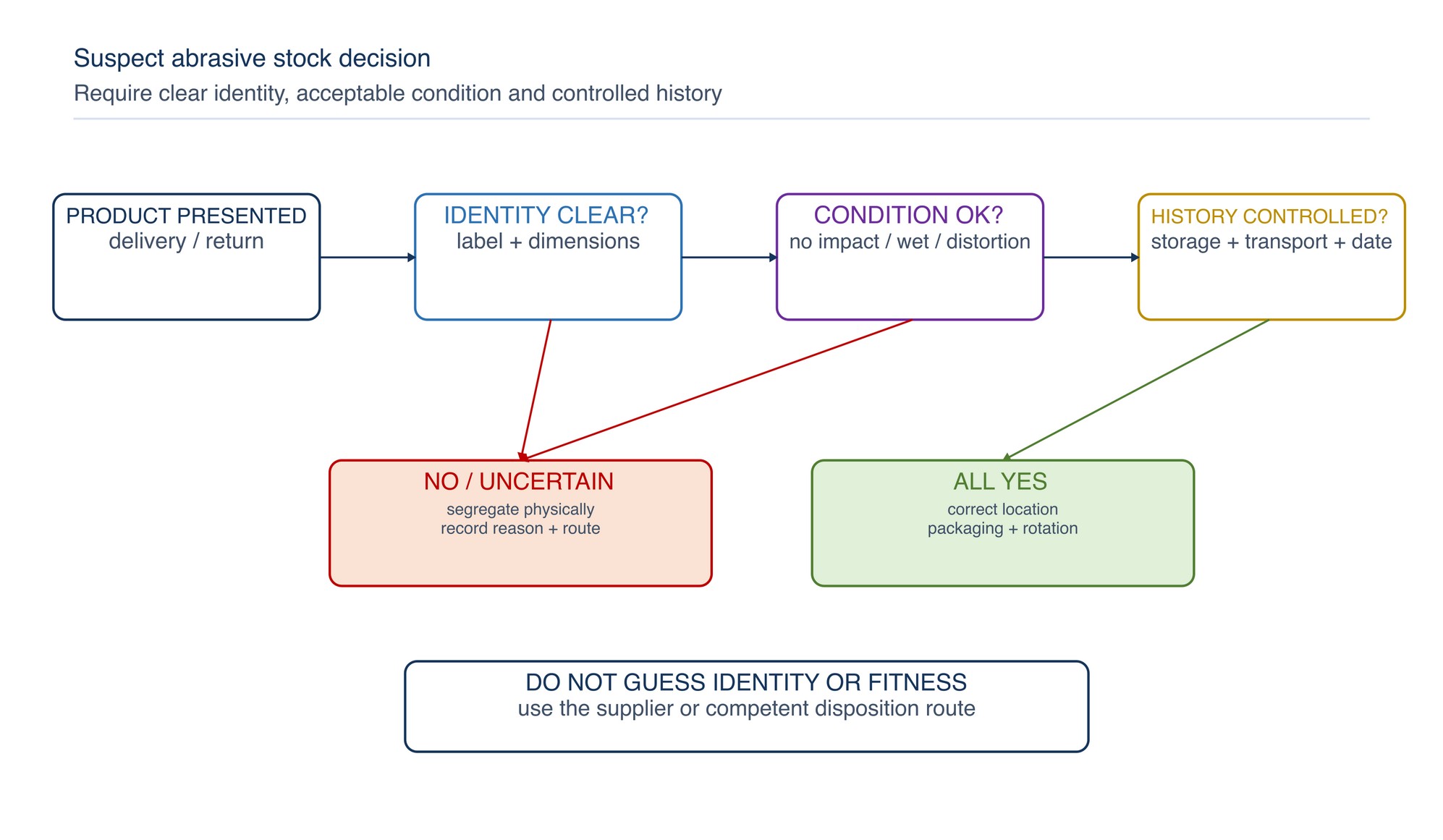
Check the outer container before opening. Look for crushing, puncture, water marks, broken pallet restraint, impact damage and evidence that cartons have been dropped or stored incorrectly.
When unpacking:
- confirm the purchase and delivery identity;
- compare the product marking with the ordered type and dimensions;
- check quantity and packaging integrity;
- inspect accessible products for cracks, chips, warping, crushed edges, delamination, contamination or missing labels;
- retain batch, date and product information with the stock; and
- place suspect material in a clearly separated hold area.
Do not mount or issue a product that has been dropped, struck, wetted, visibly damaged or separated from reliable identification. Use the supplier or manufacturer route for disposition.
Store bonded grinding wheels by shape and size
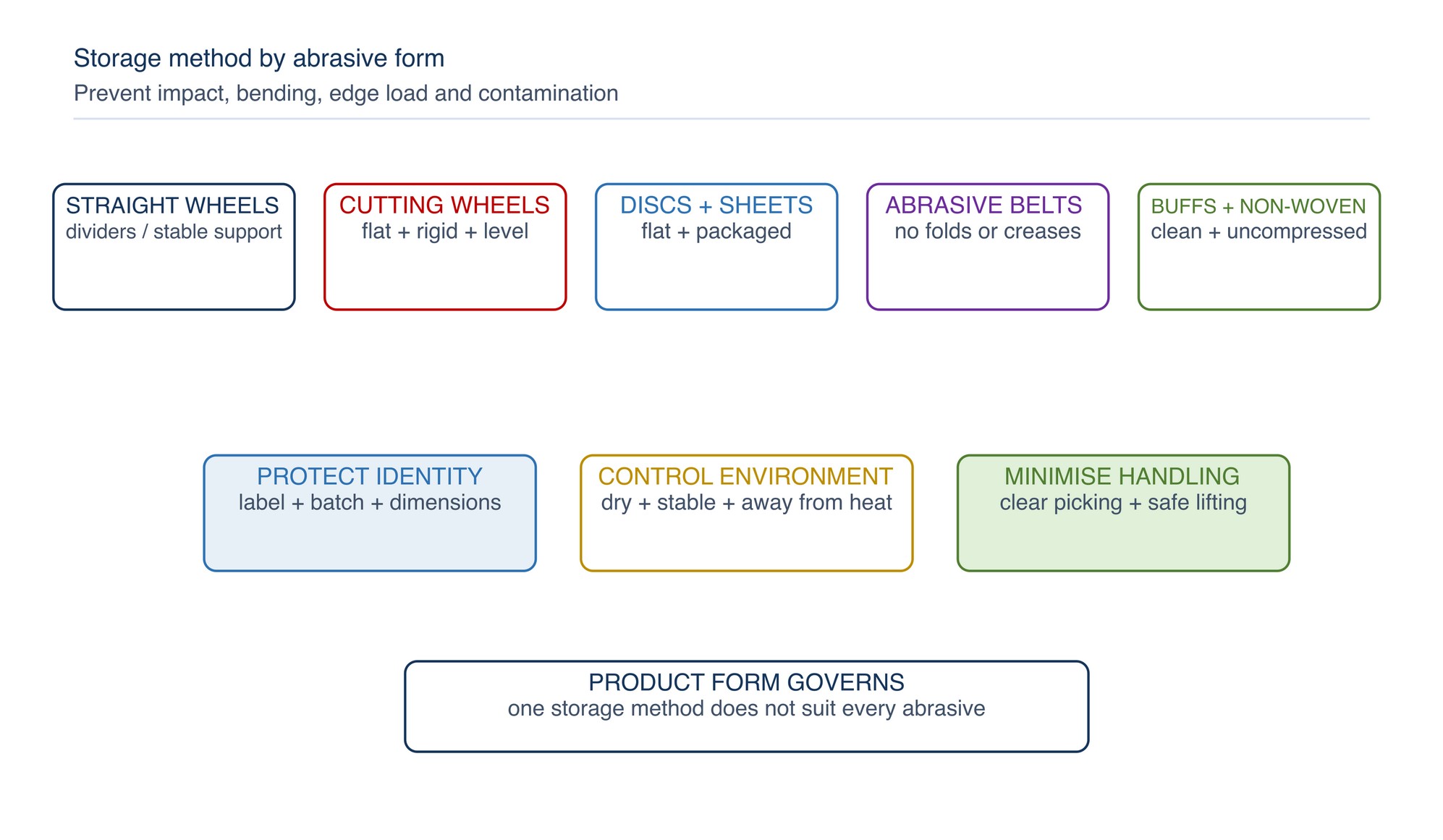
Suitable support depends on wheel form. The aim is to prevent rolling, edge loading, bending, impact and excessive stack pressure.
| Product form | Storage approach |
|---|---|
| Small straight wheels | Divided drawers, bins or supported shelves that prevent rolling and edge impact |
| Large straight wheels | Stable vertical partitions or manufacturer-recommended support with safe handling access |
| Cup, dish and shaped wheels | Individual compartments or nested support only where the product information permits |
| Segments and blocks | Divided trays or boxes that preserve identity and prevent chipping |
| Mounted points | Organised trays or racks that protect the abrasive head and spindle from impact or bending |
| Superabrasive products | Original protective packaging with identity and mounting surfaces protected |
Never use an improvised peg through the bore unless the storage arrangement is specifically suitable for that wheel. Protect bore surfaces, blotters, flanges and mounting faces from damage and contamination.
Give thin cutting wheels rigid, flat support
Thin cutting wheels are particularly vulnerable to bending and edge damage. Store them flat on a clean, rigid, level support in their original packaging. Keep stacks modest and stable; do not place unrelated heavy parts on top. Avoid leaning loose cutting wheels against a wall or mixing diameters in an unsupported pile.
If a package has sagged, become wet or been exposed to abnormal heat, separate it for assessment. A wheel that appears flat while constrained in a stack may still have been affected.
For the permitted stacking arrangement or product life, Refer to the product label, Technical Data Sheet, or MKTECH representative.
Protect coated abrasive discs and sheets
Paper, cloth, film and fibre backings respond differently to moisture and heat. Store coated products in their original closed packaging until required. Keep cartons off concrete floors and away from damp external walls, windows and heat sources.
Keep discs flat and supported. Do not fold sheets or place irregular parts on them. Preserve adhesive-disc liners and hook-and-loop faces. Separate products used on stainless steel from stock exposed to carbon-steel debris where contamination control matters.
Curling, cupping, brittle backing, softened backing or edge lift indicates that the storage or packaging condition should be investigated before issue.
Store abrasive belts without creases
Keep belts in their original cartons wherever possible. Do not crush cartons or place belts under uneven loads. Loose belts should be supported so they do not kink, fold, develop a sharp bend or collect dust on the joint and abrasive face.
Wide belts may require controlled conditioning before use, particularly when the store and machine area have different environments. Follow the product and machine information; do not apply one conditioning time to every backing, belt width or workshop.
At issue, check joint condition, edges, shape and directional marking where present. A creased or distorted belt can track poorly and should not be forced onto the machine.
Store flap discs, fibre discs and backing pads as systems
Keep flap discs flat or in their protective packaging so the flaps are not crushed or bent. Protect the centre and product label.
Store fibre discs flat and dry; moisture-related distortion can prevent correct support by the backing pad.
Backing pads, flanges and adapters should be kept clean, identified and free from cuts, distortion and embedded debris. Do not combine accessories in an unlabelled bin where incompatible threads, diameters or support types can be selected by appearance alone.
Control non-woven and polishing products
Store non-woven belts, discs, wheels and sheets clean and dry without compression that permanently changes their shape. Protect convolute and unitised wheels from edge damage. Keep polishing mops and buffs in clean bags or cabinets so they do not collect metal particles, grit or shop dust.
Separate compounds by material and finishing stage. Keep containers closed and applicators dedicated where cross-contamination could create scratches or stain a workpiece. Do not return a used compound bar to clean stock when its identity or contamination state is uncertain.
Store power tools ready for inspection, not hidden in a pile
Disconnect tools from energy before storage. Remove abrasive products where the tool or product instructions require it. Clean approved exterior and ventilation areas without driving dust into the tool.
Use racks, cases or cabinets that support the tool body and protect the spindle, guard, cable, plug, hose connection and controls. Do not hang a tool by its cable or hose. Avoid tight cable coils, sharp hose bends and drawers that close on leads.
Keep guards, handles, flanges, nuts and dedicated accessories with clear tool-family identification. A complete storage position makes missing or damaged parts visible before the next job.
Battery and pneumatic tool storage
Protect battery packs from short circuit, impact, water, heat and contact with metal objects. Store and charge them using the specified equipment and arrangement. Damaged, swollen, overheated or leaking packs require immediate segregation under the workplace battery procedure.
For pneumatic tools, disconnect the air supply, release stored pressure and protect the inlet from dirt. Store hoses without crushing or tight kinks and keep couplings clean. Apply only the lubricant and storage method specified for the tool.
Preserve labels and product identity
The label or marking connects the product to its dimensions, type, limitations and traceability. Do not separate loose products from their labelled packaging unless an equivalent controlled identification method is used.
Each pick location should distinguish similar products clearly. Useful information includes product family, dimensions, grit or grade, backing or bond type, material application, batch or date identifier and stock status. Avoid handwritten abbreviations that only one operator understands.
Unidentifiable abrasives should not be guessed into service.
Rotate stock without overriding product information
First-in, first-out is a useful default, but date-controlled products require earliest-valid-use logic and current product instructions. Put newly received stock behind or below the existing valid stock where safe. Review slow-moving items, opened packs and products approaching a marked use-by date.
Stock rotation does not make damaged or expired product acceptable. Do not relabel dates, combine batches without traceability or move suspect stock back into normal issue locations.
Control issue, open packs and returns
Issue the smallest practical quantity in protective packaging. At point of use, keep abrasives in a clean cabinet or covered container away from sparks, coolant, water, oil and foot traffic.
Returned products need a defined decision:
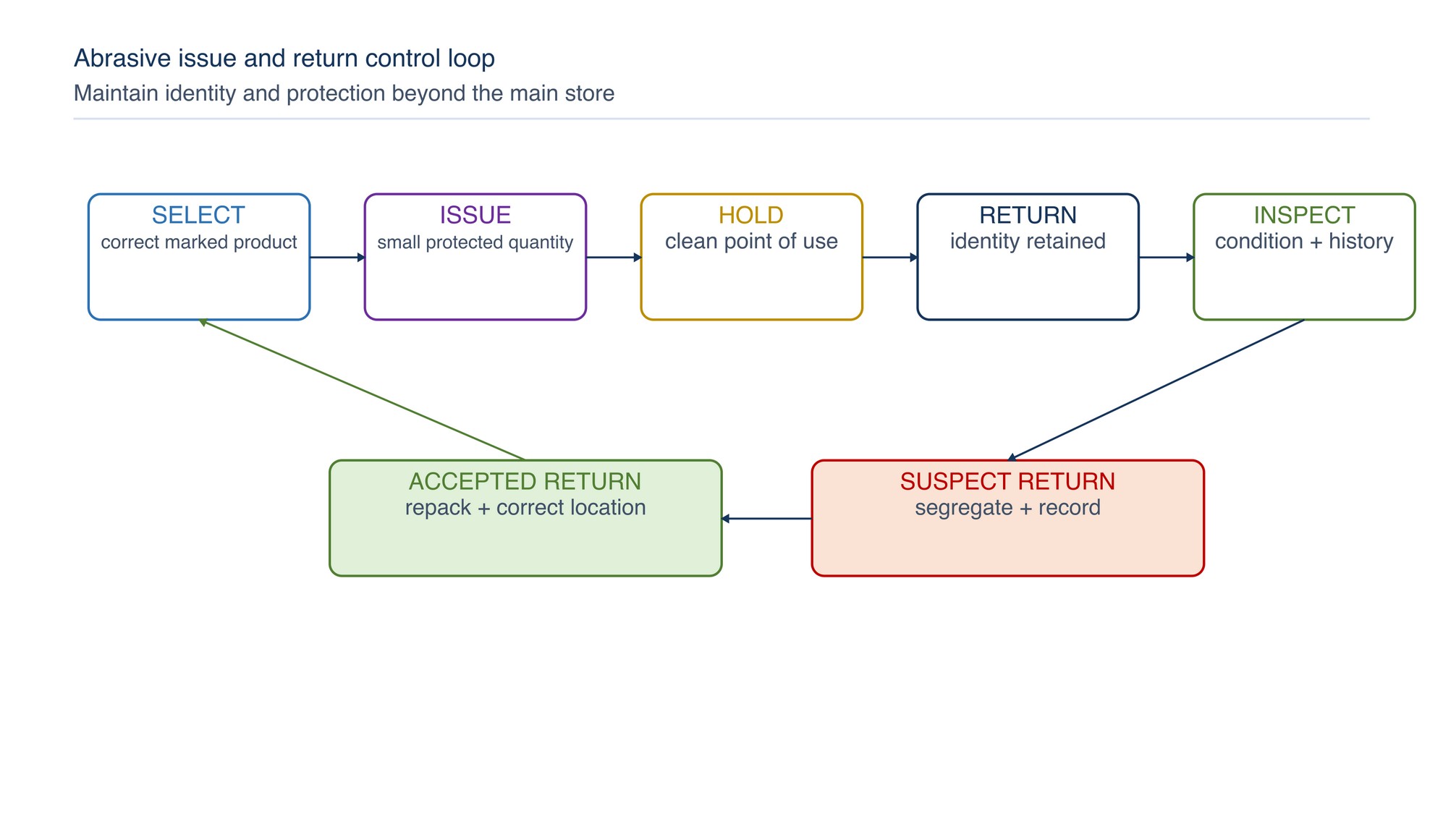
| Return condition | Action |
|---|---|
| Unopened, identified and protected | Inspect and return to the correct controlled location |
| Opened but clean and fully identified | Repack, preserve the label and use through the controlled open-pack route |
| Dropped, wet, distorted, contaminated or damaged | Segregate; do not reissue |
| Identity or storage history uncertain | Hold for supplier or competent disposition |
Mobile stores and service vehicles
Vehicle and site boxes experience vibration, heat, humidity and impact. Use fixed compartments, rigid support and weather protection. Do not leave cutting wheels loose in a toolbox or under heavy equipment. Inspect mobile stock more frequently when transport conditions are severe.
Carry only the quantity and product range needed for the work. Return unused stock through the same inspection route; do not silently replenish the main store with products of uncertain transport history.
Segregate suspect product visibly
The hold area should prevent accidental picking. Mark the status, product identity, quantity, reason for hold, date and responsible decision route. Physical separation is stronger than a note placed on a normal shelf.
Common hold reasons include impact, water exposure, condensation, fire or heat exposure, cracked or crushed packaging, missing marking, warping, chipped edges, delamination, corrosion, chemical contamination and exceeded marked product life.
Troubleshooting storage symptoms
| Symptom | Likely storage contributors | Corrective action |
|---|---|---|
| Cutting wheels no longer lie flat | Poor support, uneven loading, heat or moisture | Segregate stock; correct the shelf and environmental cause |
| Coated discs curl | Humidity change, open packaging or damp storage | Hold affected product; stabilise storage and keep packs closed |
| Belts crease or track poorly | Crushed cartons, sharp bends or inadequate conditioning | Correct support; inspect belt and machine before use |
| Labels detach or become unreadable | Moisture, handling or repacking failure | Restore controlled identification; do not guess the product |
| Repeated chipped wheels | Impact during receipt, picking or transport | Review handling path, compartments and lifting method |
| Polished surfaces develop random scratches | Contaminated buffs, compound or storage cabinets | Segregate materials and clean the storage and handling system |
| Tools return with damaged leads or hoses | Piled storage, tight coils or drawer pinch points | Provide dedicated supports and inspect before reissue |
Storage-area safety reminders
- Handle every bonded wheel as breakable.
- Use suitable assistance for heavy or awkward products.
- Keep aisles, shelves and emergency access clear.
- Do not roll wheels along the floor.
- Do not use abrasive cartons as workbenches or seats.
- Keep chemicals under their label and Safety Data Sheet storage controls.
- Prevent ignition sources and incompatible materials from entering controlled chemical or battery areas.
- Inspect product condition again before mounting or use.
Storekeeper checklist
- [ ] Receiving stock is separated until identity and visible condition are checked.
- [ ] Racks, drawers and cabinets support each product form without edge load or bending.
- [ ] Thin cutting wheels are flat, protected and free from unrelated stack loads.
- [ ] Coated abrasives remain packaged, dry and away from heat or damp surfaces.
- [ ] Belts are protected from crushing, folds and sharp bends.
- [ ] Labels, batches and date information remain legible through issue.
- [ ] Open packs and returns follow a defined inspection route.
- [ ] Suspect, damaged, expired or unidentifiable product is physically segregated.
- [ ] Tools, batteries, hoses, cables and accessories have dedicated protected positions.
- [ ] Mobile stock is restrained, weather-protected and inspected after transport.
- [ ] Stock rotation is working and slow-moving inventory is reviewed.
- [ ] Exact product storage conditions are checked against current controlled product information.
Writing an Industrial Abrasive Specification
The next chapter, “Writing an Industrial Abrasive Specification”, appears on the following page of the printed handbook (page 509), outside this chapter extract.